We independently review everything we recommend. When you buy through our links, we may earn a commission. As an Amazon Associate we earn from qualifying purchases.
5 Best Compound Microscopes to Buy (November 2026)
Find the best compound microscopes for students, teachers, and hobbyists. Compare five binocular, trinocular, and monocular models with real specs.
Find the best compound microscopes for students, teachers, and hobbyists. Compare five binocular, trinocular, and monocular models with real specs.
A compound microscope purchase turns on a handful of concrete trade-offs, not on the biggest magnification number printed on the box. A 2500X figure means little when it comes from an empty eyepiece pairing rather than a sharp objective, and a monocular head that tires one eye during a long lab session is a real cost for a student who uses the instrument every week. Buyers also have to decide whether they need a mechanical stage, an oil immersion objective, and a camera connection, because each of those adds cost and changes how the microscope gets used.
This guide is for high school and college students, homeschool parents, teachers setting up a classroom set, and hobbyists who want to look at pond water, prepared slides, and stained cells. The five models below were chosen from names and specifications listed on Amazon product pages, covering a budget monocular, two binocular workhorses, a camera bundle, and a trinocular body with a dedicated camera port.
Quick Picks
As an Amazon Associate we earn from qualifying purchases
Product
Best for
Key spec from title
AmScope M150C-I
First-time buyers on a tight budget
40X-1000X monocular compound microscope
OMAX M82ES-SC100-LP100
Students who need slides in the box
40X-2000X binocular with 100 slides
AmScope B120C
Shared classroom and lab benches
40X-2500X Siedentopf binocular
AmScope B120C-E1
Capturing photos and video on a computer
40X-2500X binocular with 1MP USB camera
Swift SW380T
Teaching with a dedicated camera port
40X-2500X trinocular, camera-compatible
How to Choose
Match the head to who will look through it
A monocular head suits one person working alone for short sessions, while a binocular head lets both eyes work together and reduces fatigue during longer viewing. A trinocular head adds a third tube for a camera, so a teacher can project the view for a whole class or record it for later. Siedentopf heads let the viewer adjust the distance between the eyepieces without losing focus, which matters when several people share one microscope. If only one student will use the instrument at a desk, a monocular body is fine; if a family or a classroom shares it, a binocular or trinocular head is worth the step up.
Read magnification as objective times eyepiece
Total magnification is the objective power multiplied by the eyepiece power, and the useful range for most biology work sits between 40X and 1000X. A 100X oil immersion objective reaches the highest usable detail for bacteria and stained cells, but it needs immersion oil and careful cleaning after every session. The 2500X figure on many listings comes from pairing a 100X objective with a 25X eyepiece, and the image at that setting is larger but not sharper than at 1000X. Check the objective set first: four achromatic objectives in 4X, 10X, 40X, and 100X cover the full range a student or hobbyist will need.
Insist on a mechanical stage and a real condenser
A mechanical stage with X-Y controls moves the slide in small, controlled steps, so the viewer can scan a whole specimen without nudging it by hand and losing the field of view. A plain stage with clips works for a first microscope, but it becomes frustrating once the user starts looking at larger tissue sections. The condenser matters just as much: an Abbe condenser with an iris diaphragm and a numerical aperture of 1.25 focuses the light properly at high magnification. A single-lens condenser is acceptable on a budget monocular, yet it limits contrast and resolution at 400X and above.
Decide about imaging before you buy
Some buyers only need to look, while others need to save photos, measure cells, or show the view on a screen. A bundle with a USB eyepiece camera solves that in one box, with software for capturing stills and video on a computer. A trinocular body with a dedicated camera port is the more flexible route, since the camera can be upgraded later without replacing the microscope. Eyepiece cameras that replace one eyepiece work too, but they take that eyepiece out of viewing. Decide whether imaging is a core need or a nice extra, and buy the head that matches that answer.
The 5 Best Options
AmScope M150C-I
The AmScope M150C-I is the sensible starting point for a student or hobbyist who wants a real compound microscope without committing to a full lab instrument. Its monocular head keeps the design simple and the body compact, while the all-metal frame and optical glass lenses give it a solid feel that cheaper plastic bodies lack. The cordless LED light runs on batteries, so the microscope works on a kitchen table, in a classroom without a spare outlet, or out in the field. With 40X to 1000X magnification and coaxial coarse and fine focus, it covers the whole range of school biology work, from onion skin to cheek cells.
Specs
Magnification: 40X-1000X
Head: monocular
Eyepieces: WF10x and WF25x wide field
Objectives: DIN achromatic 4X, 10X, 40X
Condenser: 0.65 NA single-lens condenser
Illumination: cordless LED
Stage: plain stage with 2 clips
Focus: coaxial coarse and fine focus
Includes: dust cover
Best for: students and first-time buyers who want a portable, low-cost compound microscope for school biology.
Watch out for: the plain stage has no X-Y mechanical controls, and the 1000X top end comes from the 25X eyepiece rather than a 100X oil objective.
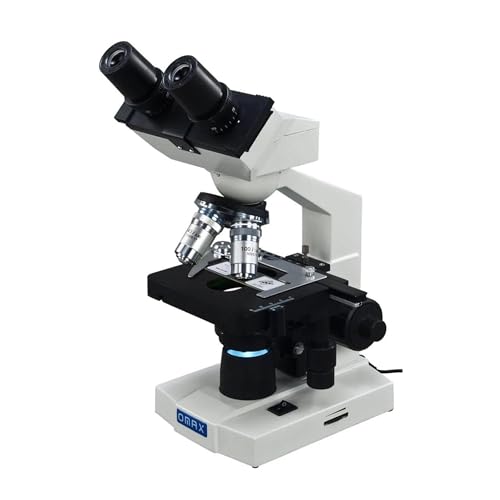
OMAX M82ES-SC100-LP100
Top Pick
OMAX M82ES-SC100-LP100
Best for: students and homeschool families who want a complete binocular kit with slides included.
Magnification: 40X-2000X
Head: binocular
Eyepieces: wide field WF10X and WF20X
Objectives: achromatic DIN 4X, 10X, 40X spring, 100X spring oil
The OMAX M82ES bundle answers the most common frustration of a first microscope purchase: opening the box and having nothing to look at. It ships with 100 blank glass slides, cover slips, and lens cleaning paper, so a student can start preparing specimens on day one. The binocular head with wide field WF10X and WF20X eyepieces gives comfortable two-eye viewing, and four achromatic objectives run up to a 100X oil lens for 2000X total magnification. A double-layer mechanical stage with a scale and coaxial coarse and fine focus knobs makes scanning a slide precise, and the Abbe NA1.25 condenser with an iris diaphragm keeps the light focused at high power.
Watch out for: the 100X objective needs immersion oil and careful cleaning, and the bundle adds weight and bulk compared with a bare microscope body.
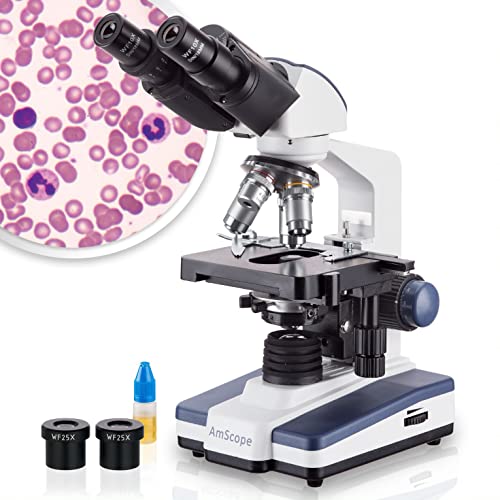
AmScope B120C
Runner-Up
AmScope B120C
Best for: classrooms, teaching labs, and shared benches where several people use one microscope.
The AmScope B120C is the binocular workhorse that shows up on classroom benches and teaching labs because its optics and mechanics cover serious work. The Siedentopf binocular head tilts 30 degrees, rotates a full 360 degrees, and adjusts interpupillary distance from 53 to 77 mm, so different users can share one instrument without refocusing. Four achromatic objectives in 4X, 10X, 40X, and 100X oil pair with WF10x and WF25x eyepieces for six magnification levels from 40X to 2500X. The 3-axis mechanical stage, coaxial coarse and fine focus with a 0.002 mm fine division, and a centerable Abbe NA1.25 condenser make it a proper tool for slides, cells, and bacteria.
Watch out for: it ships without a camera, so imaging needs a separate eyepiece camera, and the 2500X setting enlarges the image without adding sharpness over 1000X.
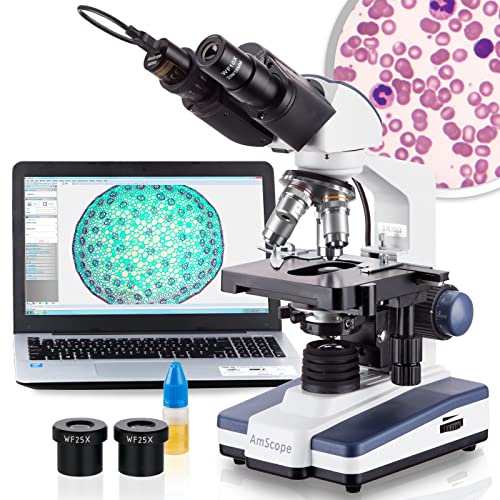
AmScope B120C-E1
AmScope B120C-E1
Best for: students and teachers who need to capture photos and video or display the view on a screen.
The AmScope B120C-E1 takes the same B120C optical body and adds the one feature that changes how the microscope gets used: a 1MP USB digital camera in place of one eyepiece. That lets the viewer watch a live image on a computer screen, capture photos and video, and share the view with a group instead of taking turns at the eyepieces. The included software for Windows, Mac, and Linux adds measuring, image stitching, and time-lapse capture, which turns the microscope into a documentation tool for lab reports and class projects. Everything else matches the base B120C: Siedentopf binocular head, four achromatic objectives, Abbe NA1.25 condenser, and a double-layer mechanical stage.
Watch out for: the 1MP camera resolution is modest for detailed documentation, and the camera occupies one eyepiece slot while it is in use.
Swift SW380T
Swift SW380T
Best for: teachers and lab workers who want a camera port while keeping both eyepieces free for viewing.
The Swift SW380T is the pick for buyers who want a trinocular body, with a dedicated camera port that leaves both eyepieces free. That makes it the natural choice for teachers projecting slides, lab workers documenting specimens, and hobbyists adding a camera later. Its Siedentopf trinocular head rotates 360 degrees with a 30-degree tilt, and the four DIN achromatic objectives in 4X, 10X, 40X spring, and 100X spring oil pair with WF10X and WF25X eyepieces for six levels from 40X to 2500X. The large 130 mm by 130 mm mechanical stage, ultra-fine focusing in 0.002 mm steps, and NA1.25 Abbe condenser give it research-grade handling.
Watch out for: no camera is included with the base model, so the full imaging setup costs extra, and the 100X objective needs immersion oil.
Which One Fits Your Situation
Buying a first microscope for a student
Pick the AmScope M150C-I when the budget is tight and the work is school biology at 40X to 1000X. Its monocular head, cordless LED light, and all-metal body cover the basics, and the plain stage is fine while the student is still learning to center a slide. Move up to the OMAX bundle when the student also needs slides and a binocular head for longer sessions.
Setting up a classroom or shared bench
Pick the AmScope B120C, because its Siedentopf head adjusts to different users, the mechanical stage survives daily use, and the 5-year warranty covers a shared instrument. Add the B120C-E1 instead when the class needs to see the same slide on a screen, since its USB camera and software let a teacher project the view for the whole room.
Needing photos, video, or a projected view
Pick the AmScope B120C-E1 for the simplest imaging setup, since the 1MP USB camera and software arrive in the box. Pick the Swift SW380T when the camera matters more than the bundle, because its trinocular port keeps both eyepieces free and accepts a better camera later. Either way, budget for a camera mount or software time if the microscope will feed lab reports.
Wanting the most complete kit in one box
Pick the OMAX M82ES-SC100-LP100, which includes 100 blank slides, cover slips, and lens cleaning paper alongside a binocular body with a mechanical stage and oil immersion objective. It suits a homeschool family or a student who wants to start preparing specimens immediately, without a separate supply order. The AmScope B120C is the stronger optics pick, but it arrives without slides.
Common Mistakes
Judging a microscope by its top magnification number instead of its objective set, condenser, and stage.
Buying a monocular head for a microscope that several people will share for long sessions.
Skipping the mechanical stage, then struggling to scan a slide by nudging it with a fingertip.
Using the 100X oil objective dry, or leaving immersion oil on the lens after a session.
Ordering a camera-ready trinocular body and assuming a camera is included in the box.
Frequently Asked Questions
What magnification do I need for a compound microscope?
Most school and hobby biology work happens between 40X and 400X, which covers onion skin, cheek cells, and pond water organisms. The 1000X setting with a 100X oil objective is needed for bacteria and fine cell detail. Magnification above 1000X enlarges the image without adding sharpness, so treat the 2000X and 2500X figures on listings as a byproduct of the 25X eyepiece rather than a sign of better optics.
Is a binocular microscope better than a monocular one?
A binocular head is more comfortable for long sessions because both eyes work together, and it suits microscopes shared by several people. A monocular head is lighter, simpler, and cheaper, which makes it a good fit for a single student doing short sessions. Neither head changes the image quality by itself; the objectives, condenser, and illumination decide how sharp the view looks.
Do I need immersion oil for a compound microscope?
Immersion oil is only needed with the 100X oil objective, which uses oil between the lens and the cover slip to capture more light and reach its full resolution. Dry objectives in 4X, 10X, and 40X never need oil, and oil on those lenses can damage them. Use a small drop, clean the lens after every session, and store the oil upright so it does not leak onto the stage.
Can I take photos through a compound microscope?
Yes, in three ways: a bundle with a USB eyepiece camera, a trinocular body with a dedicated camera port, or an eyepiece camera that replaces one eyepiece. Bundles are the simplest route, while a trinocular port gives the most flexibility for upgrading the camera later. Check the camera resolution and software support for the buyer’s computer before ordering, since a low-resolution camera limits how much detail the photos keep.
A
admin
We compare specs, materials and verified owner reviews before a product earns a spot. Rankings are never paid.
Affiliate disclosure. As an Amazon Associate we earn from qualifying purchases at no extra cost to you. Prices accurate as of the date shown.
Looking for the best clone battery for rigid tools? We compare third-party Ridgid 18V replacement packs on fit, capacity claims, charger compatibility and safety.
Find the best battery for a Mercedes S430 (W220). We explain the Group 49 / H8 AGM fitment, the 94R confusion, and compare 95Ah AGM picks on CCA and reserve capacity.
Four 36V lithium ebike batteries matched to a 500W motor, compared on capacity, BMS discharge rating, mount style and connector, plus the checks to run before you buy.
Compare the best CarPlay adapters for turning factory wired CarPlay wireless, with picks for mixed phone households, shared cars, and tidy USB-C setups.
Compare the best ATV wheel tie downs: chock-and-strap kits from Erickson, Rhino USA, DC Cargo Mall and more, with tire ranges and load limits explained.
Turbochargers for the Detroit Diesel Series 60 12.7L matched by OEM number: Garrett GTA4294, BorgWarner S400 171702 and 171701, Detroit reman and Rotomaster options, with DDEC and EGR fitment warnings.
Tacoma front coilovers matched by manufacturer part number: King 25001-119, FOX 880-06-418, ICON 58635, Bilstein B8 8112 and Eibach Pro-Truck 2.0, with generation, spring and upper control arm checks.

 Swift SW380T