Key takeaways
- The best 8GB SD cards still sold new today, including Gigastone and Stealth Cam two-packs for trail cameras, older cameras, 3D printers and legacy devices.
An 8GB SD card sounds like a relic in an era of terabyte storage, yet a steady stream of devices still asks for exactly this size. Older digital cameras and camcorders often cap out at SDHC capacities. Trail cameras run happily for a season on a small card. 3D printers, embroidery and sewing machines, older sat-nav units, checkout terminals and plenty of industrial controllers all read full-size SD cards and many of them behave best with modest capacities formatted as FAT32. The catch is that the big memory brands have largely moved on: most famous-name 8GB cards are discontinued, and surviving listings are frequently old stock, marketplace-only or gone entirely. This guide covers the 8GB full-size SD cards that can still be verified as current listings on Amazon US, and explains what to check before buying any card in this size class.

Why 8GB is a special case
Capacity in the SD world is not just a number. Cards up to 32GB belong to the SDHC family, and 8GB sits comfortably inside it, which is precisely why older devices accept it: an SDHC host that cannot read modern SDXC cards will still read an 8GB card without complaint. Many legacy devices also expect a FAT32 file system and small allocation units, and an 8GB card formats that way natively.
Speed markings need translating. Class 10 guarantees a minimum sustained write speed suitable for Full HD video of its era. UHS-I U1 adds the same minimum under the newer UHS grading, and makers quote read speeds separately, which are always higher than writes. For a trail camera taking stills, even a Class 4 card is workable; for a camcorder recording Full HD, Class 10 is the sensible floor. None of the cards in this class is built for 4K video or fast burst photography, and no honest guide should pretend otherwise.
The other special case is authenticity. Small legacy cards are a favourite target for counterfeiters, because buyers rarely test them. Buy from the listing itself rather than an unknown marketplace seller where you can, check the card’s true capacity with a verification tool when it arrives, and format it in the device that will use it.
Gigastone 8GB SD Card 2-Pack: the modern-spec choice
The Gigastone 8GB SD Card 2-Pack (ASIN: B08MQRQNWH) is the strongest all-round pick in this size. These are full-size SDHC cards rated UHS-I U1 and Class 10, with read speeds quoted up to 80 MB per second, which is quick for this capacity class and makes emptying a full card to a computer painless. The listing describes the cards as water, temperature, X-ray, shock and magnet resistant, and each card ships in its own mini case, which sounds trivial until a loose card disappears into a camera bag lining.
Gigastone backs the cards with a five-year limited warranty, unusually long for a budget card and a sign the maker expects them to survive trail-camera and printer duty. The two-pack format suits the most common use pattern: one card in the device, one formatted and ready to swap. For an older compact camera, a 3D printer or a sewing machine that wants a full-size card, this is the listing to start with. Because small-capacity cards attract stale listings, confirm the pack count and capacity on the listing itself before ordering.
Stealth Cam 8GB SD Card 2-Pack: built for the trail
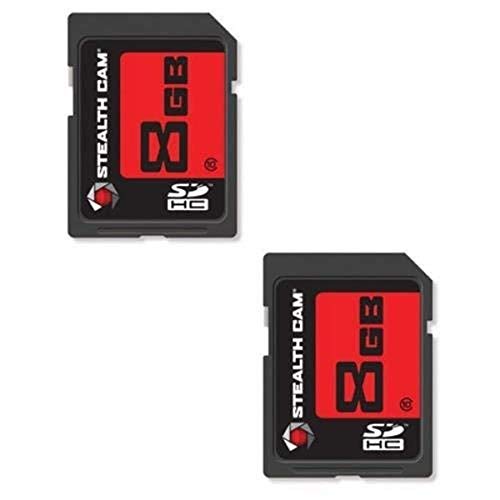
The Stealth Cam 8GB SD Card 2-Pack (ASIN: B01JDMXA8E), model STC-2SD8GB, comes from a trail-camera maker, and it shows in the priorities: reliability outdoors, low power draw and simple swap-in, swap-out use. The cards are Class 10 rated, which covers the photo bursts and short video clips that trail cameras record, and the two-pack format is designed around field routine: walk to the camera, exchange cards, walk away, and read the pulled card at home.
That same routine suits other set-and-forget devices: a feeder camera, a construction time-lapse box, or an older dash or backup camera that accepts full-size cards. The Stealth Cam name also means the cards are stocked through outdoor retailers as well as Amazon, which gives buyers a second route if a listing ever runs dry. As with the Gigastone, check the listing shows the two-card pack before ordering, since single-card variants of the same model family exist.
What about the famous brands?
Buyers often go looking for an 8GB card from SanDisk, Kingston, Samsung or Lexar first, so it is worth stating the position plainly. In this capacity, those brands’ full-size SD lines have been discontinued for years. Listings under their names do still surface, but verification is the problem: tracker records for the old SanDisk 8GB SDHC point at non-US storefronts, availability checkers report no current Amazon listing for the classic SanDisk card, and the Kingston equivalent has a listing record with no independent tracker confirmation behind it. Under a standard that requires a listing record plus independent confirmation of current availability, none of them clears the bar today. If a fresh, verifiable listing appears, it would belong in this guide; until then, the two packs above are the defensible choices, and because availability in this size class changes often, both listings are worth one final look at order time.
Matching the card to the device
Different legacy devices lean on an 8GB card in different ways, and the right expectations keep you out of trouble. In an older digital camera, 8GB holds thousands of JPEG stills but fills quickly if the camera shoots video, so the two-pack habit of carrying a formatted spare is worth adopting. In a trail camera, the card is a consumable in a working rotation: capacity matters less than reliability across temperature swings and months outdoors, which is the duty the Stealth Cam pack is built around.
In a 3D printer, the card is a transfer medium rather than storage; files move from computer to printer, the print runs, and the card cycles back. Speed barely matters there, but file-system cleanliness does, so eject the card properly and reformat it occasionally to clear fragmentation and stray files. Embroidery and sewing machines are stricter: many read only specific folder structures and modest capacities, and an 8GB card formatted in the machine itself is the combination most likely to be accepted first time.
Older games consoles, handhelds and car entertainment units sit in between. Some accept SDHC happily, some have undocumented ceilings below 8GB, and some read the card but stumble on very large individual files. The general method is the same in every case: check the manual’s memory section if it survives, format in the device, load a small test batch first, and only then trust the card with a full set of files you care about.
Reading speed claims honestly
Packaging for small cards mixes several numbers that are easy to confuse. The class marking, Class 4, 6 or 10, is a guaranteed minimum sustained write speed, and it is the figure that decides whether a camcorder records without dropping frames. The UHS grade, U1 or U3, repeats the same idea in newer language. The large number on the front of the pack is a peak read speed under laboratory conditions, useful for how fast a full card empties into a computer and for very little else.
For the uses in this guide, Class 10 with UHS-I U1, as the Gigastone carries, is comfortably above every requirement an 8GB device can present. Chasing higher numbers in this capacity buys nothing, because the host devices themselves predate the faster interfaces. Spend attention instead on authenticity and condition: a genuine Class 10 card outperforms a counterfeit anything, every time.
Buying checks for any 8GB card
First, confirm the physical format. This guide covers full-size SD cards. Many small cards sold today are microSD with an adapter in the box; those work in most slots, but some older devices and card mechanisms dislike adapters, so match the format your device manual specifies.
Second, confirm the host limit. If your camera manual says SDHC up to 32GB, an 8GB card is safe. If a device is very old and specifies original SD only, it may reject SDHC entirely, in which case a 2GB card is the answer rather than an 8GB one.
Third, format in the device, not on a computer, whenever the device provides the option. In-device formatting sets the file system and folder structure the device expects, and it is the single most effective step against corrupted files and unreadable cards.
Fourth, test on arrival. Fill the card once with real files and read them back, or run a capacity-verification utility. A genuine 8GB card should accept close to its stated capacity; a card that fails early is counterfeit or faulty and should go straight back.
Care, storage and realistic lifespan
Flash memory is durable but not immortal, and small cards live hard lives in gloveboxes, camera bags and printer slots. Store spares in the cases they ship in rather than loose, since the contact edge is exposed on a full-size SD card and a scratched or dirty contact is the most common cause of a card that reads intermittently. Keep cards out of prolonged heat, and treat any card that a device reports errors on as retired: copy its contents, verify the copies, and replace it rather than reformatting it back into service.
Write endurance is rarely the limit at this size; handling and loss are. That is the practical argument for the two-pack format shared by both picks in this guide. A rotation of two cards means a device is never cardless while its data is being copied, a failed card never strands a trail camera for a whole season, and a card left in a card reader at home does not stop a printer mid-job. Buy the pair, label them, and rotate them deliberately.
Verdict
For most buyers, the Gigastone two-pack is the better card on paper: faster UHS-I grading, protective cases and a long warranty. For trail cameras and outdoor devices, the Stealth Cam two-pack is the natural fit, designed around exactly that swap routine. Either way, an 8GB card bought knowingly, for a device that genuinely wants one, remains a small and sensible purchase, and a verified listing from a known maker beats a famous badge attached to stock nobody can confirm.
Disclosure: As an Amazon Associate, this site may earn from qualifying purchases made through links in this article, at no additional cost to you.