
Key takeaways
- Find the best plant moisture meter for houseplants with our guide to five analog, digital, and wireless picks that help you water only when soil is dry.
Guessing when to water is the quiet reason so many houseplants fail. The top inch of soil can feel bone dry while the root zone is still damp, or the surface can look moist while the roots sit in dry mix. A plant moisture meter takes that guesswork out of the routine by reading dampness where the roots actually live, so you water only when the soil asks for it.
The five meters below cover every style of plant care: a simple battery-free probe for quick daily checks, two three-function analog testers that also read pH and light, and a wireless sensor that watches soil around the clock and reports to your phone. Each one is a real listing with a verified ASIN.
As an Amazon Associate, we earn from qualifying purchases.
Quick answer
The XLUX T10 is the best plant moisture meter for most houseplant owners because it is simple, battery-free, and reads moisture on a clear one-to-ten dial with a single probe that disturbs few roots. Gardeners who also want pH and light readings should pick the Sonkir MS02, while the ECOWITT WH51 suits anyone who wants wireless monitoring without daily manual checks.
The 5 Best Plant Moisture Meters
XLUX T10 Soil Moisture Meter

The XLUX T10 is the classic houseplant meter, and it earns its place at the top of this list by doing one job well. A single probe slides into the pot, and the large analog dial shows moisture on a one-to-ten scale with red, green, and blue zones for dry, moist, and wet. There is no battery to charge or replace, no calibration step, and nothing to set up before a check. You push it in, wait a few seconds for the needle to settle, read the dial, and pull it out.
That single-probe design is a real advantage in small pots. Twin-probe meters push two metal rods through the root ball, which can nick fine roots in a crowded container. The T10 uses one probe, so it disturbs far less soil and far fewer roots, which matters when you check the same plant week after week.
The meter suits indoor and outdoor use, and the listing gives overall dimensions of 2.36 by 10.24 inches, a slim shape that stores easily beside a watering can. One caution applies to every analog probe meter: do not leave it in the soil between checks. The probe can corrode when it sits in damp mix for days, and the reading will drift. Wipe it clean after each use and it stays reliable.
Specs
– Measurement: soil moisture only, analog dial, 1 to 10 scale with dry, moist, and wet color zones
– Probe: single stainless-steel probe (length not stated on the listing)
– Power: none needed, battery-free
– Dimensions: 2.36 x 10.24 in
– Model: T10
– Maker: IAGtek
– Use: indoor and outdoor
Gouevn Soil Moisture Meter
The Gouevn meter is the best value pick for plant keepers who want a longer probe. It is another battery-free analog meter, but its probe runs just over seven inches, which reaches deeper into large pots and raised planters than most budget probes. The dial is large and easy to read from a distance, with the same color-coded scale: red for dry, green for moist, blue for wet.
Each Gouevn meter ships with a printed watering guide that covers more than 200 plants, which is genuinely useful if you are building a collection and have not yet learned how much water each species likes. The meter comes in green or black, weighs about 1.5 ounces, and carries an 18-month warranty.
The Gouevn is the right choice when your pots are deep. A short probe only reads the top few inches, which can mislead you in a tall planter where the surface dries fast and the bottom stays wet. The longer probe reaches the root zone of larger containers, so the reading reflects what the plant actually experiences.
Specs
– Measurement: soil moisture only, analog dial, 1 to 10 scale with dry, moist, and wet color zones
– Probe: stainless-steel probe, just over 7 in long
– Power: none needed, battery-free
– Weight: about 1.5 oz
– Colors: green or black
– Extras: printed watering guide covering more than 200 plants
– Warranty: 18 months
– Model: G01
Sonkir MS02 3-in-1 Soil Tester

The Sonkir MS02 is the best-selling soil tester on Amazon, and it earns that spot by packing three readings into one battery-free tool. A switch on the front moves the dial between moisture, pH, and light, so one device answers three common plant-care questions: is the soil wet, is it acidic or alkaline, and is the spot bright enough. Moisture reads on a one-to-ten scale, pH reads from 3.5 to 8, and light reads from zero to 2000 lux.
Two stainless-steel probes sit about 7.9 inches long, and the whole unit measures 11.5 by 2 by 1.5 inches and weighs 2.89 ounces. It needs no battery, which keeps it ready whenever you pick it up.
Treat the pH number as a rough guide rather than a lab result. The meter cannot be calibrated, and the maker publishes no accuracy figure for pH. The moisture reading is the strongest of the three functions, and it is the one most owners use every week. One point to confirm before you buy: some Amazon listing crawls show a manufacturer-discontinued field for this model, while other crawls show it as not discontinued, and the meter remains widely stocked. Check availability at import.
Specs
– Measurement: moisture 1 to 10, pH 3.5 to 8, light 0 to 2000 lux
– Probe: two stainless-steel probes, about 7.9 in long
– Power: none needed, battery-free
– Dimensions: 11.5 x 2 x 1.5 in
– Weight: 2.89 oz
– Model: MS02
– Maker: Sonkir
Atree 3-in-1 Soil Tester
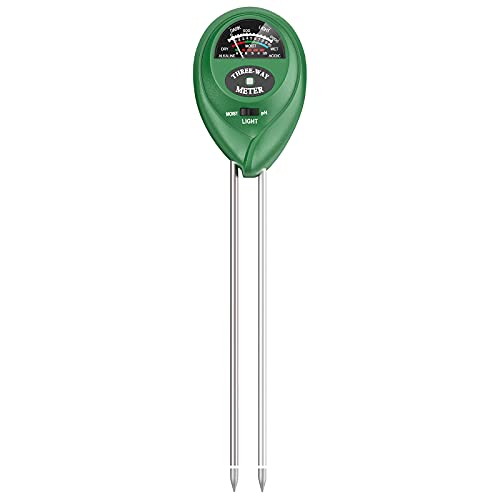
The Atree 3-in-1 follows the same proven pattern as the Sonkir: two metal probes, one dial, three functions, and no battery. Moisture reads one to ten, pH reads 3.5 to 8, and light reads zero to 2000 lux, switched by a button on the front. It makes a smart spare meter or a first tester for a small balcony collection.
The Atree works best when you treat it as a moisture meter first and a pH guide second. Its moisture reading is quick and repeatable, while the pH figure, like every uncalibrated analog tester, is an approximation. The probes are slim, so push them into loose potting mix rather than forcing them into hard, dry soil, where thin probes can bend or snap.
One listing note: the printed ASIN field on the Amazon listing is the code used in this article, while one search-result link for the same Atree listing title shows a different dp code. Confirm the code at import.
Specs
– Measurement: moisture 1 to 10, pH 3.5 to 8, light 0 to 2000 lux
– Probe: two metal probes (length not stated on the listing)
– Power: none needed, battery-free
– Dimensions: not stated on the listing
– Model: RR-07-007
– Maker: Atree
ECOWITT WH51 Wireless Soil Moisture Sensor

The ECOWITT WH51 is the only meter here that watches your soil while you are away. It is a small wireless sensor that stays buried in the bed or pot and reports moisture to an Ecowitt gateway or weather-station console, which then shows the reading in an app. You see a percentage and a graph over time, so you can watch how fast a bed dries after watering instead of guessing from a single spot check.
The sensor uses capacitive sensing rather than exposed metal prongs, which avoids the corrosion problem that affects analog probes left in soil. It transmits on a 915 MHz radio signal with a range of up to 300 feet in open air, and it updates every 70 seconds. The listing names it an accessory only, and it cannot be used alone: you need a compatible Ecowitt gateway or console, sold separately, to see the readings on your phone.
Specs
– Measurement: soil moisture only, reported as a percentage in the Ecowitt app
– Sensor: capacitive probe, no exposed metal
– Wireless: 915 MHz, range up to 300 ft in open air, updates every 70 seconds
– Power: 1 AA battery
– Model: WH51B
– UPC: 711639641259
– Maker: ECOWITT
– Requirement: Ecowitt gateway or weather-station console, sold separately
How to choose
Match the meter to how you garden. If you keep a handful of houseplants and want a fast check before watering, a battery-free analog probe is enough. The XLUX T10 and the Gouevn both do this well, and the Gouevn wins when your pots are deep. If you also want to learn about your soil, a three-function tester such as the Sonkir MS02 or the Atree adds pH and light readings as well, but remember those extra numbers are rough guides, not lab results.
Probe length matters more than most buyers expect. A short probe reads only the top layer, which dries first, so it can tell you to water when the roots are still damp. Measure your deepest pot and choose a probe that reaches at least halfway down. Digital and wireless meters suit gardeners who want numbers they can track over time, and the ECOWITT WH51 is the pick when you want readings without daily manual checks.
Who should skip
Skip a moisture meter entirely if you grow only one or two plants and already know their watering rhythm by touch and weight. Lifting a pot tells you plenty when the collection is small, and a meter adds little. Skip the wireless ECOWITT if you do not own, and do not want to buy, an Ecowitt gateway or console, since the sensor cannot show readings on its own. Skip three-function analog testers if you need exact pH numbers for sensitive plants such as blueberries or orchids, because uncalibrated dials cannot give that precision, and a dedicated digital pH pen is the right tool instead.
FAQ
How deep should I push a moisture meter probe into the soil?
Push the probe about halfway to two-thirds down into the pot, which is where most feeder roots live. A reading taken only an inch deep reflects the surface, which dries fastest, so it can mislead you into watering too often.
Can I leave a moisture meter in the soil all the time?
No, not an analog probe meter. Leaving the probe in damp soil corrodes the metal tip and the readings drift over time. Insert it, wait a few seconds for the dial to settle, read it, then pull it out and wipe it clean. Wireless sensors such as the ECOWITT WH51 are the exception, since they use a sealed capacitive sensor built to stay buried.
Do 3-in-1 meters measure pH accurately?
They give a useful rough guide, not an exact number. Analog three-function testers such as the Sonkir MS02 and the Atree read pH from 3.5 to 8, but they cannot be calibrated and the maker publishes no accuracy figure. That is enough to spot strongly acidic or alkaline soil, but not enough for plants that need a precise pH range.
Why does my meter read wet right after watering but dry a day later?
Fast-draining potting mix sheds water quickly, so the top layer dries within a day even when deeper soil holds moisture. Take the reading at root depth rather than near the surface, and check again a few hours after watering so the water has time to settle through the mix.
Final verdict
The XLUX T10 is the best plant moisture meter for most houseplant owners: a simple, battery-free probe with a clear dial and a single probe that treats roots gently. The Gouevn is the better value when your pots run deep, and the Sonkir MS02 is the pick when you want pH and light readings alongside moisture. The Atree is a fine budget spare. For gardeners who want soil data without daily manual checks, the ECOWITT WH51 wireless sensor is the premium choice, as long as you already own or plan to buy its gateway.
