Key takeaways
- Two verified coaxial bookshelf speakers with wood cabinets: a concentric three-way ELAC and a real wood veneer MoFi, with maker specs, fit and limits.
As an Amazon Associate, we earn from qualifying purchases made through links on this page.

A coaxial bookshelf speaker places the tweeter at the acoustic center of the midrange or woofer cone, so high and low frequencies leave the cabinet from the same point instead of from two points spaced apart on the baffle. Listeners who sit close, sit off to one side, or move around the room while music plays tend to value that single-point radiation, because the tonal balance holds together across a wider area than a conventional two-driver layout usually manages. The second half of this search is the cabinet itself. Plenty of speakers wear a wood-look finish, yet the keyword asks for wood cabinets, so this guide holds a strict line: a model qualifies only when its maker documents a genuine concentric or coaxial driver and a cabinet built from wood panels or MDF wrapped in real wood veneer, or describes the cabinet in wood by name in its own published specifications.
That strict line shrinks the field fast, and this guide says so openly. Several well-known coaxial models fail the cabinet test because their walnut finish is a vinyl wrap over MDF, and a few genuine wood-veneer designs could not be matched to a verifiable Amazon US listing during research, so they are named without links in the notes that follow the picks rather than linked on a guess. Two speakers passed both tests with manufacturer documentation behind them. One is a compact three-way design from ELAC with a concentric midrange and tweeter. The other is a very large two-way design from MoFi Electronics whose maker specifies furniture-grade real wood veneer by name. Between them they cover two very different rooms, two very different stands, and two very different amplifiers.
What to look for
Confirm the driver is truly concentric. A coaxial or concentric driver nests the tweeter inside the voice-coil opening of the cone in front of it, sharing one axis. ELAC calls its arrangement a concentric driver, with a soft dome tweeter mounted at the center of an aluminum midrange cone. MoFi uses the same geometry at a much larger scale, with a soft dome tweeter at the center of a ten-inch paper-pulp cone. A speaker with a tweeter merely mounted close to the woofer, or with a waveguide around a separate tweeter, is not the same construction, however similar the front baffle may look in a photo.
Read the cabinet wording, not the color name. A finish called walnut may be real wood veneer, a printed vinyl film, or a painted surface, and product photos cannot tell them apart. MoFi states in plain language that its SourcePoint cabinets use thick MDF panels wrapped in real wood veneer, book matched so the grain mirrors across a pair. ELAC lists the Uni-Fi Reference cabinet as CARB2 rated MDF and names the finish as walnut sides with a painted baffle, so the wood in that model is the finish layer and side panels rather than a solid timber box. Neither speaker here is solid wood; no mainstream bookshelf speaker in this class is, because solid timber panels are difficult to keep dimensionally stable at cabinet scale. What matters is that the maker documents the construction, and both makers do.
Match sensitivity and impedance to your amplifier. The two picks sit at opposite ends of the load spectrum. The ELAC is a 6 ohm speaker with 85 dB sensitivity, a combination that asks an amplifier to deliver real current before the music gets loud. The MoFi is an 8 ohm speaker with 91 dB sensitivity, which reaches the same listening level with a fraction of the power and tolerates modest amplifiers far better. Check the amplifier figures your maker publishes for low-impedance loads before pairing a low-sensitivity 6 ohm or 4 ohm speaker with a small receiver.
Measure your stands and your shelf before anything else. Bookshelf is a category name, not a size promise. The ELAC stands about fourteen inches tall and weighs under twenty-four pounds per speaker, which suits a sturdy stand or a deep shelf. The MoFi stands twenty-two and a half inches tall, spans fourteen and a half inches wide, and weighs over forty-six pounds per speaker. That is a stand-mount speaker only in the technical sense; it needs a stand built for its footprint and mass, floor space beside the listening seat, and a room large enough to let a ten-inch cone breathe.
Plan placement around the ports. Both cabinets are vented designs. The ELAC vents through dual flared slots on the front baffle, which makes it the more forgiving of the two when a stand sits near a wall. A vented cabinet of the MoFi’s size moves a large volume of air, so give it open space on every side and avoid pushing it into a corner, where boundary gain will thicken the bass beyond what the designer intended.
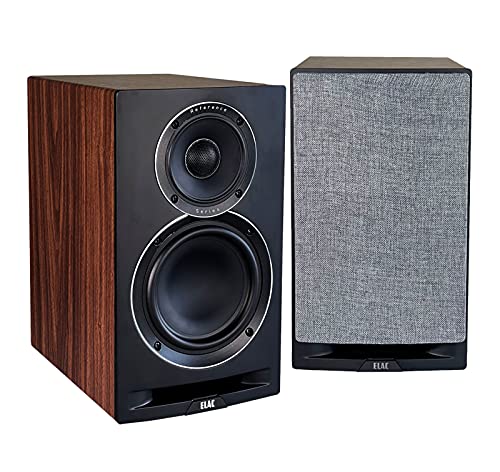
ELAC Uni-Fi Reference UBR62, Walnut
See the ELAC Uni-Fi Reference UBR62 on Amazon
The Uni-Fi Reference UBR62 is a three-way bookshelf speaker built around a concentric driver that ELAC developed for this series. A one-inch soft dome tweeter sits at the center of a four-inch aluminum midrange cone, and a separate six-and-a-half-inch aluminum woofer handles the bass below them. Crossing the drivers over at 260 Hz and 1,800 Hz keeps the midrange cone working in the band where a concentric layout helps most, while the woofer works as a dedicated bass unit rather than as half of a two-way compromise. ELAC publishes a frequency response of 41 Hz to 35 kHz, sensitivity of 85 dB, and a nominal impedance of 6 ohms, with a maximum power input of 140 watts. The cabinet is CARB2 rated MDF with full perimeter bracing, finished in the walnut version with walnut sides and a satin black painted front baffle; a white version pairs oak sides with a satin white baffle. Binding posts are five-way and bi-wire capable, and the dual flared slot ports vent through the front.
The published dimensions are 8.19 inches wide, 14.13 inches tall, and 13.15 inches deep, with a net weight of 23.54 pounds for each speaker. That footprint fits a normal speaker stand and most deep shelves, and the front-facing slots mean the speaker can sit closer to a rear wall than a rear-ported cabinet of similar size without the bass swelling as quickly. The three-way concentric layout suits listeners who sit near field at a desk, or off axis on a sofa, and still want voices to stay centered and stable rather than shifting as they move.
The limitations follow from the same specification sheet. Sensitivity of 85 dB with a 6 ohm nominal load is the least forgiving combination in this guide; a small amplifier will run out of headroom in a large room long before the speaker reaches its own limits, and ELAC’s 140 watt ceiling describes power handling, not a recommendation to buy the largest amplifier available. The wood element is a walnut finish on the cabinet sides over an MDF structure, exactly as ELAC documents it; a buyer who wants veneer that the maker explicitly calls real wood should read the MoFi section below before deciding. Bass extension to 41 Hz is honest for the cabinet size, yet a subwoofer remains the sensible partner for film soundtracks in a big space.
MoFi Electronics SourcePoint 10 Master Edition, Satin Walnut
See the MoFi SourcePoint 10 Master Edition on Amazon
The SourcePoint 10 Master Edition is a two-way stand-mount speaker designed around a single ten-inch concentric driver. A 1.25-inch wide-roll soft dome tweeter sits at the center of a paper-pulp cone, driven by what MoFi calls its Twin-Drive magnet system, and a crossover at 1.6 kHz hands over between the two. The Master Edition revision adds upgraded crossover components, improved impedance linearity, and a mid and high frequency adjustment switch on the cabinet for tuning the speaker to the room. MoFi publishes a frequency response of 42 Hz to 30 kHz, sensitivity of 91 dB, and a nominal impedance of 8 ohms with a 6.2 ohm minimum, which makes this the easier load of the two speakers here by a wide margin. Minimum recommended power is 30 watts and maximum input is 200 watts.
The cabinet is where this speaker answers the keyword most completely. MoFi states that the top, bottom, and side panels are one-inch thick MDF wrapped in real wood veneer, with a two-inch thick faceted front baffle finished in satin black, and that the veneer is furniture grade and book matched for mirror-imaged grain across a pair. The satin walnut version is the wood finish to choose; a satin black ash version uses the same real wood veneer construction in a darker stain. Magnetic grilles are included, connections are five-way binding posts, and the maker publishes a five-year parts and labor warranty. With the grille fitted, each speaker measures 14.5 inches wide, 22.5 inches tall, and 16.6 inches deep, and weighs 46.2 pounds.
That size is also the limitation section, almost by itself. This speaker will not fit a bookshelf, a desk, or a small media console, and it asks for stands that can carry its weight and footprint without rocking. The 91 dB sensitivity and 8 ohm load welcome tube amplifiers and modest integrated designs that the ELAC would strain, yet the ten-inch cone still needs a room with enough distance between speaker and seat for the concentric wavefront to integrate. Buyers with a compact room should treat the published dimensions as a hard filter, not a suggestion.
How the line was drawn
Two widely sold coaxial ranges were left out on cabinet evidence alone. KEF’s Q series bookshelf models use a walnut-look finish that the maker’s own material does not document as real wood veneer, and the same gap applies to the newer Q Concerto Meta, so neither appears above even though their Uni-Q drivers are genuinely concentric. Fyne Audio builds concentric bookshelf speakers with documented real wood veneer, and MoFi’s smaller SourcePoint 8 shares the construction of the pick above, yet neither could be matched to a verifiable Amazon US product listing during this research round, so both are named here without links rather than attached to an unverified address. If those listings can be confirmed later, both belong in this comparison.
Comparison table
| Specification | ELAC Uni-Fi Reference UBR62 | MoFi SourcePoint 10 Master Edition |
|---|---|---|
| Design | Three-way, bass reflex | Two-way, vented box |
| Concentric driver | 1 in soft dome tweeter inside 4 in aluminum midrange | 1.25 in soft dome tweeter inside 10 in paper-pulp cone |
| Bass driver | 6.5 in aluminum woofer | The same 10 in concentric cone |
| Frequency response (maker) | 41 Hz to 35 kHz | 42 Hz to 30 kHz |
| Sensitivity (maker) | 85 dB | 91 dB |
| Nominal impedance (maker) | 6 ohms | 8 ohms, 6.2 ohms minimum |
| Crossover (maker) | 260 Hz and 1,800 Hz | 1.6 kHz |
| Cabinet | CARB2 rated MDF, walnut sides, painted baffle | MDF panels wrapped in real wood veneer, book matched |
| Dimensions (W x H x D) | 8.19 x 14.13 x 13.15 in | 14.5 x 22.5 x 16.6 in with grille |
| Weight each | 23.54 lb | 46.2 lb |
| Best fit | Near-field and off-axis listening in small to midsize rooms | Larger rooms, efficient pairing with modest amplifiers |
FAQ
What does a coaxial driver do that a normal bookshelf layout cannot?
It places the tweeter and the cone on one axis, so the sound arrives from a single point. The practical result is a tonal balance that changes less as you move sideways or sit closer than the designer assumed, which is why concentric designs are popular for desks, wide sofas, and rooms where only one seat can sit in the middle.
Are these cabinets solid wood?
No, and their makers do not claim otherwise. The MoFi uses thick MDF panels wrapped in real wood veneer that the maker describes as furniture grade and book matched. The ELAC uses a CARB2 rated MDF cabinet with walnut-finished sides and a painted baffle. Veneer over a braced MDF structure is the standard construction at this level because it resists the warping that solid panels develop over years of heating and cooling.
Which speaker is easier for a small amplifier to drive?
The MoFi, by a clear margin. Its 91 dB sensitivity and 8 ohm nominal impedance ask far less of an amplifier than the ELAC’s 85 dB and 6 ohm load. A listener with a low-power amplifier should weigh that difference heavily, while a listener with a strong solid-state amplifier and a small room may prefer the ELAC’s compact cabinet.
Can either speaker sit on an actual bookshelf?
The ELAC can, provided the shelf is deep enough for its thirteen-inch cabinet and strong enough for a speaker of nearly twenty-four pounds. The MoFi cannot in any practical sense; at twenty-two and a half inches tall and over forty-six pounds, it belongs on a dedicated stand sized to its footprint.
Do these speakers need a subwoofer?
Both reach the low forties in hertz on their makers’ figures, which covers most acoustic and popular music without help. Film soundtracks and electronic music with deep synthesized bass will still benefit from a subwoofer in a larger room, and the ELAC’s front slot ports make it the easier of the two to place when a subwoofer joins the system.
Conclusion
Choose the ELAC Uni-Fi Reference UBR62 when the room is small to midsize, the listening seat is a desk or a wide sofa, and the amplifier can handle a 6 ohm load with modest sensitivity; its three-way concentric driver is the technically finer instrument at this scale, and its walnut-sided MDF cabinet is documented by the maker in plain terms. Choose the MoFi SourcePoint 10 Master Edition when the room can take a genuinely large stand-mount speaker and the brief calls for documented real wood veneer, book matched across the pair, together with the easy 8 ohm, high-sensitivity load that suits gentle amplifiers. Either way, the deciding evidence is the same: a concentric driver the maker can describe, and cabinet wording you can read before the speakers arrive.