We independently review everything we recommend. When you buy through our links, we may earn a commission. As an Amazon Associate we earn from qualifying purchases.
4 Best Mobile Phone Portable Projectors (November 2026)
Compare the best mobile phone portable projectors, from pocket pico models to a native 1080p smart projector with WiFi casting and built-in batteries.
Compare the best mobile phone portable projectors, from pocket pico models to a native 1080p smart projector with WiFi casting and built-in batteries.
A portable projector turns your phone into the source for a screen far bigger than anything in your pocket. Instead of crowding around a handset to watch a video, you can throw the picture onto a wall, a ceiling, or a tent flap and let everyone see it at once. The trade-off is that these small projectors give up brightness and sharpness compared with a full-size home projector, so the model you pick has to match where and how you actually plan to watch.
This guide is for phone-first viewers: people who stream from an iPhone or Android handset, travel with their entertainment, or want a screen they can set up in a bedroom, dorm, backyard, or hotel room in a couple of minutes. The four picks below were chosen from their Amazon listings, using the specifications each listing states — native resolution, maximum image size, battery playtime, inputs, and onboard smart features. They range from a true pocket pico projector to a native 1080p smart model, so there is an option for every level of picture quality and portability.
A phone-friendly projector needs a painless way to get your screen onto the wall. The simplest route is wireless: WiFi screen mirroring and casting let an iPhone or Android phone send video without any cable at all, which is how the KODAK Luma 350 and both NEBULA models work. The wired route still matters as a backup, because mirroring can stutter on a weak network and some apps restrict wireless playback. HDMI and USB inputs, like those on the KODAK Luma 75, let you plug the phone in directly with the right adapter and avoid the network entirely. If you plan to watch downloaded files rather than streams, a microSD slot is another useful fallback.
Native resolution and brightness
Portable projectors advertise two different resolution numbers, and only one of them describes the picture you actually see. Native resolution is the real pixel count of the image; input support only means the projector can accept a higher-resolution signal and scale it down. In this group the spread is wide: the KODAK Luma 75 is native 640×360 while accepting 1080p input, the NEBULA Capsule is native 854×480, and the NEBULA Capsule 3 outputs native 1080p. Brightness matters just as much — the Capsule’s 100 ANSI lumens is typical for this class, and projectors at this level are meant for dark or dim rooms. The darker you can make the space, the less the resolution and brightness limits will bother you.
Battery life and portability
The point of a mobile phone portable projector is that it does not need a wall outlet or a fixed setup. Every pick here runs on a built-in rechargeable battery, but playtime varies enough to change how you use it: roughly one and a half to two hours on the KODAK Luma 75, two and a half hours on the NEBULA Capsule 3, and up to four hours on the original NEBULA Capsule. A shorter battery is fine for a single film or a presentation; a longer one covers a double feature or an evening outdoors. Size matters too — these models range from pocket-size to soda-can-size, so all of them travel easily, but the smallest ones are the ones you will actually carry every day.
Sound and built-in smart features
A tiny projector with a weak speaker can ruin a film, so check what handles the audio. The NEBULA Capsule builds in a 360-degree speaker designed to fill a small room, and the Capsule 3 adds Dolby Digital audio support. Smart features decide whether the phone is the only source or just one option: the KODAK Luma 350 runs Android onboard with streaming apps, and the Capsule 3 runs Google TV with officially licensed Netflix, so both can stream on their own over WiFi and simply take casting from your phone when you prefer. A basic model like the Luma 75 skips the smart platform and relies on your phone, a cable, or a memory card for content — simpler, but entirely dependent on what you connect to it.
The 4 Best Options
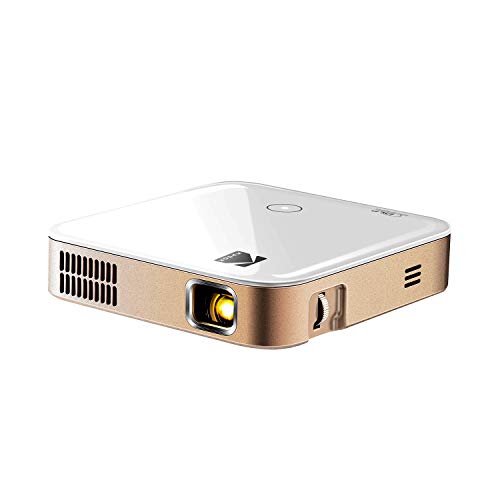
KODAK Luma 75 Ultra Mini Portable Projector (RODPJS75)
The Luma 75 is the smallest projector in this roundup, a pocket-size DLP pico model built around the idea that the projector should be no harder to carry than the phone feeding it. It plays media from iPhone, iPad, and Android phones and gives you three ways to get content in: HDMI, USB, and a microSD slot, which makes it a good fit for downloaded files and offline viewing where there is no WiFi to mirror over.
Its limits are the honest cost of the size. The native resolution is 640×360 — it accepts 1080p HD input, but the projected image itself is standard definition, so it suits casual clips, kids’ content, and small images better than detailed films. It can project up to a 100-inch display, though a smaller image will look sharper. The built-in rechargeable battery runs for roughly one and a half to two hours per charge, and there is a built-in speaker for sound without extra gear.
Specs
Brand: KODAK
Model: Luma 75 (RODPJS75)
Type: DLP pico projector
Native resolution: 640×360, with 1080p HD input support
Maximum image size: up to 100 inches
Battery: built-in rechargeable, up to about 1.5–2 hours playtime
Speaker: built-in
Inputs: HDMI, USB, microSD
Compatibility: iPhone, iPad, and Android phones
Amazon: https://www.amazon.com/dp/B078NCG82N
Best for: Carrying a projector in a pocket or jacket for casual, small-screen viewing anywhere.
Watch out for: The native 640×360 resolution is standard definition, and the battery covers a short film rather than a long one.
The Luma 350 keeps the pico-projector form but adds a smart platform, running Android onboard with streaming apps so it can play content without the phone doing all the work. When you do want the phone involved, it supports WiFi screen mirroring, and HDMI and USB inputs cover wired connections. A remote control is included, which makes navigating apps from the sofa or the bed much easier than tapping on the unit itself.
The headline figure is image size: the Luma 350 projects up to a 150-inch image, the largest in this group, which makes it the pick for filling a wall in a dark room. It runs on a rechargeable battery for cable-free placement, and it connects to both iPhone and Android devices. As with any small projector, that maximum size is best reserved for dark spaces, where the picture holds up best.
Watch out for: The listing leads with image size rather than sharpness, so manage expectations on detail at the largest sizes.
Anker NEBULA Capsule (D4111)
Runner-Up
Anker NEBULA Capsule (D4111)
Best for: Travel and outdoor movie nights where battery life and room-filling sound matter most.
The original NEBULA Capsule is shaped like a soda can, and that small cylinder packs in the most balanced spec sheet of the pico models here. Its DLP image is native 854×480 at 100 ANSI lumens, a step up in sharpness from the Luma 75, and it projects up to a 100-inch picture. It runs Android with WiFi streaming and phone mirroring, so your handset can either hand off content or drive the show directly.
Battery life is where the Capsule pulls ahead: up to four hours of video playtime on the built-in battery, the longest in this group, enough for two films back to back without hunting for an outlet. The 360-degree speaker fires sound in every direction, which suits a group sitting around the projector outdoors or in a tent. For travelers who watch a lot and charge rarely, this is the endurance pick.
Watch out for: The native 854×480 resolution is below HD, so fine detail in films and text will look soft.
NEBULA Capsule 3 GTV Portable Mini Projector
NEBULA Capsule 3 GTV Portable Mini Projector
Best for: Viewers who want true 1080p sharpness and built-in Netflix in a battery-powered portable.
The Capsule 3 is the step up to a genuinely sharp portable picture. It outputs native 1080p — full HD rather than a scaled-down signal — and projects up to a 120-inch display, so films keep their detail at sizes where the pico models start to soften. It runs Google TV with officially licensed Netflix built in, plus WiFi streaming and phone casting, which makes it the most complete standalone streaming package in this group.
It is still built for the road: a built-in battery delivers 2.5 hours of playtime, Dolby Digital audio support gives soundtracks more body than a basic mono speaker, and the adjustable foldable stand design tilts the image toward a wall or ceiling without a separate tripod. If your phone viewing has outgrown standard definition and you want one device that streams, casts, and plays on battery, this is the one to shortlist.
Watch out for: The 2.5-hour battery is shorter than the original Capsule’s, so long double features may need a recharge or a power bank.
Which One Fits Your Situation
You want the smallest possible projector
Choose the KODAK Luma 75. It is genuinely pocket-size, plays from phones over HDMI or USB and from microSD cards, and its built-in speaker and battery keep the kit to a single item. Accept the standard-definition image as the price of that size.
You want the biggest picture in a dark room
Choose the KODAK Luma 350. Its 150-inch maximum image is the largest here, and onboard Android plus WiFi mirroring means your phone can hand over a stream in seconds. Keep the room dark and the image will reward you.
You watch outdoors or travel for long stretches
Choose the Anker NEBULA Capsule. Four hours of battery playtime outlasts everything else in this group, and the 360-degree speaker suits a circle of viewers. It is the pick for camping trips, garden movie nights, and long hotel stays.
You want streaming apps and full HD detail
Choose the NEBULA Capsule 3 GTV. Native 1080p output, Google TV, and licensed Netflix make it a self-contained streaming projector, and phone casting is there whenever the handset has the content instead.
Common Mistakes
Confusing input support with native resolution — a projector that accepts 1080p input may still project a much lower native pixel count, as the Luma 75 does.
Projecting at maximum size in a lit room — every model here performs best in darkness, and the largest image sizes wash out fastest under lights.
Assuming every app allows phone mirroring — some streaming apps restrict wireless playback, so keep an HDMI cable and adapter as a backup.
Ignoring battery playtime — a projector that dies mid-film is worse than a dimmer one that finishes; match playtime to your typical viewing session.
Forgetting the sound plan — built-in speakers vary widely, from a basic speaker on the Luma 75 to Dolby Digital support on the Capsule 3, so check before you rely on one.
Frequently Asked Questions
Can these projectors really work with both iPhone and Android phones?
Yes. The KODAK Luma 75 and Luma 350 both list iPhone and Android compatibility, and the NEBULA models cast and mirror over WiFi, which covers both phone platforms. Wired connections may need a phone-specific HDMI adapter, which is sold separately from the projector.
Do I need WiFi to use a portable projector with my phone?
Not always. The KODAK Luma 75 can play from HDMI, USB, and microSD sources with no network at all, which suits downloaded content. Mirroring, casting, and the built-in streaming apps on the Luma 350 and the NEBULA models do need a WiFi connection.
How big a room do these projectors need?
Very little. All four are small projectors designed for walls in bedrooms, dorms, and living rooms, and they can also aim at a ceiling. What they need most is darkness rather than space; a dim room and a plain light-colored wall will do.
Which of these has the best picture quality?
The NEBULA Capsule 3, on paper: it is the only native 1080p model here and reaches a 120-inch image. The Anker NEBULA Capsule follows at 854×480 native, and the KODAK Luma 75 sits at 640×360 native, so the ranking follows the native resolution figures in each listing.
Related guides
Best 4 wire smart thermostat
Best little home projectors
Best home projectors for 500 dollars
As an Amazon Associate, we earn from qualifying purchases.
S
Softlavender Editorial Team
We compare specs, materials and verified owner reviews before a product earns a spot. Rankings are never paid.
Affiliate disclosure. As an Amazon Associate we earn from qualifying purchases at no extra cost to you. Prices accurate as of the date shown.
Looking for the best 4 wire smart thermostat? Compare four picks that work without a C-wire, with included adapters, room sensors and voice control built in.
The best keyboards for Apple TV compared in depth: three Bluetooth models with page-stated Apple TV compatibility, for faster search, sign-ins and text entry.
Compare five thermostats for mini-split systems, from WiFi controllers with app control to a programmable wall control, and match features to your setup.
Compare the best scuba computers with a user replaceable battery: Cressi, Mares, Oceanic and Suunto coin-cell models, battery types, O-ring care, and what to check before you change a battery yourself.