Key takeaways
- Compare five multichannel power amplifiers with RCA inputs, from 5-channel theater models to a 12-channel zone amp, using the specs listings state.
Adding a separate power amplifier is the point where a surround system stops depending on whatever output a receiver can spare. The real decision is not brand loyalty; it is whether the amp matches your speaker count, delivers its output with every channel working at once, and connects cleanly to the pre-outs you already own. Choose wrong and you gain bulk without headroom. Choose well and dialogue stays clear at the same volume where a receiver alone begins to strain.


The five models below cover distinct buyers. Home theater owners who want one strong five-channel block will look at the Monoprice, Outlaw, OSD and Marantz units, while whole-home installers get a twelve-channel Dayton Audio design. Each pick was chosen from its Amazon listing name and stated specifications, with channel counts, per-channel output and input types taken from the listings themselves.
Quick Picks
As an Amazon Associate we earn from qualifying purchases.
| Product | Best for | Key spec from title |
|---|---|---|
| Monoprice Monolith 5X | Maximum five-channel output | 200 watts per channel into 8 ohms |
| Outlaw Audio Model 5000x | Receiver upgrades on a sane footprint | 120 watts x 5 into 8 ohms |
| OSD Audio Nero HTA5200 | Status monitoring and balanced inputs | 145 watts per channel into 8 ohms |
| Marantz MM7055 | A compact five-channel chassis | 140 watts per channel into 8 ohms |
| Dayton Audio MA1260 | Whole-home audio across many rooms | 12 channels in 6 stereo zones |
How to Choose
Count Channels Against Your Speaker Layout
Start with the speakers you actually run today, then add the ones already planned. A 5.1 system needs five channels of amplification; a 7.1 layout needs seven, and Atmos setups split channels between a main amp and whatever the receiver keeps driving. Buying exactly the channel count you need leaves rack space and budget for the processor side. Buying one size up, such as a seven-channel unit for a five-speaker room, gives you a path to add surround backs later without replacing the amplifier.
Read the Power Figure the Right Way
Listings state output in several ways, and the conditions matter more than the headline number. Look for watts per channel with all channels driven, since a figure measured with one or two channels working says little about a busy soundtrack. Note the load used for the measurement: output into 8 ohms is the conservative figure, while 4-ohm numbers run higher and suit speakers that dip low. Full-bandwidth measurements, stated as 20 Hz to 20 kHz, tell you more than a single-frequency figure taken at 1 kHz.
Check the RCA Path From Your Processor
A power amplifier has no volume control of its own in normal use, so it needs a preamp, processor or receiver with pre-outs feeding it one RCA cable per channel. Confirm your source component has pre-outs for every channel you plan to hand over; some receivers provide them for the front pair only. Short RCA runs in a rack are usually quiet, but balanced XLR inputs, fitted alongside RCA on several models here, help where cables pass near power supplies or run long distances.
Plan Space, Weight and Heat
Multichannel amplifiers are heavy, deep and warm in operation. The five-channel models in this guide weigh between roughly 50 and 78 pounds as listed, and several need close to 17 inches of shelf depth before cables are attached. Measure the rack, leave ventilation space above the chassis, and check whether a 12V trigger input is provided so the amp wakes with the rest of the system instead of needing its own power routine every session. Fans and vents also need clearance on the sides, not just above the top panel.
The 5 Best Options
Monoprice Monolith 5X
The Monolith 5X is the heavyweight of this group, a five-channel Class AB design whose listing leads with 200 watts per channel into 8 ohms and 300 watts per channel into 4 ohms. Two toroidal transformers anchor the power supply, and each channel accepts either an XLR or an RCA connection, so it pairs with processors at both ends of the market. Monoprice also states there is no current limiting in the amplifier circuit path, which suits speakers whose impedance drops during demanding passages.
Specs
- Channels: 5
- Power output: 200 watts per channel into 8 ohms; 300 watts per channel into 4 ohms
- Inputs: XLR and RCA inputs per channel, as stated in the listing title
- Power supply: 2 toroidal transformers
- Signal-to-noise ratio: more than 120 dB, per the listing
- Dimensions: 16.5 x 17 x 7 inches
- Weight: 78.2 lb
Best for: Large theater rooms with power-hungry speakers that need full output on every channel at once.
Watch out for: At 78.2 lb listed weight, it needs a genuinely sturdy shelf or rack and two people to move safely.
ASIN: B073GGJ56R
Outlaw Audio Model 5000x
Outlaw built the Model 5000x for the classic upgrade path: keep your receiver, let it handle decoding and switching, and hand the speaker work to a dedicated amp. The listing states 120 watts RMS per channel into 8 ohms and 180 watts into 4 ohms across the full 20 Hz to 20 kHz bandwidth. Each channel keeps its own power supply rectification and protection relays, and the RCA inputs use a differential-sensing design the listing describes as rejecting hum, a thoughtful touch for racks full of mixed gear.
Specs
- Channels: 5
- Power output: 120 watts RMS per channel into 8 ohms; 180 watts per channel into 4 ohms
- Bandwidth for the power figure: 20 Hz to 20 kHz, under 0.02 percent THD
- Inputs: balanced XLR and differential-sensing RCA
- Trigger: 12V trigger for power on and off with a receiver
- Dimensions: 16.75 x 17 x 5.83 inches
- Weight: 50 lb
- Warranty: 5 years, parts and labor
Best for: Receiver owners who want honest all-channel power and hum-resistant RCA inputs in a mid-size chassis.
Watch out for: The listing gives depth with the power cord attached as 18 inches, so shallow cabinets can be a problem.
ASIN: B08G9RGJCL
OSD Audio Nero HTA5200

The Nero HTA5200 takes a five-channel Class AB layout and adds the monitoring touches installers appreciate. Per-channel status LEDs on the front panel show what each amplifier block is doing, and the listing states 145 watts per channel into 8 ohms and 210 watts per channel into 4 ohms with all channels driven. Balanced XLR and unbalanced RCA inputs sit side by side on the rear panel, and a 12V trigger handles remote power. OSD backs the unit with a five-year warranty, matching the longest coverage in this group.
Specs
- Channels: 5
- Amplifier class: Class AB
- Power output: 145 watts per channel into 8 ohms; 210 watts per channel into 4 ohms, all channels driven
- Inputs: balanced XLR and RCA
- Signal-to-noise ratio: 110 dB
- Trigger: 12V trigger
- Model number: NERO-HTA5200
- Warranty: 5 years
Best for: Rack-based theaters where per-channel status LEDs and both input types make setup and troubleshooting easier.
Watch out for: The listing title headlines the 4-ohm figure, so check the 8-ohm output against your speakers before deciding.
ASIN: B0CYJVNGKP
Marantz MM7055
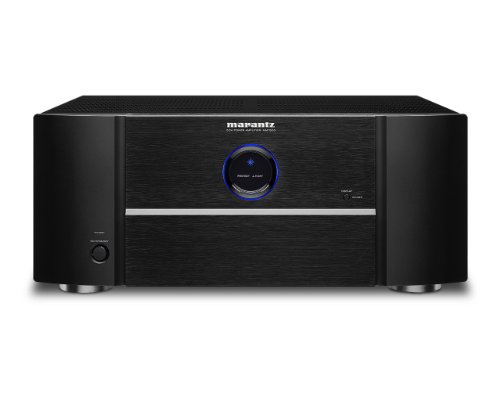
Marantz packages five channels into a shallower, more furniture-friendly chassis than most rivals here, which makes the MM7055 the natural pick where rack depth is limited. The listing states 140 watts per channel into 8 ohms, and the rear panel carries both balanced XLR and unbalanced RCA inputs, so it works behind a Marantz processor or any receiver with pre-outs. Gold-plated speaker terminals are named in the listing title. A current-feedback design keeps the presentation consistent with the brand’s receivers for owners building a matched stack.
Specs
- Channels: 5
- Power output: 140 watts per channel into 8 ohms
- Inputs: balanced XLR and unbalanced RCA
- Speaker terminals: gold-plated, as stated in the listing title
- Model: MM7055
Best for: Owners of Marantz processors or receivers who want matching five-channel power in a compact chassis.
Watch out for: Amazon availability for this model runs through marketplace sellers and stock can be a single unit, so timing matters.
ASIN: B004LNZJYO
Dayton Audio MA1260

The MA1260 answers a different question: not how much power one room needs, but how many rooms one amplifier can feed. Its listing describes a multi-zone 12-channel Class D amplifier, arranged as six stereo zones, with 60 watts per channel in the product title. Independent RCA inputs serve individual zones while bus inputs let one source play everywhere, and channels can be bridged when a single speaker position needs more output. Independent gain controls per channel help balance rooms of different sizes from one rack location.
Specs
- Channels: 12, arranged as 6 stereo zones
- Amplifier class: Class D
- Power output: 60 watts per channel, as stated in the listing title
- Inputs: independent RCA inputs per zone plus bus inputs
- Bridging: channel outputs are bridgeable for higher output where needed
- Controls: independent channel gain controls
- Model: MA1260
Best for: Whole-home audio systems feeding ceiling or patio speakers in up to six zones from one component.
Watch out for: Output per channel is modest next to the theater amps above, so it suits distributed speakers rather than demanding main towers.
ASIN: B00HFG41JI
Which One Fits Your Situation
Your Receiver Has Pre-Outs but Sounds Strained
Keep the receiver and add the Outlaw Model 5000x or the OSD Nero HTA5200. Both take over all five main channels, both accept the RCA pre-outs your receiver already provides, and both include a 12V trigger so the system still powers up as one. The receiver runs cooler, and its processing and room correction stay exactly as you set them.
You Are Building a Dedicated Theater Room
Start with the Monolith 5X if your speakers are large or your room is big. Its 200-watt-per-channel figure into 8 ohms, dual toroidal transformers and freedom from current limiting give action scenes room to breathe. Pair it with a processor that has XLR outputs if you want the quietest possible cable runs across a long equipment rack.
You Want Music in Several Rooms From One Rack
The Dayton Audio MA1260 is built for this, with twelve channels covering six stereo zones and bus inputs that send one source everywhere. Kitchen, patio and bedroom speakers each get their own gain setting, and bridging covers a zone that needs extra output. Theater amplifiers would waste most of their channels and budget in this role.
Your Speakers Dip to 4 Ohms
Compare the 4-ohm figures rather than the headlines. The Monolith 5X states 300 watts per channel into 4 ohms, the Nero HTA5200 states 210 watts, and the Outlaw states 180 watts with a high-current design. Any of the three will hold together better than a receiver section when impedance drops during loud, bass-heavy scenes.
Common Mistakes
- Buying a power amplifier for a receiver that has no pre-outs, leaving no way to feed it a signal.
- Comparing one brand’s single-channel figure against another brand’s all-channels-driven figure and treating them as equal.
- Ignoring chassis depth and weight, then finding the amp overhangs the shelf or blocks its own ventilation.
- Running long RCA cables beside power cords and blaming the amplifier for the hum that follows.
- Forgetting the 12V trigger cable, which turns a one-button system into a two-switch routine.
Frequently Asked Questions
Does a power amplifier work with any AV receiver?
No. Your receiver needs pre-out connections for the channels you want the amplifier to drive. Many mid-range and higher receivers include full pre-outs, while entry models may cover only the front pair or none at all. Check the rear panel of your receiver or its manual before ordering, because without pre-outs there is no clean way to send it a processed signal.
How many watts per channel does a home theater need?
Most living-room systems play comfortably with 100 to 150 honest watts per channel into 8 ohms, measured with all channels driven. Bigger rooms, low-sensitivity speakers and a taste for high playback levels push the requirement upward, which is where a 200-watt design earns its keep. Sensitivity matters as much as wattage, so read the two figures together rather than chasing the largest number.
Can I use only some channels of a multichannel amplifier?
Yes. Channels you do not connect simply sit idle, and nothing in these designs requires every output to be loaded. A common pattern is running the front three speakers from a five-channel amp while the receiver keeps the surrounds, or buying a seven-channel-capable layout path and populating it gradually as the room grows from 5.1 toward 7.1.
Should I connect with RCA or XLR cables?
For the short runs inside a typical rack, RCA connections are entirely adequate and every model here provides them. XLR balanced inputs earn their place when cables run several metres, pass near electrically noisy equipment, or when your processor already provides XLR outputs. Several amplifiers in this guide include both, so you can start with RCA and change later without replacing the amp.