We independently review everything we recommend. When you buy through our links, we may earn a commission. As an Amazon Associate we earn from qualifying purchases.
Best 8-Inch Powered Studio Monitors With Balanced Inputs
Compare the best 8-inch powered studio monitors with balanced XLR and TRS inputs, including amplifier power, frequency response and room controls.
Compare the best 8-inch powered studio monitors with balanced XLR and TRS inputs, including amplifier power, frequency response and room controls.
An 8-inch powered studio monitor is the size most home and project studios land on when smaller nearfields run out of low end. The bigger woofer moves enough air to present bass and kick drums at a useful level without a subwoofer, while the built-in amplifiers keep the setup simple: one power cable and one signal cable per speaker. The detail that separates a clean installation from a noisy one is the input stage. Balanced XLR or TRS connections reject hum and interference picked up along the cable run, which matters when monitors sit near computers, LED lighting and long cable paths.
This guide lines up four 8-inch powered monitors that all take a balanced input, and sorts them by the things that actually decide a purchase: amplifier power, low-frequency reach, the room controls on the back panel, and how each one is sold. Every model here is a two-way design with an 8-inch woofer, and every one is priced and sold as a single speaker unless the listing says otherwise, so remember to budget for two when you build a stereo pair.
As an Amazon Associate, we earn from qualifying purchases.
Quick Picks
Our Short List of 3
Editor’s Choice
Yamaha HS8
Best for: Mixers who want a plain, honest reference with simple rear-panel controls
8-inch cone woofer and 1-inch dome tweeter; bi-amplified power 120 W total (75 W low frequency, 45 W high frequency); frequency response 38 Hz to 30 kHz; inputs are balanced XLR and balanced TRS phone; Room Control and High Trim response switches plus level control; sold as a single monitor
Best for: Rooms that need boundary EQ to tame placement near walls
8-inch woofer and 1-inch soft dome tweeter behind an Image Control waveguide; Class D power 112 W total (56 W low frequency, 56 W high frequency); frequency response 45 Hz to 20 kHz within 3 dB, with a range of 37 Hz to 24 kHz at the minus 10 dB point; inputs are balanced XLR and balanced quarter-inch TRS; Boundary EQ, input sensitivity switch and volume control; sold individually as a single monitor
Best for: Listeners who want the deepest listed bass reach and a ribbon tweeter
8-inch polypropylene woofer and 1.9-inch U-ART ribbon tweeter; Class D power 90 W total (70 W woofer, 20 W tweeter) with DSP-managed crossover; frequency response 33 Hz to 25 kHz; maximum SPL 118 dB per pair as listed; inputs are balanced XLR and unbalanced RCA; high and low shelving switches; sold as a single monitor
Best for: Setups that need detailed boundary compensation for tricky placements
8-inch woofer and 1-inch soft dome tweeter; Class D power 100 W total (60 W low frequency, 40 W high frequency); frequency response 37 Hz to 25 kHz at the minus 10 dB point, and 43 Hz to 21 kHz within 3 dB; inputs are balanced XLR, balanced quarter-inch TRS and unbalanced RCA; boundary EQ DIP switches with placement diagrams; sold as a single monitor
Confirm the woofer is really 8 inches, and the monitor is powered. The keyword hides two traps. Some listings headline a cabinet or package size rather than the woofer diameter, and some 8-inch speakers are passive designs that need an external amplifier. Every pick in this guide is an active, powered monitor with a true 8-inch low-frequency driver, so the amplifiers are built in and matched to the drivers at the factory.
Balanced inputs are the whole point, so check the rear panel. A balanced connection uses XLR or a quarter-inch TRS plug and cancels noise picked up along the cable. An RCA input is unbalanced and fine for a short run from a nearby device, but it is not a substitute. All four monitors here accept balanced XLR, and three of the four also accept balanced TRS. If your interface or mixer outputs only TRS, that narrows the field before sound even enters the discussion.
Read power figures as a split, not a single number. These monitors are bi-amplified, with one amplifier for the woofer and another for the tweeter. A total such as 120 W usually means something like 75 W to the woofer and 45 W to the tweeter. The woofer share does most of the work, so compare the low-frequency amplifier size first when two models look close on total power.
Compare frequency response with its tolerance attached. A response quoted at plus or minus 3 dB describes the usable range where output stays close to level. A wider figure quoted down to a minus 10 dB point describes where output has already fallen away. Listings mix the two, so this guide prints both numbers where the listing provides them, with the tolerance named each time. A monitor that reaches 33 Hz at the minus 10 dB point and one that holds level to 38 Hz within 3 dB are closer in practice than the headlines suggest.
Room controls decide how the monitor behaves in your space. Rear-panel switches trim the low end when a speaker sits close to a wall, and trim the top end for bright or dull rooms. Yamaha uses labelled room control and high trim switches, JBL offers boundary EQ, ADAM fits high and low shelving switches, and Kali uses a bank of DIP switches keyed to placement diagrams. If your desk forces the monitors against a wall, these controls are worth more than a few extra watts.
Check whether the listing sells one speaker or a pair. Studio monitors are conventionally sold singly, and all four listings in this guide are for one monitor. Pair bundles exist under separate listings with separate identifiers. Before ordering, confirm the unit count on the listing page so a stereo setup does not arrive as a single box.
Best Options
Yamaha HS8
Top Pick
Yamaha HS8
Best for: Mixers who want a plain, honest reference with simple rear-panel controls
8-inch cone woofer and 1-inch dome tweeter; bi-amplified power 120 W total (75 W low frequency, 45 W high frequency); frequency response 38 Hz to 30 kHz; inputs are balanced XLR and balanced TRS phone; Room Control and High Trim response switches plus level control; sold as a single monitor
The HS8 is the largest model in Yamaha’s HS series and the one that has become a default recommendation for project studios that want a straightforward reference. Its white 8-inch cone woofer and 1-inch dome tweeter are driven by a bi-amplified system with a healthy share of power going to the woofer, which suits the low-frequency workload of an 8-inch design. The presentation is deliberately plain: this is a tool for hearing balance problems, not for flattering a rough mix.
The rear panel covers the practical bases. Balanced inputs arrive on both XLR and TRS phone connectors, a level control sets gain, and two response switches, Room Control and High Trim, let you pull back low-end build-up near walls and adjust the top end to the room. There is no RCA input, so sources need a proper balanced or line-level output from an interface, mixer or monitor controller.
Watch out for: No unbalanced RCA input, so a consumer source with only RCA outputs needs an interface or adapter solution in between
JBL 308P MkII
Runner-Up
JBL 308P MkII
Best for: Rooms that need boundary EQ to tame placement near walls
8-inch woofer and 1-inch soft dome tweeter behind an Image Control waveguide; Class D power 112 W total (56 W low frequency, 56 W high frequency); frequency response 45 Hz to 20 kHz within 3 dB, with a range of 37 Hz to 24 kHz at the minus 10 dB point; inputs are balanced XLR and balanced quarter-inch TRS; Boundary EQ, input sensitivity switch and volume control; sold individually as a single monitor
The 308P MkII is the 8-inch model in JBL’s 3 Series MkII line, built around the company’s Image Control waveguide, the shaped horn around the tweeter that widens the area where the stereo image holds together. That matters in real rooms, where the listening chair moves and mixes get checked from more than one seat. The low end comes from an 8-inch long-throw woofer in a front-ported cabinet, so placement close to a wall is less punishing than with a rear port.
Power is split evenly between the two Class D amplifiers, and the connection panel is one of the more flexible here: balanced XLR and balanced TRS inputs, a sensitivity switch that matches the monitor to professional or consumer line levels, a volume control, and Boundary EQ that trims the bass lift you get when a speaker sits on a desk or near a wall. For a small room with the monitors pushed back on a worktop, that switch earns its keep every session.
Watch out for: The listed response within 3 dB tops out at 20 kHz, the narrowest top end in this group on paper, even though the minus 10 dB range extends higher
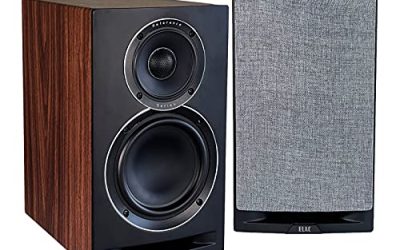
ADAM Audio T8V
ADAM Audio T8V
Best for: Listeners who want the deepest listed bass reach and a ribbon tweeter
8-inch polypropylene woofer and 1.9-inch U-ART ribbon tweeter; Class D power 90 W total (70 W woofer, 20 W tweeter) with DSP-managed crossover; frequency response 33 Hz to 25 kHz; maximum SPL 118 dB per pair as listed; inputs are balanced XLR and unbalanced RCA; high and low shelving switches; sold as a single monitor
The T8V is the largest model in ADAM Audio’s T series and takes a different route at the top end: instead of a dome, it uses the company’s U-ART ribbon tweeter, a folded diaphragm design paired with a waveguide for controlled dispersion. The listing credits the T8V with the deepest bass reach in this guide, with the 8-inch polypropylene woofer extending down to 33 Hz, which is why it appeals to producers working on bass-heavy material who do not want to add a subwoofer.
Amplification is Class D with DSP managing the crossover, split between a stronger woofer amplifier and a smaller tweeter amplifier, and the listing quotes a maximum level of 118 dB measured per pair. On the back, the balanced input is XLR only, joined by an unbalanced RCA for a consumer source, plus high and low shelving switches with boost, flat and cut positions for room tuning. If your interface outputs balanced TRS only, plan on TRS-to-XLR cables, which carry the same balanced signal on a different plug.
Watch out for: There is no TRS input, so balanced connections from TRS outputs need a cable with an XLR plug at the monitor end
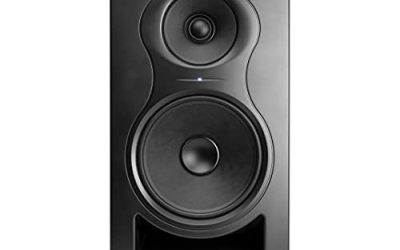
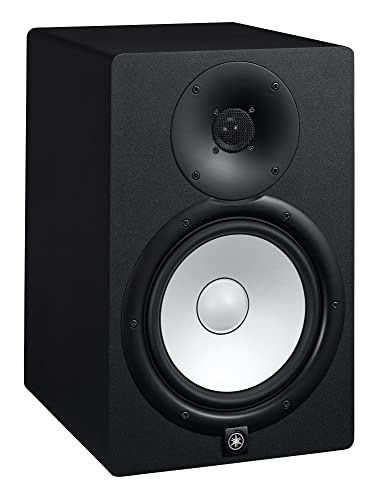
Kali Audio LP-8 V2
Kali Audio LP-8 V2
Best for: Setups that need detailed boundary compensation for tricky placements
8-inch woofer and 1-inch soft dome tweeter; Class D power 100 W total (60 W low frequency, 40 W high frequency); frequency response 37 Hz to 25 kHz at the minus 10 dB point, and 43 Hz to 21 kHz within 3 dB; inputs are balanced XLR, balanced quarter-inch TRS and unbalanced RCA; boundary EQ DIP switches with placement diagrams; sold as a single monitor
The LP-8 V2 is the second-generation version of Kali Audio’s Lone Pine 8-inch monitor, and its defining feature is how seriously it treats placement. A bank of boundary EQ DIP switches on the rear panel follows printed diagrams for the common situations: on stands away from walls, on a desk, against a wall, or on a console meter bridge. Each position applies a compensation curve drawn for that placement, which gives this monitor the most granular room adjustment of the four.
The rest of the design is equally methodical. A low-noise front port keeps bass output clean at level, the amplifiers split 100 W of Class D power between woofer and tweeter, and the input panel is the most complete in this guide, with balanced XLR, balanced TRS and unbalanced RCA all present. Whatever your interface or mixer provides, the LP-8 V2 accepts it without adapters, and the balanced paths keep longer cable runs quiet.
Watch out for: The DIP-switch system takes a few minutes to set correctly for each placement, and the switches are small, so changes mean reaching behind the cabinet
Which One Fits
Choose the Yamaha HS8 if you want the most straightforward reference here, with the highest woofer amplifier power and simple labelled room switches.
Choose the JBL 308P MkII if your monitors will sit on a desk or near a wall and you want boundary EQ plus a level-matching switch for consumer or professional sources.
Choose the ADAM Audio T8V if deep bass extension without a subwoofer is the priority and your gear already speaks balanced XLR.
Choose the Kali Audio LP-8 V2 if your placement is awkward and you want the most detailed placement compensation, with every input type covered.
Common Mistakes
Buying one monitor and expecting stereo. Listings for all four models here sell a single speaker. A stereo pair means ordering two, and the pair bundles that appear in search results are separate listings with separate identifiers. Check the unit count field on the listing before ordering.
Running balanced outputs into the RCA input. An adapter cable from a balanced output into an RCA socket works electrically but throws away the noise rejection you bought the balanced gear for. Use the XLR or TRS input with a proper balanced cable and keep RCA for genuinely unbalanced sources.
Comparing frequency numbers without their tolerances. A headline of 33 Hz and a headline of 38 Hz can describe similar real-world bass once you notice one is a minus 10 dB point and the other sits inside a 3 dB window. Compare like with like, and weigh the within-3 dB figures more heavily.
Ignoring the rear-panel switches. An 8-inch woofer against a wall can build up enough low-end lift to bury mix decisions. Every monitor here ships with some form of boundary or room compensation, and leaving it flat in a compromised placement wastes the feature that would fix the problem.
Placing the tweeters at the wrong height. Nearfield monitors are designed to fire at ear level from roughly an equilateral triangle with the listener. Stands or isolation pads that put the tweeter at ear height do more for imaging accuracy than any cable upgrade.
FAQ
Are all four monitors in this guide sold as pairs?
No. Each listing here is for a single monitor, which is the convention for studio speakers because buyers build pairs, surround arrays and single centre setups from the same model. Order two of the same monitor for a stereo pair, and check the unit count on the listing page before you pay, because pair bundles exist under different listings.
What is the difference between the XLR and TRS balanced inputs?
Electrically, very little. Both carry the same balanced signal that cancels interference picked up along the cable; they differ in plug shape and locking. XLR connectors latch in place, while TRS plugs are quicker to swap. The ADAM Audio T8V is the only pick here without a TRS socket, and a balanced TRS-to-XLR cable connects it to TRS outputs without losing the balanced connection.
Do I still need a subwoofer with an 8-inch monitor?
For most music mixing in small and mid-size rooms, no. The models here reach into the mid-30 Hz region on their listings, which covers the fundamental range of bass guitar and kick drum. Film work, electronic music with deep sub-bass content, and larger rooms are the cases where a subwoofer still adds something, and each of these systems can be extended later if the need appears.
Can I connect these monitors to a computer or phone directly?
You can, with the right cable into the balanced inputs, but a dedicated audio interface is the better route. An interface provides balanced outputs at the correct line level, a proper volume control within reach, and clean conversion. Feeding the monitors from a headphone socket usually means an unbalanced signal and a volume control buried in software, which risks noise and accidental full-level blasts.
Final Verdict
All four of these 8-inch powered monitors deliver the balanced connection the keyword asks for, so the decision comes down to placement and priorities. The Yamaha HS8 is the safe reference choice, with the strongest woofer amplifier and simple controls. The JBL 308P MkII suits desks and wall-adjacent setups that need boundary EQ. The ADAM Audio T8V reaches deepest on paper and adds a ribbon tweeter for those who favour its top-end character. The Kali Audio LP-8 V2 offers the most thorough placement compensation and the widest input choice. Match the monitor to your room and your outputs, order two for stereo, and set the rear-panel switches for where the speakers actually sit.
A
admin
We compare specs, materials and verified owner reviews before a product earns a spot. Rankings are never paid.
Affiliate disclosure. As an Amazon Associate we earn from qualifying purchases at no extra cost to you. Prices accurate as of the date shown.
Five beauty picks for calm evenings at home, from snap hair clips and a foot cream to vacuum sealer bags, coin wrappers, and a face cream for quiet nights.
Five beauty picks for calm evenings at home, from snap hair clips and a foot cream to vacuum sealer bags, coin wrappers, and grow lights for quiet nights.
Five beauty picks for calm evenings at home, from snap hair clips and a foot cream to vacuum sealer bags, succulents, and grow lights for quiet nights.
Five beauty picks for calm evenings at home, from snap hair clips and a foot cream to vacuum sealer bags, succulents, and coin wrappers for quiet nights.
Five beauty picks for calm evenings at home, from snap hair clips and a foot cream to styling clips, vacuum sealer bags, and rubber gloves for tidy rooms.
Five beauty picks for calm evenings at home, from snap hair clips and a foot cream to styling clips, vacuum sealer bags, coin wrappers, and a tidy drawer.



 Kali Audio LP-8 V2