We independently review everything we recommend. When you buy through our links, we may earn a commission. As an Amazon Associate we earn from qualifying purchases.
3 Best Three-Way Active Studio Monitors for Home Studios (November 2026)
Compare three-way active studio monitors for home studios, from the Kali IN-8 V2 to the Neumann KH 310 and Dynaudio LYD 48, with specs and fit advice.
Compare three-way active studio monitors for home studios, from the Kali IN-8 V2 to the Neumann KH 310 and Dynaudio LYD 48, with specs and fit advice.
Choosing a three-way monitor for a home studio is really a decision about your midrange. Vocals, guitars, keys, and dialogue all live in the band that a two-way design forces one woofer to share with the bass, so the real question is whether a dedicated midrange driver will clarify the part of your mixes you judge most often. Cabinet size, listening distance, and whether a model is sold as a single unit or a handed left or right piece matter just as much as driver count.
This guide is for home producers, mix engineers working from a spare room, and composers who sit at a fixed desk and want monitoring that stays honest at close range. Every pick below comes from an Amazon listing that states a three-way design and powered or active operation, and each one is a studio monitor rather than a bookshelf speaker or a passive cabinet needing a separate amp.
Quick Picks
As an Amazon Associate we earn from qualifying purchases
Product
Best for
Key spec from title
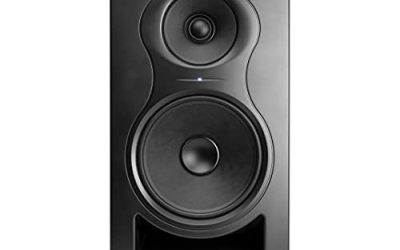
Kali Audio IN-8 V2
Desk-based mixing in small to mid-size rooms
8-inch powered 3-way monitor, 140W speaker system
Neumann KH 310 A (Right)
Critical listening in a treated room, bought as a single right unit
3-way active monitor with 8.25-inch driver
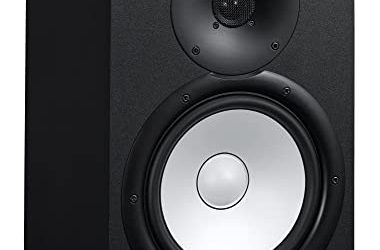
Dynaudio LYD 48 (Left)
The left side of a mirror-imaged pair on a larger desk
3-way active reference monitor, 180W maximum output power
How to Choose
Match Cabinet Size to Your Listening Distance
An 8-inch three-way cabinet needs more air between you and the drivers than a compact nearfield does. Sit too close and the separate woofer, midrange, and tweeter may not blend into one coherent picture before the sound reaches your ears, which can make balances shift as you lean in and out. Measure the distance from your chair to where the tweeters will sit, then check it against the role each model is built for. A monitor described for nearfield use suits a shallow desk, while a larger midfield-leaning cabinet rewards a deeper room, stands behind the desk, and a listening position set farther back.
Confirm the Midrange Driver Is Genuinely Separate
A true three-way design gives the midrange its own driver and its own share of the amplification, so the woofer stops early and never has to reproduce voices. When you read a listing, look for three named drivers, such as a woofer, a midrange, and a tweeter, rather than a single cone described with wide range language. Coaxial layouts place the midrange and tweeter at the same point, which helps imaging at a desk. Traditional layouts stack three separate drivers on one baffle, which usually needs a little more distance. Either approach counts, provided the listing states three-way operation outright.
Check Whether You Are Buying a Single, a Left, or a Right
Studio monitors are commonly sold one at a time, and three-way models add a second trap: handed cabinets. Some ranges are mirror-imaged, so the left and right units are not interchangeable, and ordering two of the same side leaves you with an asymmetric pair. Before ordering, confirm three things on the listing: whether the quantity is a single monitor or a pair, which side a handed model is built for, and whether the matching opposite side is available from the same listing family. Budget and plan for two units unless you are replacing one side of a pair you already own.
Plan Inputs and Placement Controls Around Your Room
Active monitors carry their amplifiers inside the cabinet, so each one needs its own power outlet and its own signal cable from your interface. Check that the inputs match what you own: balanced XLR or TRS connections suit most interfaces, while an RCA input helps if a consumer device ever feeds the monitors directly. Placement controls matter in spare rooms, where desks sit against walls. Boundary compensation or similar EQ settings let a monitor adjust for the bass buildup that comes from a nearby wall or desktop, which is far easier than moving furniture every session.
The 3 Best Options
Kali Audio IN-8 V2
Top Pick
Kali Audio IN-8 V2
Best for: Home producers mixing at a desk who want a dedicated midrange without moving up to midfield cabinets.
Configuration: Powered 3-way studio monitor, sold as a single unit
The IN-8 V2 is the natural starting point for a home studio because its Amazon listing states the full brief in one line: a powered three-way monitor with an 8-inch woofer and boundary compensation EQ for placement near walls or on a desk. That combination suits producers who mix vocals and acoustic instruments at a fixed chair position and need the midrange kept separate from bass duties. The mix of XLR, TRS, and RCA inputs also makes it forgiving about sources, covering a typical interface today and a simpler playback device tomorrow without adapters or a change of cabling plan.
Neumann KH 310 A (Right)
Runner-Up
Neumann KH 310 A (Right)
Best for: Critical mixing and arranging in a treated home room, especially when completing or replacing the right side of a pair.
Configuration: 3-way active studio monitor, single right unit
The KH 310 A fits the home studio owner who treats the room, works at moderate distance, and wants one carefully engineered right-hand unit rather than a matched bundle. Its listing describes a three-way active monitor using Class AB amplifiers for each driver, with a Mathematically Modeled Dispersion waveguide intended to keep the sound consistent across a wider listening area. That matters when you shift between a keyboard, a desk, and a second chair while arranging. Because this listing is specifically the right monitor, it suits buyers completing a pair or replacing the right side of an existing KH 310 setup.
Dynaudio LYD 48 (Left)
Dynaudio LYD 48 (Left)
Best for: The left channel of a mirror-imaged pair in a bigger home studio with stands or a deep desk.
Configuration: 3-way active studio reference monitor, powered, left side
The LYD 48 suits a larger home studio where the desk or stands can hold a substantial cabinet and the listening position sits a little farther back. Its listing presents it as a three-way active studio reference monitor in powered form, built as the left side of a mirror-imaged pair, which is the correct way to keep driver layout symmetrical across the stereo field. With an 8-inch woofer and 180 watts of maximum output power in the listing specifications, it is aimed at producers who play mixes at confident levels while editing, tracking, or checking low-end decisions in a room that can support them.
Which One Fits Your Situation
You Mix at a Desk in a Small Spare Room
Choose the Kali Audio IN-8 V2. Its boundary compensation EQ settings address the wall and desktop closeness that define most spare-room setups, and its powered three-way layout keeps vocals clear without demanding a long listening distance. The RCA input is a quiet bonus if a phone or media player ever feeds the monitors directly between sessions.
You Have a Treated Room and Work a Little Farther Back
Choose the Neumann KH 310 A, ordering the matching left unit alongside this right one. The waveguide design and per-driver Class AB amplification suit a settled listening position where you make final balance and reverb decisions. In a treated room, that consistency across small head movements is worth more than extra placement EQ you may rarely touch.
You Are Building a Mirror-Imaged Pair on Stands
Choose the Dynaudio LYD 48 for the left side and its matching right-side counterpart. Mirror imaging keeps the driver arrangement symmetrical, which helps the stereo image stay stable on stands behind a desk. The 8-inch woofer and higher output suit a room where you can sit farther back and listen at fuller levels while tracking or arranging.
You Switch Between an Interface and Simpler Sources
Choose the Kali Audio IN-8 V2 again, this time for its input mix. XLR and TRS cover a balanced interface connection, while RCA accepts unbalanced consumer gear without a converter box. If your home studio doubles as a listening space, that flexibility saves constant re-cabling, and the single-unit format lets you start with one monitor and add the second later.
Common Mistakes
Buying two units of the same handed side, then discovering the pair is not mirror-imaged and the stereo image leans.
Placing a large three-way cabinet at arm’s length, where the separate drivers have no distance to blend before reaching your ears.
Forgetting that active monitors each need mains power, so a pair requires two outlets plus two signal cables, not one shared lead.
Judging bass in an untreated corner and blaming the monitor, when boundary buildup from walls and the desk is shaping what you hear.
Assuming every listing is a pair, when most studio monitors, including all three picks here, are sold as single units.
Frequently Asked Questions
Does a three-way monitor remove the need for a subwoofer at home?
Not automatically. A three-way design mainly improves midrange clarity by giving voices and instruments their own driver; low-end reach still depends on woofer size and your room. Many home producers work happily without a sub, then add one later only if they regularly produce bass-heavy material and can place and calibrate it properly.
Are these monitors sold as pairs or singles?
All three picks here are single units. The Kali Audio IN-8 V2 is listed as a single monitor, the Neumann KH 310 A listing is the right unit, and the Dynaudio LYD 48 listing is the left side. For stereo, order two matching units, and with handed models, make sure one is left and one is right.
Can I lay a three-way monitor on its side to fit under a shelf?
Only if the manufacturer designs that model for horizontal use. Turning a vertically arranged three-way cabinet sideways changes how the drivers align with your ears and can narrow the useful listening area. A coaxial model tolerates repositioning more gracefully, but checking the stated orientation for your exact model is safer than assuming any cabinet works both ways.
Do active monitors need a power amplifier or a special interface?
No separate power amplifier is needed, because active monitors carry their amplification inside the cabinet. You do need a line-level source, which in most home studios is an audio interface with balanced outputs, plus a mains outlet for each monitor. A headphone output can feed them in a pinch, but a proper interface gives cleaner level control.
A
admin
We compare specs, materials and verified owner reviews before a product earns a spot. Rankings are never paid.
Affiliate disclosure. As an Amazon Associate we earn from qualifying purchases at no extra cost to you. Prices accurate as of the date shown.
Five beauty picks for calm evenings at home, from snap hair clips and a foot cream to vacuum sealer bags, coin wrappers, and a face cream for quiet nights.
Five beauty picks for calm evenings at home, from snap hair clips and a foot cream to vacuum sealer bags, coin wrappers, and grow lights for quiet nights.
Five beauty picks for calm evenings at home, from snap hair clips and a foot cream to vacuum sealer bags, succulents, and grow lights for quiet nights.
Five beauty picks for calm evenings at home, from snap hair clips and a foot cream to vacuum sealer bags, succulents, and coin wrappers for quiet nights.
Five beauty picks for calm evenings at home, from snap hair clips and a foot cream to styling clips, vacuum sealer bags, and rubber gloves for tidy rooms.