We independently review everything we recommend. When you buy through our links, we may earn a commission. As an Amazon Associate we earn from qualifying purchases.
4 Best Magnified Red Dots for AR Rifles (November 2026)
Four magnified red dot optics for AR rifles compared: three 1-6x LPVOs with illuminated BDC reticles and one 3x prism, with listing specs and fit notes.
Four magnified red dot optics for AR rifles compared: three 1-6x LPVOs with illuminated BDC reticles and one 3x prism, with listing specs and fit notes.
A plain 1x dot is quick at close range, yet it gives you nothing when a target sits past 100 yards and you need to confirm what it is before deciding. Magnified dot-style optics answer that gap in two distinct ways: a low power variable scope that behaves like a dot at 1x and zooms in for distance, or a compact prism with fixed power and an etched reticle. Picking between those two shapes, and then between reticle styles, is the real decision here.
This guide is written for carbine owners moving up from a plain dot, for shooters who want one optic covering drills and mid-range steel, and for anyone whose eyesight makes an unmagnified dot bloom into a blur. Every pick below was chosen from its Amazon listing name and specification block, and each one pairs magnification with an illuminated dot-style aiming point, either a variable 1-6x scope or a fixed 3x prism.
Quick Picks
As an Amazon Associate we earn from qualifying purchases.
Product
Best for
Key spec from title
Vortex Strike Eagle 1-6×24
All-round carbine use
Illuminated AR-BDC3 reticle
Primary Arms SLx 1-6×24 Gen IV
Brightest daylight dot
ACSS Nova fiber wire reticle
Sig Sauer Tango-MSR 1-6×24
A complete box with mount
MSR-BDC6 reticle, mount included
Primary Arms SLx 3x MicroPrism
Lightweight fixed power
Etched ACSS Raptor reticle, 3x
How to Choose
Variable LPVO or Fixed Prism
A 1-6x variable scope gives you a true 1x setting for close work and a zoom ring for longer shots, at the cost of length and weight around 18 ounces. A fixed 3x prism is far shorter and lighter, and its etched reticle stays visible with the illumination switched off, which helps shooters whose astigmatism smears a projected dot. The trade is flexibility: the prism cannot dial down for room-distance speed, and the variable scope demands more rail space and a proper cantilever mount.
Reticle Style and Holdover Marks
Most of these reticles draw a bold center point or chevron inside a horseshoe, then stack drop marks below it for longer distances. Those marks are drawn around common 5.56 and .308 loads, so check which cartridge family a reticle is built for before ordering. On every second focal plane scope here, the holdover spacing is only correct at the highest magnification. A fiber wire reticle concentrates brightness into the center point, while a BDC layout spreads references further down the post.
Illumination and Battery Habits
All four optics run on a single CR2032 cell and give you a rotary dial of brightness settings, eleven on the three variable scopes and thirteen on the prism. Daylight visibility varies more than the setting count suggests, because a fiber wire design pushes far more light into the center point than a standard etched-and-lit reticle. Etched glass matters here too: if the cell dies, the black reticle lines remain, so the optic still aims. The prism adds motion-sensing shutoff that wakes the illumination when the rifle moves.
Eye Relief, Mounting and Weight
Eye relief decides where the optic sits and how forgiving the sight picture feels. The variable scopes list roughly 3.3 to 4 inches, which suits a cantilever mount pushing the tube forward over the handguard. The little prism lists only 2.7 inches, so it mounts further back and rewards a consistent cheek weld. Weight spreads widely across this group, from under 8 ounces for the prism to about 18 ounces for each variable scope, and that difference changes how a lightweight carbine balances.
The Strike Eagle is the familiar middle path: a 1-6×24 second focal plane scope whose glass-etched AR-BDC3 reticle carries holdover and ranging references out to 650 yards, lit by eleven illumination settings. A thread-in throw lever comes in the box, so magnification changes stay quick without extra parts. The tube is aircraft-grade aluminum, nitrogen purged and o-ring sealed, with fully multi-coated lenses and a fast-focus eyepiece. For a shooter who wants one optic that acts like a dot up close and still reaches, this is the balanced starting point.
Where the Strike Eagle spreads its illumination across a BDC tree, the Gen IV Nova concentrates it. Its fiber optic wire feeds the center aiming point, and Primary Arms describes the top setting as dot-bright in full sun, which is exactly where many lit reticles wash out. Around that point sit MIL subtensions with ranging marks and moving-target leads. The Gen IV optical system rides in a 30 mm tube with an integrated dovetail throw lever, 0.1 MIL clicks and 120 MOA of total travel, and the listing describes the housing as waterproof, shockproof and fog resistant.
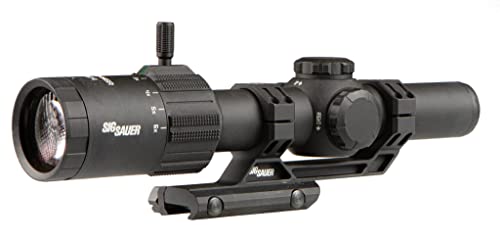
The Tango-MSR removes the most common extra errand: it ships with the Alpha-MSR one-piece cantilever mount in the box, along with flip caps and an integrated throw lever. Its MSR-BDC6 reticle places a precise 1 MOA free-floating center dot inside an illuminated semicircle, with eleven brightness levels and low dispersion glass behind it. Turrets are capped and click in half-MOA steps. If your rifle has a bare rail and you want everything needed for mounting in a single carton, this is the straightforward route onto the range.
The MicroPrism takes the other road entirely. Instead of a zoom ring you get fixed 3x magnification in a body under 3 inches long and under 8 ounces, with an etched ACSS Raptor reticle drawn for 5.56 and .308 yard holds. Thirteen illumination settings include an AutoLive motion sensor that sleeps when the rifle rests and wakes when it lifts. Because the reticle is etched, a dead battery never blanks your sight picture. The included Picatinny mount adjusts across eight height configurations, which makes fitting it behind different rear sights easier.
Specs
Magnification: 3x fixed
Objective lens: 23 mm
Reticle: ACSS Raptor 5.56/.308, etched and illuminated
Illumination settings: 13, with AutoLive motion sensing
Eye relief: 2.7 in
Field of view: 38 ft at 100 yd
Exit pupil: 7.4 mm
Total adjustment: 80 MOA
Click value: 0.25 MOA
Length: 2.95 in
Weight: 7.95 oz
Battery: CR2032
Best for: A light carbine that still needs reach past 200 yards, and shooters with astigmatism.
Watch out for: Short eye relief means head position has to stay consistent; there is no 1x setting for close work.
ASIN: B0B4PTWPCJ
Which One Fits Your Situation
One Carbine That Does a Bit of Everything
Pick the Strike Eagle. Its 1-6x range covers close transitions and mid-range steel in a single tube, the throw lever is already in the box, and the AR-BDC3 holds give you references out to 650 yards once you confirm them at 6x. It asks only for a 30 mm cantilever mount to complete the setup.
Close Work Where the Dot Must Stay Visible at Noon
Pick the Primary Arms Gen IV Nova. The fiber wire center point is the brightest aiming reference in this group, so the 1x setting keeps a dot-like feel under harsh sun instead of fading into a thin black cross. You still keep 6x in reserve for identification and longer shots.
A First Magnified Optic With Nothing Else to Buy
Pick the Tango-MSR. The Alpha-MSR cantilever mount, flip caps and throw lever all arrive in the same carton, so the scope goes from box to rail without a second order. Its center dot inside an illuminated semicircle is easy to learn, and capped turrets stay put once zeroed. That completeness is the whole appeal here.
A Lightweight Build That Still Reaches Past 200 Yards
Pick the SLx 3x MicroPrism. At 7.95 ounces it adds less weight than many plain dots plus their mounts, yet the fixed 3x and Raptor holds stretch a short carbine well past 200 yards. The etched reticle also suits eyes that turn a projected dot into a smear. It is the simplest setup in this entire guide.
Common Mistakes
Using BDC holdover marks at 3x or 4x on a second focal plane scope, when those marks are only correct at full power.
Mounting a short-eye-relief prism too far forward, then blaming the optic for a shadowy sight picture.
Leaving illumination dialed to its highest setting for weeks, which drains the CR2032 long before a range day.
Ordering a variable scope without a cantilever mount, forgetting that eye relief pushes the tube ahead of the receiver.
Expecting any LPVO at 1x to match a reflex sight’s eye box; head position still matters behind magnified glass.
Frequently Asked Questions
Is a magnified optic like these better than a dot with a flip-aside magnifier?
It depends on how often you shoot past 100 yards. A single magnified optic keeps the reticle, holds and zero in one unit with nothing to flip, while a dot and magnifier combo preserves a true reflex sight for close work. Frequent mid-range shooting favors the single unit; mostly close work favors the combo.
Do the holdover marks work at every magnification on these scopes?
On the three variable scopes, no. They are second focal plane designs, so the reticle keeps one size while the image zooms, and the drop marks line up only at 6x. The fixed 3x prism has no zoom, so its Raptor holds stay consistent at the only power it has.
Can I still aim if the battery dies?
Yes. Every reticle in this group is etched into glass, so the aiming marks remain visible in black with the illumination off. You lose the bright center point, not the reticle itself. Carrying a spare CR2032 in the grip or range bag makes the question mostly academic anyway.
What should I check before mounting one of these on a flat-top AR?
Confirm the mount matches your tube or footprint, since the three scopes need 30 mm rings or a cantilever while the prism uses its included Picatinny base. Then check eye relief against your stock position, and leave clearance for flip caps and the charging handle before torquing anything down.
S
Softlavender Editorial Team
We compare specs, materials and verified owner reviews before a product earns a spot. Rankings are never paid.
Affiliate disclosure. As an Amazon Associate we earn from qualifying purchases at no extra cost to you. Prices accurate as of the date shown.
Looking for the best 4 wire smart thermostat? Compare four picks that work without a C-wire, with included adapters, room sensors and voice control built in.
The best keyboards for Apple TV compared in depth: three Bluetooth models with page-stated Apple TV compatibility, for faster search, sign-ins and text entry.