Key takeaways
- Compare true Class-AB integrated amplifiers for a dedicated listening room, with power, damping, analog inputs, and phono stages from Yamaha, Denon, and Marantz.
As an Amazon Associate we earn from qualifying purchases.
A dedicated listening room changes what you should ask from an amplifier. There is no television dialogue to rescue, no soundbar convenience to chase, and no multi-zone party trick that matters more than two speakers, one chair, and the distance between them. In that room, the amplifier has one job: take a turntable, a CD transport, a streamer used as a digital source, or a tape deck, and drive a pair of loudspeakers cleanly at the levels you actually listen at, without adding hiss, glare, or a sense of strain when the music gets busy.

That is why many listeners still choose a Class-AB integrated amplifier for this job. Class-AB is the long-established linear topology used in most classic hi-fi integrated amps: the output devices conduct for more than half the signal cycle, crossover distortion is kept low, and the design trades some efficiency and extra heat for a familiar, high-current way of controlling a loudspeaker. It is not magic, and a well-made Class-D amp can also sound excellent. But if your shortlist is specifically about traditional linear integrated amplifiers, with a proper analog volume control, a phono input, tone controls you can bypass, and speaker terminals built for a permanent two-channel system, the four models below are the right category — and only that category.
Every pick in this guide is a stereo integrated amplifier with a Class-AB output stage. There are no AV receivers here, no separate power amplifiers that need a preamp, and no Class-D mini amps. Each model was selected for a dedicated room, which means analog connectivity, usable continuous power into 8 ohms, the ability to drive 4-ohm loads within the maker’s ratings, and controls that suit long, seated listening sessions rather than a desktop.
Affiliate disclosure: This article contains affiliate links. If you buy through a link on this page, we may earn a commission at no extra cost to you. Prices and availability change, so check the product page for the current offer before you buy.
Quick comparison
| Model | Power per channel | Phono input | Digital inputs | Best for |
|---|---|---|---|---|
| Yamaha A-S801BL | 100 W into 8 ohms | MM | USB DAC, optical, coaxial | Most power and a USB DAC in one box |
| Yamaha A-S501BL | 85 W into 8 ohms | MM | Optical, coaxial | A balanced analog-first room system |
| Denon PMA-600NE | 45 W into 8 ohms, 70 W into 4 ohms | MM | Optical x2, coaxial, Bluetooth | Smaller rooms and an analog bypass mode |
| Marantz PM6007 | 45 W into 8 ohms, 60 W into 4 ohms | MM | Optical x2, coaxial | Low-level listening and tonal refinement |
Specifications in the table and in each section are taken from the manufacturers’ published figures as shown on their product listings. They are not listening impressions from a bench test of our own, and you should confirm the exact figure on the listing for the finish and region you are buying, because model suffixes differ by market.
How we chose for a listening room, not a living room
Power that matches the room and the speaker
In a dedicated room you usually sit at a fixed distance, often 2 to 3.5 metres from the speakers, and you listen at repeatable levels. That makes the sensitivity of your speakers more important than a headline watt number. A speaker rated at 88 dB at 1 watt at 1 metre needs roughly ten times the power for every extra 10 dB at the seat, before room gain and peaks are considered. In practice, 45 watts per channel is plenty for efficient speakers in a modest room, while 85 to 100 watts buys headroom for less efficient speakers, for orchestral peaks, and for listening a little louder without the amplifier working near its limit.
All four amplifiers below publish a continuous rating into 8 ohms across the audio band with a stated total harmonic distortion figure, which is the rating worth comparing. Ignore peak or music-power numbers if a listing shows them. They do not tell you how the amp behaves on a sustained bass note.
Damping factor and speaker control
Damping factor describes how firmly the amplifier’s low output impedance controls woofer movement, especially in the bass. For a listening room, the practical point is not to chase the largest spec-sheet number. Use reasonably short, low-resistance speaker cable, connect one pair cleanly to the A terminals, and avoid running two pairs at high level into a combined load below the rated minimum impedance.
Analog first, digital where it helps
A dedicated room usually has at least one purely analog source, so look for an MM phono stage, enough line-level RCA inputs, and a tone-control bypass. All four picks have an MM phono input and multiple line inputs. Yamaha calls its bypass Pure Direct, Denon offers an Analog Mode that switches off digital and display circuitry, and Marantz provides Source Direct. Confirm subwoofer and headphone outputs on the exact model you choose rather than assuming them from a sibling model.
1. Yamaha A-S801BL — the most complete room amplifier here
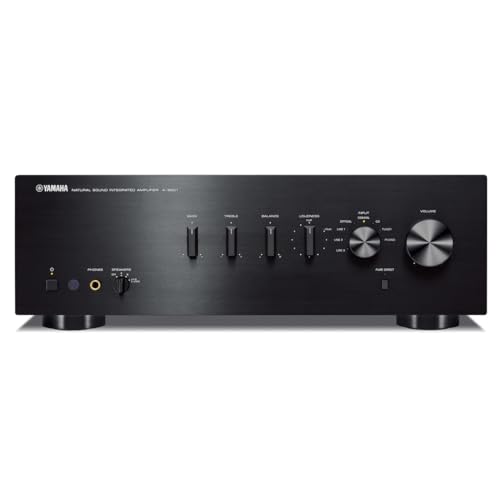
The Yamaha A-S801BL sits at the top of this shortlist because it combines the highest continuous power in the group with the most useful digital section for a room that has both vinyl and a computer or streamer as a source. Yamaha rates it at 100 watts per channel into 8 ohms, using its ToP-ART circuit layout — short, symmetrical signal paths — and a substantial chassis intended to reduce vibration and channel interference. For a dedicated room, that combination is relevant: more headroom for inefficient speakers, and a layout designed around channel separation rather than around video switching.
On the analog side, the A-S801 provides multiple line-level RCA inputs including an MM phono input, a continuously variable loudness control, bass and treble controls, balance, and a Pure Direct mode that bypasses the tone and loudness circuitry and switches off the front display for a shorter path. Speaker A and B switching is included, along with a subwoofer output, a headphone jack, and remote control. Those are the controls a seated listener actually uses: input, volume, an occasional loudness adjustment at very low level late at night, and nothing else in the way.
Digitally, this is the only model in this guide with a USB DAC input, based on an ESS Sabre design as listed, alongside optical and coaxial inputs. That makes it the natural pick if your digital source is a laptop or a dedicated music computer feeding high-resolution files, because you do not need a separate DAC between the computer and the amplifier. Optical and coaxial inputs cover a CD transport or a streamer with a digital output.
Who should buy it: the listener with medium-efficiency or lower-efficiency floorstanding or stand-mount speakers, a turntable, and a computer-based source, who wants one integrated amplifier and no separate DAC. Who should skip it: a listener with very efficient speakers in a small room who will never use USB — the A-S501 below covers the same analog ground for less power that may never be needed.
Points to check on the listing: confirm the black BL finish, the 100 W rating for the US model, and that the USB DAC driver requirements suit your computer’s operating system.
2. Yamaha A-S501BL — the balanced analog-first choice
The Yamaha A-S501BL is the middle step in the same family and, for many dedicated rooms, the most sensible one. It is rated at 85 watts per channel into 8 ohms with a stated 0.019% THD figure in the listing material, which is still substantial headroom for most speakers at normal listening-room distances. It keeps the same basic philosophy as the A-S801: ToP-ART layout, a rigid chassis, Pure Direct, variable loudness, tone and balance controls, speaker A/B switching, a subwoofer output, and an MM phono input.
The difference is in the digital section and in power. The A-S501 provides optical and coaxial digital inputs with an onboard DAC, but no USB input. If your digital sources are a CD player, a CD transport, or a streamer with optical or coaxial output — which describes a large share of dedicated rooms — that omission costs you nothing in daily use. You still get digital sources converted inside the amplifier, with the same remote and the same front-panel workflow as your analog sources.
In a room, the A-S501 makes a particularly clean system with a turntable, a CD player, and one streamer, driving speakers in the 86 to 90 dB sensitivity range. It has enough power for confident peaks in a small to medium room, and its loudness control is genuinely useful for the low-level evening listening that dedicated rooms are often used for, where human hearing loses bass and treble sensitivity and a fixed tone-control setting is a blunt substitute.
Who should buy it: the analog-first listener who wants phono, CD, and one or two digital sources, with no computer permanently attached to the system. Who should skip it: anyone who needs USB audio, or anyone driving demanding 4-ohm speakers at high levels in a large room, where the A-S801’s extra headroom or a higher-current model is the safer match — check the minimum impedance guidance for any speaker you plan to run as a second pair.
Points to check on the listing: confirm the A-S501BL model number, the 85 W per channel rating, and the optical and coaxial input count for the exact unit offered.
3. Denon PMA-600NE — refined for smaller rooms, with an analog bypass
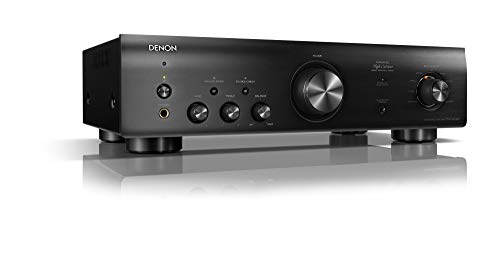
The Denon PMA-600NE is rated lower on paper — 45 watts per channel into 8 ohms and 70 watts per channel into 4 ohms in the listing — and that is exactly why it belongs in a guide for dedicated rooms rather than being dismissed. In a small to medium room with speakers of average or better sensitivity, those watts cover normal and moderately loud listening with room to spare, and Denon builds the model around its Advanced Ultra High Current single push-pull design, a traditional Class-AB approach intended to deliver current into real speaker loads rather than only a resistive test load.
Its most room-relevant feature is Analog Mode. Engaged, it disables the digital input circuitry and the display to reduce interference with the analog signal — a small, deliberate feature that only makes sense in a quiet room where you are listening closely to a record or a CD through the analog inputs. The PMA-600NE also includes an MM phono equalizer, tone and balance controls, a Source Direct style bypass via Analog Mode operation, speaker terminals for one pair plus a subwoofer pre-out arrangement as listed, and a headphone output.
Digital connectivity covers two optical inputs and one coaxial input, plus Bluetooth for casual use. In a dedicated room, treat the Bluetooth as a convenience for a guest’s phone or for background listening while you shelve records, not as the main source; the wired optical and coaxial paths are the ones to build the system around. There is no USB DAC input, so a computer source is better connected through a separate DAC into a line input, or via a streamer with an optical output.
Who should buy it: the listener in a smaller dedicated room, with efficient speakers, who values a clean analog path and mostly plays vinyl and CD. Who should skip it: anyone with low-sensitivity speakers, a large room, or a habit of listening at high levels to bass-heavy material, where 45 watts will run out of headroom sooner than the Yamaha models above.
Points to check on the listing: confirm the PMA-600NE model number, the 45 W into 8 ohms rating, and that the unit offered is the US version with the correct mains voltage.
4. Marantz PM6007 — low-level finesse and a musical tone control set

The Marantz PM6007 is the other 45-watt-class option in this guide, rated at 45 watts per channel into 8 ohms and 60 watts per channel into 4 ohms as listed. It uses Marantz’s current-feedback Class-AB amplification and HDAM discrete circuit modules in place of generic op-amps in key stages, a design approach the company has used across several generations of this model line. For a dedicated room, the relevance is at low and medium levels: this is an amplifier aimed at tonal balance and detail with speakers that do not demand large current swings.
Connectivity is well judged for a two-source-plus-turntable room. There are multiple line-level RCA inputs, an MM phono input with a dedicated phono stage, two optical digital inputs and one coaxial input feeding an AKM DAC as listed, a subwoofer output, a record output, and a headphone jack. Tone controls and a Source Direct mode let you choose between a small amount of shaping for a bright room or a thin recording, and a bypassed path for well-balanced material. A remote is included, and the front panel keeps the large volume and input controls that suit a system you operate from a chair a few feet away, often in low light.
Pairing guidance matters more with the PM6007 than with the higher-power Yamahas. Choose speakers of 87 dB sensitivity or higher for a medium room, keep cable runs short, and do not plan to run a second pair of speakers loudly at the same time. Used within those limits — a nearfield-to-midfield dedicated room, stand-mount speakers, jazz, acoustic, vocal, and chamber material alongside rock and electronic music at sensible levels — it is a coherent, complete amplifier that needs no add-ons to form a system.
Who should buy it: the listener who prioritises low-level detail and tonal balance over maximum level, with reasonably efficient speakers. Who should skip it: anyone whose room or speakers demand sustained high power, or who needs a USB DAC input in the amplifier itself.
Points to check on the listing: confirm the PM6007 model number, the black finish if that is what your rack requires, and the stated power ratings for the US model.
Setting up a Class-AB integrated amp in a dedicated room
Class-AB designs convert more power into heat than an efficient switching design, so leave clear ventilation above the top panel and keep the unit out of a closed cabinet without airflow. Heat is normal; a blocked vent is not.
Set the speakers first: pull them away from the front wall, toe them toward the chair, and keep the chair away from the back wall. Only then judge tone controls — with position settled, the bypass mode is usually the right default. Connect the turntable to phono with its ground wire attached, and a CD player or streamer to a line input or to optical/coaxial. Finally, note the volume position on the loudest passage of a familiar record: if it sits comfortably mid-range with peaks still clean, the speaker match is right; if it is near the end of travel, the speakers are too inefficient for the amplifier.
Which one should you buy?
Choose the Yamaha A-S801BL if you want the most power and a USB DAC in a single traditional integrated amplifier. Choose the Yamaha A-S501BL if your sources are vinyl, CD, and a streamer with optical or coaxial output, and you want the same analog control set with slightly less power. Choose the Denon PMA-600NE for a smaller room and an analog bypass mode, with efficient speakers. Choose the Marantz PM6007 if low-level balance and a current-feedback design appeal to you and your speakers are an easy load.
Whichever you choose, you are buying the same basic idea, executed four ways: a linear Class-AB stereo integrated amplifier, built for two speakers and one listener, in a room that exists for music. In a market full of receivers that also do video and amplifiers that are really computers with speaker terminals, that focus is the point.