Key takeaways
- The best hybrid integrated amplifiers for a dedicated listening room pair a tube preamp with solid-state power, plus DAC and phono inputs for your vinyl.
Disclosure: As an Amazon Associate, we may earn from qualifying purchases made through links on this page, at no additional cost to you.

A dedicated listening room deserves an amplifier chosen for one job: serious two-channel music. A hybrid integrated amplifier approaches that job from two directions at once. Vacuum tubes handle the preamplifier stage, where they shape the signal’s tonal character at low level, and a solid-state output stage does the heavy lifting of driving loudspeakers. The result is a single-box component that aims for the warmth and dimensionality listeners associate with tubes, backed by the power, damping and reliability of transistors.
That formula suits a listening room particularly well. There is no home theater processing to pay for, no surround channels sitting idle, and no separate preamp and power amp to house and cable together. What matters instead is clean gain, enough current for your speakers, quiet backgrounds at low volume, and inputs that cover the sources a music room actually uses: a turntable, a CD transport or player, and a digital source feeding the built-in DAC.
Every amplifier in this guide is a genuine hybrid in the strict sense — a tube preamp stage feeding a solid-state power stage — and every one is an integrated design sold on Amazon US. Some famous hybrid names are not distributed through Amazon US at all, so this shortlist reflects the models that can actually be bought there with a verifiable listing. The three picks span the realistic range: a full-power flagship for the room, a mid-sized all-rounder, and a compact hybrid for smaller spaces and efficient speakers.
Quick Picks
- Best overall: Dayton Audio HTA200 — the most power here, a tube preamp with Class A/B output, and the fullest input set, including phono and a USB DAC.
- Best for smaller rooms: Dayton Audio HTA100 — the same hybrid recipe in a smaller chassis, with phono, Bluetooth 5.0 and a headphone output.
- Best compact hybrid: Nobsound MS-10D MKIII — a small-footprint tube hybrid with five input types and a subwoofer output for a bookshelf-speaker setup.
Dayton Audio HTA200 (ASIN: B0C2WG4BTN)
View the Dayton Audio HTA200 on Amazon
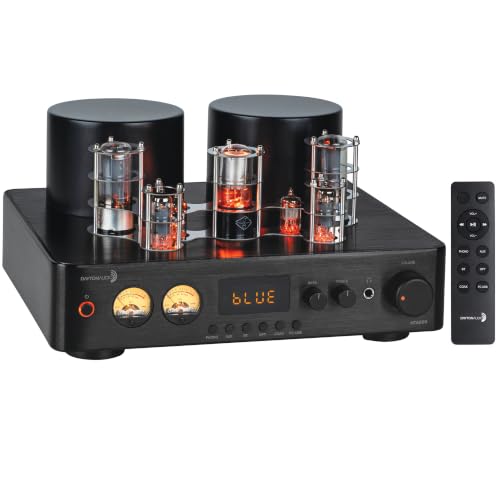
The HTA200 is Dayton Audio’s larger hybrid integrated amplifier, and its design brief is stated plainly on its product page: a classic Class A/B solid-state amplifier topology with vacuum tubes employed in the preamp circuit. That is the textbook hybrid layout — the tubes work at signal level, where they contribute their characteristic warmth and harmonic texture, while the transistor output stage delivers an RMS rating of 100 watts per channel into 4 ohms. For a dedicated listening room, that output figure matters: it gives the amplifier comfortable headroom over the bookshelf and floorstanding speakers typically found in two-channel setups, so dynamic peaks in orchestral or rock recordings are handled without the output stage straining.
Connectivity is where the HTA200 earns its place as the centerpiece of a music room. The rear panel carries analog inputs alongside a dedicated phono input for a turntable, a USB DAC input for a computer, and an optical digital input, with a subwoofer output for listeners who run a 2.1 arrangement. Bluetooth 5.0 is built in for casual wireless listening from a phone or tablet. On the front, exposed tubes sit behind classic VU meters in a brushed aluminum housing, and a large motorized volume knob works alongside bass and treble controls and an input display.
Highlights
- True hybrid topology: vacuum tube preamp stage with a Class A/B solid-state output stage
- 100 watts RMS per channel into 4 ohms for confident speaker drive
- Dedicated phono input, USB DAC and optical input cover vinyl, computer and digital sources
- Bluetooth 5.0 and a subwoofer output built in
Considerations
- The chassis is full-size hi-fi width, so measure your rack space before ordering
- No balanced XLR inputs; connections are single-ended analog plus digital
- Tone controls are convenient, but purists may prefer to leave them centered for the flattest response
Dayton Audio HTA100 (ASIN: B0C2WM7MMK)
View the Dayton Audio HTA100 on Amazon
The HTA100 applies the same hybrid formula as its larger sibling in a smaller, lighter chassis. Dayton Audio describes the same architecture on the product page: a Class A/B amplifier topology with vacuum tubes in the preamp circuit, so the tonal recipe — tube character up front, transistor reliability at the output — is unchanged. The Amazon listing rates the output at 65 watts RMS per channel into 4 ohms, which is still substantial power for a listening room built around bookshelf speakers or moderately sized floorstanders, and more than enough for nearfield and small-room systems where listening distances are short.
The input set mirrors the bigger model closely. There is a dedicated phono input for a record player, a USB DAC for computer audio, Bluetooth 5.0 for wireless streaming, and a subwoofer output if you want to extend the low end of small speakers. The longer listing title also confirms a headphone output, which makes the HTA100 a practical choice for rooms where late-night listening matters. Exposed tubes and front-panel VU meters carry over, as do bass and treble controls and a large volume knob in the brushed aluminum housing.
Highlights
- Same tube-preamp, Class A/B solid-state hybrid design as the HTA200, in a smaller chassis
- Phono input, USB DAC and Bluetooth 5.0 cover the main listening-room sources
- Headphone output and subwoofer output add flexibility for quiet hours and small speakers
- VU meters and exposed tubes give clear visual feedback and classic styling
Considerations
- Less output headroom than the HTA200, so very inefficient speakers in a large room are a stretch
- Third-party documentation lists a lower power figure than the Amazon page, so confirm the rating if it is critical to your speaker match
- No optical input is named in the main Amazon description, so check the current listing if a TV or CD transport needs one
Nobsound MS-10D MKIII (ASIN: B00KFGKKR2)
View the Nobsound MS-10D MKIII on Amazon
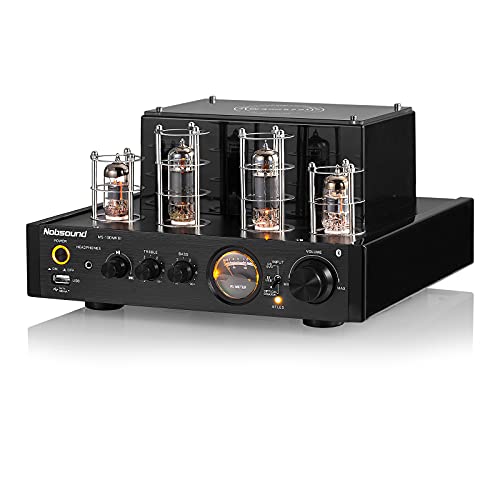
The MS-10D MKIII is the compact end of the hybrid market: a small integrated amplifier from Nobsound, sold on Amazon by Douk Audio Direct, that pairs a vacuum tube stage built around 6P1 and 6N1 tubes with a solid-state output section. Its appeal for a listening room is not raw power — this is a low-output design intended for efficient bookshelf speakers and shorter listening distances — but the combination of genuine tube circuitry and modern source handling in a box that fits where a full-width component will not, such as a sideboard, a study or a small dedicated room.
Five input types are on hand: Bluetooth for wireless streaming, USB, coaxial and optical digital inputs, and a stereo RCA analog input, so a phone, computer, CD player and streamer can all stay connected. Outputs are equally practical, with speaker terminals, an active subwoofer output for building a 2.1 system, and a 3.5mm headphone output for private listening. Bass and treble controls let you trim the sound to the room and the recording without extra equipment in the chain.
Highlights
- Genuine hybrid design with 6P1 and 6N1 tubes in a compact chassis
- Five input types — Bluetooth, USB, coaxial, optical and RCA — cover nearly any source
- Subwoofer output and headphone output included despite the small footprint
- Ships from Amazon with the maker selling direct, which simplifies support
Considerations
- Low output power suits efficient bookshelf speakers; it is not the pick for large rooms or demanding floorstanders
- No phono stage, so a turntable needs its own phono preamp before the RCA input
- The long-running listing has covered several hardware revisions, so confirm the current version’s details on the page before ordering
How to Choose
Start with your speakers, because they set the power requirement. Check the sensitivity figure in your speaker manual: models in the high-80s dB range and above reach satisfying levels in a listening room with modest wattage, while low-sensitivity designs and large rooms reward the headroom of a stronger output stage like the HTA200’s. Impedance matters too — most of the amplifiers here quote their headline power into 4 ohms, so compare like with like when you read the specifications.
Next, inventory your sources. A turntable needs either a built-in phono input, as on both Dayton Audio models, or a separate phono preamp. A computer benefits from a USB DAC input, a CD transport or streamer from optical or coaxial, and a phone from Bluetooth. Buying the amplifier whose input panel matches your rack avoids a tangle of adapters and add-on boxes later.
Finally, think about the room itself. In a treated, dedicated space you will hear the noise floor and the tonal balance of the amplifier more clearly than in a living room, which is exactly where the tube preamp stage earns its keep at low listening levels. Decide as well whether you need a subwoofer output for a 2.1 setup or a headphone output for late sessions, since those features vary between models and are awkward to retrofit.
Key Specifications Explained
Hybrid topology. In this guide, hybrid always means the same division of labor: vacuum tubes in the preamplifier stage, transistors in the power stage. Some products marketed with tubes use them only as a buffer or, worse, as decoration; every pick here is sold as a tube-preamp, solid-state-power design, which is the configuration that actually shapes the sound.
Output power and impedance. Wattage is quoted per channel and depends on the load: a figure given into 4 ohms will read higher than the same amplifier measured into 8 ohms. RMS figures are the meaningful ones for continuous listening; treat any large round number in a product title as a total or peak claim until the specification table confirms otherwise.
Damping and control. A solid-state output stage typically offers firmer control over woofer movement than a pure tube output stage, which is one reason hybrids pair well with modern speakers. This shows up as tighter, better-defined bass rather than as a number you can compare directly across brands.
DAC resolution. Built-in digital inputs are fed by an internal DAC. For CD-quality and typical streaming sources, any competent modern DAC stage is sufficient; listeners with high-resolution libraries should check the stated sample-rate support on the product page.
Phono stage. A phono input applies the equalization and gain a turntable cartridge needs. If an amplifier lacks one, as the Nobsound does, the turntable requires its own phono preamp — a small extra box, but one to plan for.
Setup and Use Tips
Give the tubes a few minutes after switch-on before judging the sound; a hybrid’s preamp stage settles quickly compared with a pure tube amplifier, but the first track of the evening is rarely the fairest test. Keep ventilation space above the chassis, since exposed tubes and a Class A/B output stage both shed heat, and never stack other components directly on top.
Set your listening position and speaker placement before reaching for tone controls. Toe-in, distance from the rear wall and a symmetrical layout change the sound of a two-channel room more than any amplifier adjustment. Once placement is right, use bass and treble sparingly, if at all, to trim a recording rather than to fix the room.
Match levels when you compare inputs. A louder source almost always sounds better in a quick switch, so balance volumes before deciding that one input or one amplifier setting is superior. If your amplifier has a subwoofer output, cross the subwoofer over low and set its level by ear with familiar bass-heavy tracks, aiming for extension you feel rather than bass you can locate.
Common Mistakes to Avoid
The most common mistake is buying by the wattage in the product title. Title figures are often totals or peaks; the RMS per-channel rating at a stated impedance is the number that predicts how the amplifier will drive your speakers. A related error is pairing a low-power compact hybrid with inefficient speakers and a large room, then blaming the tubes for the thin result.
A second mistake is assuming every amplifier with visible tubes is a true hybrid. Some inexpensive designs place tubes where they contribute little to the signal. Check that the product description actually describes a tube preamplifier stage feeding a solid-state power stage before you buy.
Finally, do not overlook the phono question. Connecting a turntable’s raw output to a line-level input produces quiet, bass-less sound, and connecting a line-level source to a phono input overloads it. Confirm which inputs your chosen amplifier provides, and budget for a separate phono stage if it has none.
FAQ
What makes an amplifier a true hybrid?
A true hybrid integrated amplifier uses vacuum tubes in the preamplifier stage and a solid-state (transistor) output stage to drive the speakers. The tubes shape the signal’s character at low level, while the transistors provide the current and control that loudspeakers demand.
Is a hybrid amplifier better than a pure tube amplifier for a listening room?
It depends on your speakers and habits. Hybrids generally offer more power, tighter bass control and less maintenance than pure tube designs, while keeping much of the tube tonal character. Pure tube amplifiers remain appealing with efficient speakers, but they ask more of the owner in tube replacement and heat management.
How much power does a dedicated listening room need?
For typical bookshelf or floorstanding speakers at normal listening distances, a few dozen honest RMS watts per channel is usually plenty, because most listening happens at low average power. Larger rooms, low-sensitivity speakers and a taste for high volume are what push the requirement upward.
Can I connect a turntable to any of these amplifiers?
The two Dayton Audio models include a dedicated phono input, so a turntable connects directly. The Nobsound MS-10D MKIII has no phono stage, so it needs a separate phono preamp between the turntable and its RCA input.
Do hybrid amplifiers need tube maintenance?
Eventually, yes, but gently. Because the tubes work only in the low-level preamp stage, they typically last far longer than power tubes in a pure tube amplifier, and replacements are inexpensive common types. Keep the tube pins clean, ensure ventilation, and expect years of service from a set.
Final Verdict
For most dedicated listening rooms, the Dayton Audio HTA200 is the strongest choice here: it pairs a genuine tube preamp stage with 100 watts per channel of Class A/B solid-state power, and its phono, USB DAC, optical and Bluetooth inputs cover the sources a music room actually uses. The HTA100 delivers the same hybrid character and nearly the same flexibility in a smaller chassis for rooms and speakers that need less power. If your space is compact and your speakers are efficient, the Nobsound MS-10D MKIII brings real tube circuitry and unusually complete connectivity at the smallest size. Whichever you choose, match the amplifier to your speakers’ sensitivity and your source list first — in a room built for listening, that match matters more than any single specification.