We independently review everything we recommend. When you buy through our links, we may earn a commission. As an Amazon Associate we earn from qualifying purchases.
Best Low Cost Bike: Affordable Hybrids That Still Ride Well
Find the best low cost bike for commuting, errands and fitness rides, with four affordable hybrid picks compared on frame, gears, brakes and fit.
Find the best low cost bike for commuting, errands and fitness rides, with four affordable hybrid picks compared on frame, gears, brakes and fit.
As an Amazon Associate we earn from qualifying purchases.
Affiliate Disclosure: This article contains affiliate links. If you buy through a link on this page, we may earn a commission at no extra cost to you. Product details are taken from the manufacturer and retailer listings, and availability can change, so check the product page before you order.
A low cost bike is not simply the cheapest bicycle you can find in a search result. It is a bike whose total ownership effort stays low: it arrives with sensible parts, it fits you properly, it stops reliably, and it does not need a stream of replacement components in its first season. Written qualitatively, without a specific budget figure, low cost means paying for the frame, wheels, gears and brakes that matter for everyday riding, and skipping the features that add expense without improving a commute, an errand run or a weekend path ride.
That distinction matters because the bottom of the bicycle market contains two very different kinds of products. The first kind is a simple, honest hybrid from an established brand, built around a proven frame and a drivetrain you can service anywhere. The second kind is a heavy, poorly assembled machine with decorative suspension, too many gears of low quality, and parts that are hard to replace. Both can be described as inexpensive. Only the first kind is genuinely low cost once you start riding it every week.
This guide focuses on the first kind. Every pick below is an adult hybrid bicycle, the same product type the keyword calls for, from a brand with a real support network. Hybrids suit low cost shopping especially well because their upright position, mid-width tires and straightforward gearing cover the widest range of everyday uses without the expense of a dedicated road, mountain or electric model.
How we chose these low cost bikes
We applied four filters. First, the bike had to be a complete adult bicycle sold as a hybrid, comfort hybrid or dual-sport hybrid, not a frame, a kit or a single-speed novelty. Second, the frame and fork combination had to make sense for pavement and light gravel paths, which is where most value-focused riders actually ride. Third, the drivetrain had to use widely available shifters and derailleurs, so a local shop can adjust or replace parts without special orders. Fourth, the listing had to give clear sizing guidance, because a low cost bike in the wrong size is not a bargain at any level.
We also weighed assembly honestly. Most bikes in this class arrive partly assembled, and the final steps usually involve fitting the front wheel, handlebar, saddle and pedals, then checking the brakes and gears. Budgeting a short amount of time, or a basic shop tune, is part of the real cost of any mail-order bicycle, and a bike that holds its adjustment after that first setup is worth more than one that needs constant attention.
The picks at a glance
The Schwinn Discover is the most complete commuter package here, with fenders and a rear rack already fitted. The Schwinn Wayfarer is the simplest and most relaxed option, with a retro steel frame and a single range of easy gears. The Schwinn GTX 2 adds a suspension fork and disc brakes for riders who mix pavement with rougher paths. The Schwinn Network 1 keeps the aluminum frame and suspension fork formula but with a cleaner, more urban specification. None of them is a racing machine, and that is precisely the point: each one spends its budget on everyday usefulness.
1. Schwinn Discover Adult Hybrid Bike
Top Pick
1. Schwinn Discover Adult Hybrid Bike
Frame: aluminum hybrid frame, in step-through and step-over versions
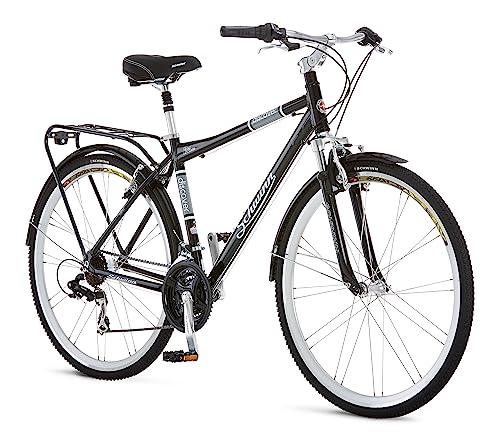
The Schwinn Discover earns the top spot because it arrives ready for the jobs a low cost bike is most often bought to do. Its aluminum hybrid frame keeps the weight manageable for carrying up steps or lifting onto a rack, and the 700c wheels roll efficiently on pavement while still accepting the kind of mid-width tire that copes with cracked surfaces and light gravel.
The 21-speed drivetrain gives you a low gear for the hill on the way home and enough range for flat cruising, and the twist shifter is intuitive for returning riders who do not want to relearn a new control layout. Front and rear fenders are fitted as standard, which sounds like a small detail until you ride through a wet street in normal clothes, and the rear cargo rack means a pannier or a strapped-down bag can carry shopping without a backpack heating up your back.
Promax alloy linear-pull brakes are a sensible specification at this level. They are strong, easy to inspect, and their pads are inexpensive and widely stocked. The swept-back style handlebar and padded saddle support an upright, relaxed position that suits errands and moderate commutes better than an aggressive crouch.
Consider the Discover if your riding is mostly on roads and paved paths, you want weather protection and carrying capacity included from day one, and you prefer a step-through or step-over frame choice within the same model family. Its limits are the limits of the class: the suspension fork adds comfort on broken pavement but also adds weight, and a rider planning long, fast weekend distances will eventually want a lighter, more performance-oriented bicycle.
2. Schwinn Wayfarer Adult Hybrid Bike
Runner-Up
2. Schwinn Wayfarer Adult Hybrid Bike
Frame: retro steel hybrid frame, in step-over and step-through versions
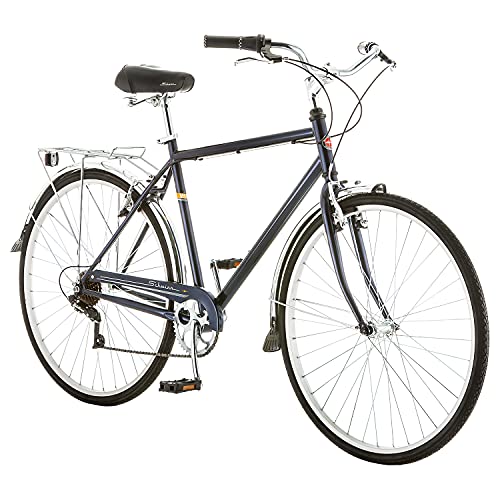
The Wayfarer is the pick for riders who value simplicity over specification. Its retro steel frame gives the ride a calm, planted feel, and steel has a long record of shrugging off the knocks of daily use. The styling is part of the appeal, with a classic look that suits city streets, campus riding and gentle neighbourhood loops, but the practical specification underneath is what makes it a sound low cost choice.
A 7-speed drivetrain is enough for flat and gently rolling terrain, and it brings real advantages for a value buyer: fewer gears to adjust, a simpler chain line, and controls that a new rider can understand in minutes. The rear rack and fenders extend its usefulness in the same way as on the Discover, turning it into a genuine errand bike rather than a fair-weather toy.
Linear-pull brakes keep maintenance straightforward, and the 700c wheels keep it feeling efficient rather than sluggish on pavement. The riding position is upright and friendly, with a saddle and grips chosen for comfort on shorter and medium-length rides.
Choose the Wayfarer if your routes are mostly flat, you like the classic look, and you would rather have a bike that is easy to live with than one with the longest feature list. Riders in hilly areas, or anyone who expects to tackle long climbs, should look at the wider gear range of the Discover, GTX 2 or Network 1 instead, because seven speeds will feel limited when the road tilts upward for a long time.
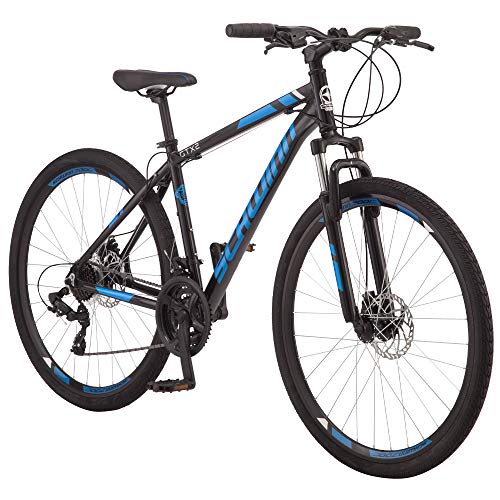
The GTX 2 is the most versatile bike in this shortlist, and the right answer for the rider whose route is not all smooth pavement. Schwinn describes the GTX family as dual-sport, which in practice means a hybrid frame and 700c wheels combined with a suspension fork and tires that stay composed when the surface turns to gravel, hard-packed dirt or a poorly maintained path.
The 21-speed drivetrain provides the range that mixed-surface riding demands, because a loose climb needs a genuinely low gear and a paved descent still rewards a higher one. Mechanical disc brakes are the other headline feature. Discs brake consistently in wet weather and on dusty surfaces, and they are less affected by a wheel running slightly out of true, which is a realistic consideration on a hard-used value bike.
The aluminum dual-sport frame keeps the bike manageable despite the extra hardware, and the specification is aimed at adults who want one bicycle for commuting during the week and light trail exploring at the weekend. That breadth is exactly what many low cost buyers need, because buying one bike that covers two jobs is cheaper than buying two specialised machines.
Be realistic about the fork, though. A suspension fork at this level is a comfort feature for rough surfaces, not a mountain bike component for jumps or rock gardens. Ridden within its intended range, the GTX 2 is a capable and forgiving all-rounder. Ridden as a downhill bike, it would be out of its depth, as would any hybrid in this guide.
The Network 1 is the urban all-rounder of the group. Its aluminum hybrid frame and 700c wheels follow the proven formula, while the suspension fork and suspension seatpost take the edge off potholes, expansion joints and patched asphalt. For a rider whose commute crosses a city every day, that comfort is not a luxury; it is what makes the bike pleasant enough to choose over the car or the bus, week after week.
The 21-speed gearing with twist shifters covers the same wide range as the Discover, and alloy linear-pull brakes keep servicing simple and parts easy to source. Alloy rims reduce rotating weight compared with basic steel rims and resist corrosion better through a wet season.
The Network 1 suits a rider who wants a single, straightforward commuter without the retro styling of the Wayfarer and without the disc brakes and dual-sport intent of the GTX 2. It is a middle path, and for many people the middle path is the smartest low cost purchase: nothing exotic, nothing fragile, and every part chosen to do a familiar job reliably.
Check the frame size against your height before ordering, as the Network family has been offered in different configurations over time, and the listing for the specific version you buy is the authority on its exact specification. That advice applies to every bike here, but it is especially worth repeating for models with several variants under one name.
Sizing: the low cost mistake that costs the most
More value is lost through wrong sizing than through any component choice. A bike that is too large will feel unstable at low speed and strain your shoulders and wrists; a bike that is too small will cramp your knees and make the ride feel like hard work. Use the frame size and rider height guidance on the product listing, measure your inseam if the listing gives a standover figure, and remember that step-through frames make mounting easier for riders with limited flexibility or anyone carrying a child seat or loaded bags.
When the bike arrives, set the saddle height so your knee keeps a slight bend at the bottom of the pedal stroke, then adjust from there in small steps. A saddle set far too low is the most common reason a new low cost bike feels slow and tiring, and fixing it costs nothing.
What to budget for beyond the bike itself
A genuinely low cost purchase still needs a few essentials. A lock is not optional if the bike will ever be left outside a shop or office. Lights are essential for riding at dawn, dusk or in poor weather, and they are a legal requirement in many places after dark. A basic floor pump with the correct valve head will keep the tires at the pressure printed on the sidewall, which improves both speed and puncture resistance. A helmet that fits properly is the most important safety purchase of all.
None of these items needs to be expensive, and all of them protect the value of the bike itself. A well-locked, well-lit, properly inflated bicycle is cheaper to own than a neglected one, because most early failures on value bikes trace back to under-inflated tires, dry chains and skipped adjustments rather than to the frame or wheels.
Maintenance that keeps a low cost bike cheap
Keep the chain clean and lightly lubricated, and the drivetrain will shift properly for far longer. Check brake pads for wear and the cables for smooth movement. Tighten the bolts you fitted during assembly after the first few rides, because new bikes settle in. Learn to fix a puncture at home, since the inner tube is a consumable on any bicycle and the skill turns a ruined day into a short delay.
Most importantly, ride the bike regularly. Bicycles deteriorate faster in storage than in use, and the cheapest bike to own is the one that replaces paid journeys every single week.
Verdict
For most riders, the Schwinn Discover is the best low cost bike here because it includes the fenders and rack that everyday riding demands. The Wayfarer is the simplest and most charming choice for flat routes, the GTX 2 is the pick for mixed surfaces and wet-weather braking, and the Network 1 is a comfortable city commuter with no unnecessary complications. Choose by your route and your terrain, size the bike carefully, and any of these four will deliver what low cost should mean: dependable transport that keeps its value in use, season after season.
A
admin
We compare specs, materials and verified owner reviews before a product earns a spot. Rankings are never paid.
Affiliate disclosure. As an Amazon Associate we earn from qualifying purchases at no extra cost to you. Prices accurate as of the date shown.
Find the best cross cycle bike for cyclocross racing and mixed-surface riding. We compare drop-bar cyclocross and gravel bikes on gearing, disc brakes, tire clearance and frame fit, using manufacturer and listing specifications.
Find the best 120V battery pack for camping, travel and home backup. We compare portable power stations with true 120V AC outlets on capacity, output, weight and recharge speed, using manufacturer and listing specifications.
Looking for the best clone battery for rigid tools? We compare third-party Ridgid 18V replacement packs on fit, capacity claims, charger compatibility and safety.
Find the best battery for a Mercedes S430 (W220). We explain the Group 49 / H8 AGM fitment, the 94R confusion, and compare 95Ah AGM picks on CCA and reserve capacity.
Four 36V lithium ebike batteries matched to a 500W motor, compared on capacity, BMS discharge rating, mount style and connector, plus the checks to run before you buy.
Compare the best CarPlay adapters for turning factory wired CarPlay wireless, with picks for mixed phone households, shared cars, and tidy USB-C setups.

 4. Schwinn Network 1 Hybrid Bike