Key takeaways
- Best hybrid integrated amplifiers with a phono input for vinyl lovers: tube warmth, solid-state power, MM phono stages, and picks that fit real rooms.
The best hybrid integrated amplifiers with a phono input give vinyl listeners the easiest possible path to a complete system. A hybrid design pairs a vacuum tube preamp stage with a solid-state power stage, so a turntable connects directly, speakers connect directly, and no separate phono box or power amplifier is needed. The tube stage adds warmth and a relaxed midrange, while the solid-state stage supplies the control, bass grip, and speaker compatibility that pure tube amplifiers often lack.

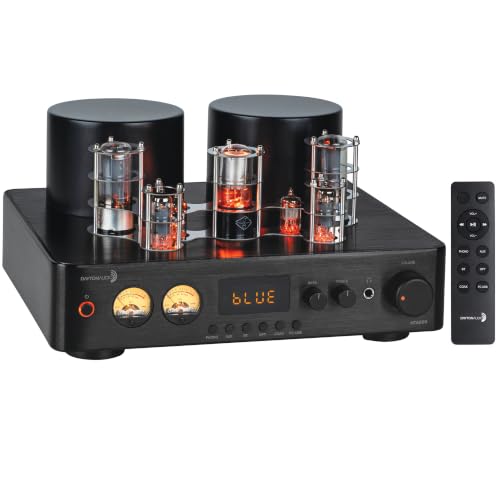
Quick answer: for most rooms and most bookshelf speakers, the Dayton Audio HTA100 is the simplest starting point, with a dedicated moving magnet phono input, Bluetooth, a USB DAC, and a subwoofer output. Listeners with larger rooms or floorstanding speakers should step up to the Dayton Audio HTA200 or the Juson Audio JTA100 for more headroom. Listeners who want the smallest footprint should look at the Douk Audio X1.
Every amplifier in this guide meets the same three tests. It is an integrated amplifier, not a preamp alone. It is a hybrid, with tubes in the preamp stage and a solid-state power stage driving the speakers. And it has a built-in phono input, so a turntable with a moving magnet cartridge can connect without an external phono stage. Amplifiers that lacked a phono input were left out, even when they were popular hybrid models.
Quick Picks
| Product | Best For | Key Spec |
|---|---|---|
| Dayton Audio HTA100 (B0C2WM7MMK) | Most vinyl listeners and first hybrid systems | 100 watts total, MM phono input, Bluetooth 5.0, USB DAC |
| Dayton Audio HTA200 (B0C2WG4BTN) | Larger rooms and harder-to-drive speakers | 100 watts per channel at 4 ohms, MM phono input, remote control |
| Douk Audio X1 (B08M6GGR6P) | Compact vinyl-first setups and desktops | 160 watts per channel maximum at 4 ohms, MM phono input, Bluetooth 5.0 |
| Juson Audio JTA100 (B0FH4P364H) | High-power multi-source systems with headphones | 200 watts RMS total, MM phono input, headphone output, subwoofer output |
How to Choose
Confirm the Phono Input Is a Real Phono Stage
A phono input is not the same as a line-level RCA input. A turntable cartridge produces a very low signal that needs extra gain and a specific equalization curve before it can be amplified to speaker level. A dedicated phono input applies that gain and equalization inside the amplifier. A plain RCA input does not, so a turntable connected to it will sound faint and thin.
Check the rear panel labeling before buying. The models in this guide label the input as phono and include a ground terminal for the turntable ground wire, which helps keep hum out of the signal. If a listing only mentions RCA inputs without naming phono, treat it as a line input.
Match the Phono Stage to Your Cartridge
Almost every built-in phono stage in this category is designed for moving magnet cartridges, the standard fitment on most entry-level and mid-level turntables, so this covers most buyers. Moving coil cartridges produce an even lower output and need more gain, and they are not supported by the phono stages below unless the manufacturer states otherwise.
A moving magnet cartridge pairs directly with these amplifiers. A moving coil cartridge will need a separate phono stage with a moving coil setting, connected to a line input. Using a moving magnet cartridge with a built-in stage keeps the system simple, with fewer boxes and fewer cables.
Understand What Hybrid Means in Practice
In a hybrid integrated amplifier, vacuum tubes sit in the preamp stage, where the signal is shaped, and transistors or a solid-state chip stage handle the power that drives the speakers. The tubes are not driving the speakers directly, which is why hybrid amplifiers can be more compact, run cooler than pure tube amplifiers, and work with a wider range of speakers.
The practical result is a sound many listeners describe as warm and smooth in the midrange, with firmer bass control than a low-power tube amplifier. Tube rolling, swapping the small preamp tubes for compatible alternatives, is possible on some models and changes the tonal balance slightly. It is optional, not a requirement.
Size the Power to the Room and the Speakers
Power ratings need careful reading. Some manufacturers state watts per channel at 8 ohms, some at 4 ohms, and some state a total figure for both channels combined. A few compact models state a maximum figure rather than a continuous RMS figure. Compare like with like.
As a rough guide, 50 watts per channel is ample for efficient bookshelf speakers in a small to medium room. Larger rooms, floorstanding speakers, and lower-sensitivity speakers benefit from 100 watts per channel or more. The HTA100 suits the first case, and the HTA200 and JTA100 suit the second. The Douk Audio X1 states a maximum figure, so read its headline number as a peak capability rather than a continuous rating.
Check the Inputs Beyond Phono
Vinyl may be the reason for buying a hybrid amplifier with a phono input, but most listeners also connect a phone, a computer, a television, or a CD player. Bluetooth is useful for casual streaming. A USB DAC input connects a computer directly. Optical and coaxial digital inputs connect a television or a CD transport. A subwoofer output allows a powered subwoofer to be added later.
Count the sources that will be connected at the same time. The Dayton models and the Juson model cover the widest mix of analog and digital sources. The Douk Audio X1 is deliberately narrower, with Bluetooth, RCA, and phono, which suits a vinyl-first system with one or two extra sources.
Look at Tone Controls, Headphone Output, and Remote Control
Tone controls are a practical feature on a vinyl system. Records vary in mastering, rooms vary in acoustics, and speakers vary in balance. Bass and treble controls allow small adjustments without changing equipment.
A headphone output matters for late-night listening. The Juson Audio JTA100 includes one with a wide impedance range, making it the strongest choice for headphone listeners. A remote control matters when the amplifier sits across the room, and the Dayton HTA200 and the Juson JTA100 include one.
Plan for Ventilation, Tube Care, and Speaker Placement
Vacuum tubes generate heat, and hybrid amplifiers need space around them for airflow. Leave clearance above and to the sides of the chassis, and keep the unit away from enclosed cabinets without ventilation. Preamp tubes in a hybrid design generally last a long time under normal home use, and replacements are widely available for the common types used here.
Bookshelf speakers sound best on stands at ear height, with a small gap from the rear wall where possible. A turntable should sit on a level, stable surface away from the speakers, because vibration can feed back into the cartridge. Keep the phono cable short, connect the ground wire, and route it away from power cables to keep hum low.
The Best Hybrid Integrated Amplifiers With A Phono Input Reviewed
Dayton Audio HTA100 (B0C2WM7MMK)
The Dayton Audio HTA100 is the most balanced starting point in this guide, and it suits listeners who want tube character, a real phono input, and modern connectivity without a large chassis or a complicated setup. It is a hybrid integrated amplifier with vacuum tubes in the preamp circuit and a Class A/B solid-state output stage. The front panel carries exposed tubes, analog VU meters, a large volume knob, and bass and treble controls.
Power is rated at 100 watts total, with 65 watts per channel at 4 ohms according to the Amazon listing. That is enough for most bookshelf speakers in a small to medium room. Inputs include a dedicated phono input with a ground connection, a line-level RCA input, Bluetooth 5.0, a USB DAC input, and optical and coaxial digital inputs. A subwoofer output and a front-panel headphone jack are also included.
The phono stage is designed for moving magnet cartridges, which covers the turntables most buyers own. Connect the turntable RCA cables to the phono input, connect the ground wire to the ground terminal, and select phono on the front panel. The USB DAC input is useful for a computer, and Bluetooth handles a phone or tablet without cables.
Who it suits: first-time vinyl listeners, small to medium rooms, bookshelf speakers, and anyone who wants one box for a turntable, a computer, and a phone. Who should skip it: listeners with large rooms, floorstanding speakers, or low-sensitivity speakers who need substantially more headroom should consider the HTA200 or the JTA100 instead.
Dayton Audio HTA200 (B0C2WG4BTN)
The Dayton Audio HTA200 takes the same hybrid idea as the HTA100 and scales it up for larger systems. It uses vacuum tubes in the preamp circuit with a Class A/B solid-state output stage, and it is rated at 100 watts per channel at 4 ohms, for 200 watts total. That extra headroom makes it a better match for floorstanding speakers and larger rooms.
Connectivity matches the larger brief. The HTA200 includes a dedicated phono input with a ground connection, a line-level AUX input, Bluetooth 5.0, a USB DAC input, and optical and coaxial digital inputs. A subwoofer output is included, and a remote control is supplied, which matters when the amplifier sits across a living room. The front panel keeps the HTA100 visual language, with exposed tubes, VU meters, tone controls, and a motorized volume control.
The phono stage is again designed for moving magnet cartridges. The difference is in scale and control. Bass stays firmer when the volume rises, and the amplifier is less likely to run out of headroom on dynamic passages.
Who it suits: larger rooms, floorstanding speakers, less sensitive speakers, and listeners who want a remote control and a full set of digital inputs alongside vinyl. Who should skip it: listeners with a small desktop setup or efficient bookshelf speakers in a small room will not use the extra power, and the larger chassis needs more shelf space and ventilation.
Douk Audio X1 (B08M6GGR6P)

The Douk Audio X1 is the compact choice in this guide, and it suits listeners who want a small hybrid amplifier with a genuine moving magnet phono input and little else to get in the way. It pairs vacuum tubes in the preamp stage with a solid-state Class D power stage, and it is rated at a maximum of 160 watts per channel at 4 ohms. That figure is a maximum rating rather than a continuous RMS rating, and the X1 is best paired with efficient bookshelf speakers in a small to medium room.
Inputs are deliberately focused. The X1 includes a moving magnet phono input, a stereo RCA line input, and Bluetooth 5.0 with aptX support. A dedicated subwoofer output allows a powered subwoofer to be added for a 2.1-channel setup. Bass and treble controls sit on the front panel, along with a bass boost control, and the compact aluminum chassis fits easily on a desk or a small shelf.
The phono stage is the reason the X1 earns a place here. Many compact hybrid amplifiers in this size class have only a line-level RCA input, which means a turntable needs an external phono stage. The X1 has a dedicated moving magnet phono input with a ground connection, so a turntable connects directly.
Who it suits: desktop systems, small rooms, efficient bookshelf speakers, and vinyl-first listeners who want a compact amplifier with Bluetooth and a subwoofer output. Who should skip it: listeners who need optical, coaxial, or USB digital inputs, a headphone output, or a remote control should choose the Dayton HTA100 or the Juson JTA100 instead, because the X1 does not include those features.
Juson Audio JTA100 (B0FH4P364H)

The Juson Audio JTA100 is the highest-power option in this guide, and it suits listeners who want a hybrid amplifier that can serve as the center of a multi-source system. It is a hybrid integrated amplifier with a vacuum tube preamp stage and a transistor Class AB power stage, rated at 200 watts RMS total. The chassis is larger and heavier than the compact models.
The JTA100 includes a dedicated phono input for moving magnet cartridges, plus AUX, coaxial, and optical inputs, Bluetooth 5.0, and a PC-USB input. A headphone output supports headphones from 16 to 600 ohms, with a gain switch, and a subwoofer output allows a powered subwoofer to be added. A remote control, VU meters, and an LED display complete a feature set that suits a living-room system used for vinyl, streaming, digital sources, and headphones.
Connect the turntable to the phono input, connect the ground wire, and select phono. The headphone output is useful for late-night listening, because the same amplifier serves speakers during the day and headphones at night. Tone controls adjust bass and treble for different records and rooms.
Who it suits: larger rooms, floorstanding speakers, multi-source systems, and listeners who want a headphone output and a remote control in the same amplifier. Who should skip it: listeners who want the smallest possible chassis, or who only need phono and Bluetooth, will find the JTA100 larger and more complex than necessary, and the Dayton HTA100 or the Douk Audio X1 will fit better.
What to Check Before You Buy
Start with the cartridge. Confirm whether the turntable has a moving magnet cartridge, because the built-in phono stages in this guide are designed for moving magnet cartridges. If the turntable has a built-in phono preamp as well, switch it off when using the amplifier phono input, because a signal should not run through two phono stages at once.
Next, check speaker sensitivity and impedance. Speakers rated at 4 to 8 ohms are the normal match for these amplifiers. Efficient speakers need less power, while less sensitive speakers need more, and a small room needs far less power than a large open-plan space.
Check the physical fit. Measure the shelf, allow clearance above the amplifier for tube heat, and confirm that the rear panel is reachable for the turntable, ground wire, and speaker cables. The turntable should sit on a stable, level surface.
Finally, check the inputs one more time against the sources that will actually be used. List every source, from the turntable to a phone, a computer, a television, and a CD player, and confirm that each one has a matching input on the amplifier. A subwoofer output, a headphone output, and a remote control are worth confirming at the same time.
FAQ
Do all hybrid integrated amplifiers have a phono input?
No. Many hybrid integrated amplifiers have only line-level RCA inputs and digital inputs, with no phono stage at all. The Vincent SV-500 is a hybrid integrated amplifier without a phono input, and the Fosi Audio MC331 and the Douk Audio ST-01 PRO are hybrid models that also lack a dedicated phono input. Check the input list before buying, and do not assume that a tube amplifier includes a phono stage.
Can I connect a turntable without a phono input?
A turntable can connect to a line input only if the turntable has a built-in phono preamp, or if a separate external phono stage sits between the turntable and the amplifier. Without one of those, the signal will be too quiet and will lack bass. The amplifiers in this guide include a built-in phono stage, so a turntable with a moving magnet cartridge connects directly.
What is the difference between a moving magnet and a moving coil cartridge?
A moving magnet cartridge is the common type fitted to most entry-level and mid-level turntables, and it produces a higher output that suits the built-in phono stages in this guide. A moving coil cartridge produces a lower output and needs a phono stage with a moving coil setting.
Do hybrid amplifiers need tube replacement?
Preamp tubes in a hybrid amplifier last a long time under normal home use, and they are not driven as hard as power tubes in a pure tube amplifier. When they eventually wear, they can be replaced with compatible types. Tube replacement is a maintenance task to plan for over years, not a frequent chore.
Is a subwoofer output useful on a hybrid integrated amplifier?
A subwoofer output is useful when bookshelf speakers need help with deep bass, or when a room is large enough that a powered subwoofer adds weight to music and film sound. All four amplifiers in this guide include a subwoofer output, so a powered subwoofer can be added later without replacing the amplifier.
Bottom Line
The best hybrid integrated amplifiers with a phono input keep a vinyl system simple: a turntable connects directly, speakers connect directly, and the tube preamp stage adds warmth while the solid-state power stage supplies control. For most listeners, the Dayton Audio HTA100 is the right starting point. Listeners with larger rooms or more demanding speakers should choose the Dayton Audio HTA200 or the Juson Audio JTA100. Listeners who want the smallest footprint for a vinyl-first desktop system should choose the Douk Audio X1. Confirm the cartridge type, match the power to the room and speakers, and check the input list against every source that will be connected.
Disclosure: As an Amazon Associate, we may earn from qualifying purchases.