Key takeaways
- The best Class-D integrated amplifiers for a dedicated listening room compared: Hypex, UcD and PFFB designs with built-in DACs, streaming and room correction.
A dedicated listening room changes what you should ask of an amplifier. The room is treated, the speakers are positioned with care, and listening sessions are long, so the amplifier has to stay composed at low volume, control difficult speaker loads without strain, and disappear into the background during quiet passages. Modern Class-D integrated amplifiers answer that brief better than their reputation from a decade ago suggests. Current designs built around Hypex, UcD and advanced feedback chipsets deliver clean, load-independent power from compact chassis that run cool enough to sit in a closed rack for hours.


This guide compares five Class-D integrated amplifiers that suit a dedicated listening room: the Cambridge Audio Evo 150 SE, the NAD C 700 V2, the Marantz MODEL M1, the Denon Home Amp and the WiiM Amp Ultra. Every pick is an integrated amplifier with a Class-D output stage, a built-in DAC and streaming or digital inputs, so each one can anchor a serious two-channel system without a stack of separate boxes. They differ in power, in the amplifier technology inside, and in how they handle room correction, vinyl and subwoofer integration, which is exactly where a listening-room decision should be made.
Disclosure: As an Amazon Associate, this site may earn from qualifying purchases made through links in this article, at no additional cost to you.
Why Class-D Works in a Dedicated Listening Room
The case for Class-D in a serious room rests on three practical points. First, efficiency: a Class-D output stage converts most of its input power into sound rather than heat, so the amplifier can run long sessions without warming the room or stressing its own components. In a small, well-sealed listening room, the heat from a large conventional amplifier is a genuine comfort and consistency problem, and a cool-running integrated removes it.
Second, control. The best current Class-D modules hold their frequency response steady regardless of the speaker connected, and they keep distortion low across the whole power range rather than only at a single measured point. Designs that take feedback after the output filter, such as post-filter feedback layouts, are notably indifferent to speaker impedance swings, which matters with the dips and phase angles of real loudspeakers.
Third, integration. Because the amplifier stage is compact, manufacturers can fit a high-quality DAC, a streamer, a phono stage and even room correction into one chassis. Fewer boxes means a shorter signal path and fewer interconnects, and in a dedicated room it also means a cleaner rack and simpler day-to-day use.
What to Look For
Amplifier technology. The module or chipset inside shapes the sound more than the headline wattage. Hypex NCore and NCOREx stages, NAD’s HybridDigital UcD designs and TI-based stages with post-filter feedback are the proven options at this level. Fully digital designs from Marantz and Denon take a different route, keeping the signal digital until the speaker terminals.
Power into real loads. Look for a published figure into 4 ohms as well as 8 ohms, and for language about continuous power with both channels driven. A listening room with demanding floor-standing speakers rewards current delivery more than a big number measured into an easy load.
DAC and digital inputs. A dedicated room usually mixes sources: a streamer, a CD transport, a television, perhaps a computer. Check the DAC chip, the supported sample rates, and whether there is a USB input, HDMI eARC for the television, and enough optical and coaxial inputs for your sources.
Room correction. Correction systems such as Dirac Live, RoomPerfect-style processing and WiiM’s RoomFit can tame the bass problems that even a treated room keeps. If your room is already well treated, correction is a refinement; if it is a converted spare room, it can be the single biggest upgrade in the chain.
Subwoofer integration. A subwoofer output is common; adjustable crossover and bass management are rarer and more useful. NAD and WiiM stand out here for the control they give over the handover between speakers and sub.
Phono stage. Vinyl listeners should confirm a moving magnet input. Three of the five amplifiers below include one; the Marantz and the WiiM do not, so a turntable paired with them needs its own phono stage or a built-in one in the deck.
Cambridge Audio Evo 150 SE
The Evo 150 SE is the flagship one-box option in this group and the most powerful, with 150 watts per channel into 8 ohms from a Hypex NCOREx Class-D stage that Cambridge tunes in-house. That combination of genuine headroom and a load-tolerant module makes it a confident partner for full-range floor-standing speakers in a treated room, where it can play quietly with composure and still have reserve for orchestral peaks.
Its ESS Sabre ES9018K2M DAC feeds the amplifier from a wide spread of sources. The StreamMagic Gen 4 platform handles streaming from the major services with support for high-resolution playback, and the rear panel adds two optical inputs, a coaxial input, asynchronous USB audio, HDMI eARC and Bluetooth with aptX HD. Analogue sources are unusually well served for a streaming amplifier: there is a line input on RCA, a balanced XLR input for a serious disc player or external DAC, and a moving magnet phono stage for a turntable.
For a listening room, the details add up. There are two sets of speaker terminals, so bi-wiring or a second pair of speakers is possible. The interchangeable side panels, in walnut or a textured black finish, let the unit sit comfortably in a furnished room rather than a rack of black boxes. There is no built-in room correction, so the Evo 150 SE suits a room that has already been treated and measured, with the amplifier asked to do amplification and source duty only. If that matches your room, it is the most complete single-box answer here.
Amazon ASIN: B0FCG3KD8G
NAD C 700 V2
The C 700 V2 is the thinking listener’s option, built around NAD’s HybridDigital UcD Class-D stage with 80 watts per channel of continuous power into 8 or 4 ohms and 120 watts of instantaneous power for transients. NAD rates its amplifiers conservatively and with both channels driven, and the UcD design is known for holding its character as speaker loads change, which is exactly the behavior a dedicated room exposes.
The digital side runs through an ESS Sabre ES9028 DAC and the BluOS streaming platform, which supports high-resolution playback up to 24-bit/192kHz from a long list of services, along with AirPlay 2, Chromecast, Spotify Connect and Tidal Connect. A 5-inch colour display on the solid aluminium front panel shows artwork and settings, and the unit can be run from the included remote or the BluOS app.
Two features make the C 700 V2 particularly relevant to a dedicated room. It is Dirac Live ready, so with the optional licence and a measurement microphone it can correct the room’s bass response and store up to five profiles for different seating positions or sources. And it can grow beyond stereo: add BluOS-enabled players and a subwoofer and it becomes the front end of a 4.1-channel setup. A moving magnet phono input and an HDMI eARC input cover vinyl and television. Listeners who want correction headroom and a mature streaming ecosystem in a compact chassis will find this the most flexible amplifier in the group.
Amazon ASIN: B0DCHKFQ4R
Marantz MODEL M1

The MODEL M1 takes the fully digital approach: its switching amplifier topology keeps the signal in the digital domain end to end, applying Marantz Musical Digital Filtering before conversion at the output stage. It delivers 100 watts per channel into 8 ohms and 125 watts per channel into 4 ohms, strong figures for a chassis barely wider than a hardback book, and it was designed and built by the Shirakawa Audio Works team in Japan.
Streaming runs on HEOS, with Wi-Fi, AirPlay 2 and Bluetooth, and high-resolution support up to 24-bit/192kHz including DSD playback. The MODEL M1 is also the strongest television partner here: its HDMI eARC input decodes Dolby Digital Plus on board, so film and television sound from a TV in the room plays as sent rather than downmixed by the set. A subwoofer output with adjustable settings lets a 2.1 system fill out the bottom end.
The trade-offs are about analogue sources. There is a single RCA line input and no phono stage, so a vinyl setup needs a turntable with a built-in phono preamp or a separate one. There is also no front-panel display to speak of; control lives in the HEOS app. For a listening room built around streaming and a screen, with one analogue source at most, the M1’s compact size, cool running and clean digital path make it an elegant fit.
Amazon ASIN: B0D5CM6X9M
Denon Home Amp
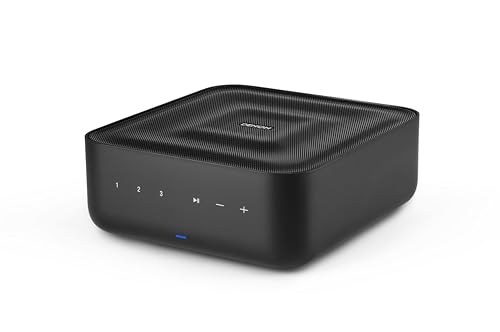
The Denon Home Amp shares its underlying concept with its Marantz sibling but wears Denon’s tuning and the same HEOS ecosystem. Its Class-D stage delivers 100 watts per channel, enough for confident listening levels with most standmount and floor-standing speakers in a dedicated room, and the compact, low-profile chassis is easy to place on a shelf or in a rack where a full-width amplifier would crowd everything else.
Digital playback covers high-resolution files in ALAC, FLAC and WAV up to 24-bit/192kHz, plus DSD at 2.8 and 5.6 megahertz, streamed over Wi-Fi through HEOS or sent by AirPlay 2 and Bluetooth. An HDMI eARC input with Dolby Digital Plus decoding handles television sound, and a subwoofer output supports a 2.1 configuration for rooms where the main speakers benefit from help below the crossover point.
Like the Marantz, the Home Amp keeps analogue provision light: it is aimed at listeners whose sources are a network, a television and perhaps one line-level component. Within that brief it is a tidy, capable amplifier, and for households already invested in HEOS speakers elsewhere, it slots into a whole-home system while still anchoring the main listening room. It runs cool, asks for little shelf space, and its straightforward control scheme suits a room that is used for listening rather than for tweaking equipment.
Amazon ASIN: B0D6XCGVCZ
WiiM Amp Ultra
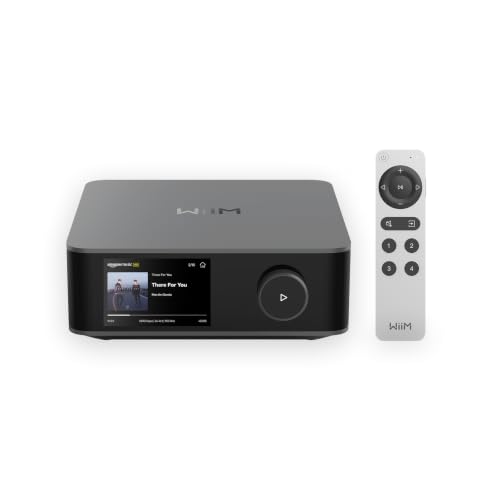
The WiiM Amp Ultra is the accessible entry in this group, and its specification explains why it belongs in the conversation. Dual TI TPA3255 Class-D amplifier chips work with post-filter feedback, a layout that keeps performance consistent across different speaker loads, and output is rated at 100 watts per channel into 8 ohms and 200 watts per channel into 4 ohms. An ESS ES9039Q2M Sabre DAC handles conversion, and the front panel carries a 3.5-inch glass touchscreen for direct control alongside the WiiM Home app and the included voice remote.
Its room correction, called RoomFit, is built in rather than an optional extra, which matters for a listening room that doubles as a living space or has known bass issues. Streaming is broad, covering the major services with Chromecast, Spotify Connect and Tidal Connect among the routes in, plus HDMI ARC for television, optical and line inputs, and a subwoofer output with proper bass management in the app. Wi-Fi 6 keeps the network side current.
Two honest limitations: there is no phono input, so vinyl needs its own stage, and the Amp Ultra cannot receive AirPlay, so Apple households should plan around Chromecast or the WiiM app instead. Neither point undermines its core appeal: genuine Class-D power, a strong DAC and built-in correction in a compact aluminium chassis that leaves more of the budget for the speakers and the room itself.
Amazon ASIN: B0F995W2NG
How to Choose for Your Room
Start with the room, not the amplifier. If the space is treated and your speakers are demanding, the Cambridge Evo 150 SE brings the most power and the richest input set, including balanced connections and a phono stage. If the room still fights you in the bass, the NAD C 700 V2 with Dirac Live, or the WiiM Amp Ultra with RoomFit built in, will do more for the final sound than extra watts.
If the listening room doubles as the film room, the Marantz MODEL M1 and Denon Home Amp lead with their eARC inputs and Dolby Digital Plus decoding, and their small footprints suit rooms where the screen dominates. Vinyl listeners should shortlist the Cambridge and the NAD for their moving magnet stages. And if the system will grow, the NAD’s path to a 4.1 BluOS setup and the HEOS pair’s whole-home reach are worth weighing now rather than later.
Whichever you choose, keep the basics in place: give the amplifier ventilation even though it runs cool, use the correction routine after the speakers are in their final positions, and revisit it whenever the room changes. A Class-D integrated chosen this way will serve a dedicated listening room for years.
Frequently Asked Questions
Is Class-D good enough for serious listening? Current designs from Hypex, NAD and TI-based stages with post-filter feedback measure and sound clean, with low distortion across the power range and stable behaviour into difficult loads. In a treated room, the amplifier is rarely the limiting factor.
How much power does a listening room need? Less than most people assume at normal levels, but headroom matters for peaks and for low-sensitivity speakers. The amplifiers here range from 80 to 150 watts per channel into 8 ohms, and all publish a 4-ohm figure, which is the more telling number.
Do I need room correction if my room is treated? Treatment handles reflections and decay; correction handles the low-frequency peaks and dips caused by room dimensions. Many listeners use both, with correction applied mainly in the bass, which is how the Dirac implementation on the NAD is commonly configured.
Can these amplifiers drive 4-ohm speakers? Yes. Each model here is specified for 4-ohm loads, and the Class-D stages used are known for stable output as impedance falls. Check the speaker maker’s minimum impedance figure against the amplifier’s stated range before pairing.
Which of these works best with a turntable? The Cambridge Evo 150 SE and the NAD C 700 V2 include moving magnet phono stages. The Marantz, Denon and WiiM models need a turntable with a built-in phono stage or a separate one.