We independently review everything we recommend. When you buy through our links, we may earn a commission. As an Amazon Associate we earn from qualifying purchases.
Best Hobby Greenhouses: Polycarbonate Kits, a Cedar Walk-In and a Tunnel House
The best hobby greenhouses compared on footprint, frame and glazing: twin-wall polycarbonate kits, a cedar walk-in with a fan, and a roomy PE tunnel house.
The best hobby greenhouses compared on footprint, frame and glazing: twin-wall polycarbonate kits, a cedar walk-in with a fan, and a roomy PE tunnel house.
As an Amazon Associate, we earn from qualifying purchases made through links on this page.
A hobby greenhouse is a permanent or semi-permanent backyard structure sized for home growers rather than commercial production: big enough to walk into, work in and overwinter plants in, small enough to ship as a kit and assemble on a domestic plot. The five kits below cover the three construction families that dominate this category. Three are aluminium-framed polycarbonate kits from Palram’s Canopia line, each glazed differently. One is a cedar-framed walk-in from Backyard Discovery with powered ventilation. The last is a steel hoop tunnel from Outsunny under a polyethylene film cover, which trades rigidity for floor area.
Every figure in this guide comes from the manufacturer’s own published specification for that model: external dimensions, panel construction, frame material and, where the maker prints them, wind and snow figures. Those load figures are the manufacturers’ own test claims, not independent certifications, and all of them assume the structure is anchored exactly as the manual directs. Where a maker does not publish a figure, this guide says so rather than filling the gap, because an unpublished snow figure is itself a buying fact for anyone gardening where winters bite.
What to Look for in a Hobby Greenhouse
Footprint and headroom. Hobby kits cluster between roughly 40 and 100 square feet of floor. Width matters as much as area: a house about six feet wide fits one bench and a narrow working aisle, while eight feet or more lets you bench both sides. Check the peak height against the tallest plants you grow and against your own height at the door, since door openings are always lower than the ridge.
Glazing. Twin-wall polycarbonate diffuses light, which softens shadows and reduces leaf scorch, and its air gap insulates better than a single sheet. Clear polycarbonate passes the most light, which suits sun-hungry crops and shady gardens, but loses heat faster after dark. Thicker multi-wall panels, such as the 10 millimetre four-wall panels on the cedar kit below, raise insulation further. Polyethylene film is the lightest and most forgiving cover, but it is a wear item that ages in ultraviolet light and eventually needs replacing, unlike rigid panels.
Frame. Aluminium frames do not rust and keep the structure light. Galvanised or powder-coated steel is heavier and is used both for rigid frames and for hoop tunnels. Cedar resists rot naturally and looks at home in a garden, but it is by far the heaviest option here and the frame timbers need the periodic care the maker describes.
Ventilation. A single roof vent is the minimum for summer temperature control. Louvre windows add low-level intake air, roll-up tunnel sides dump heat fastest of all, and a thermostat-activated exhaust fan, fitted to the cedar kit below, moves air without anyone opening anything by hand.
Published load figures and anchoring. Wind and snow figures are only comparable when a maker actually prints them. Anchor kits, buried cover edges and a level base are not optional extras; the figures assume them.
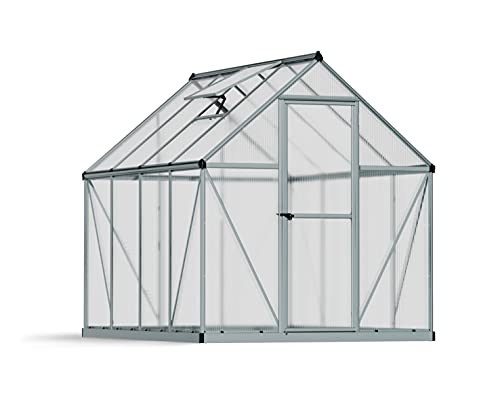
The Mythos is the reference point for this category: a 6 ft 1 in by 8 ft 1 in footprint standing 6 ft 10 in at the ridge, glazed all round in 4 millimetre twin-wall polycarbonate. Palram’s listing states the panels pass more than 70 percent of incoming light while blocking harmful ultraviolet, and the twin-wall construction diffuses that light so plants are less likely to scorch on bright days. The frame is rust-resistant aluminium on a heavy-duty galvanised steel base, with integrated rain gutters, one adjustable roof vent and a hinged door with a magnetic catch and a lockable handle. Palram publishes a snow load of 75 kilograms per square metre and a wind resistance of 90 kilometres per hour for the kit, and covers it with a five-year limited warranty.
Who it suits. First-time greenhouse owners who want one durable kit with published numbers behind it, on a footprint that fits a bench along one side and a working aisle.
Limitations. At just over six feet wide it is a one-bench house, so serious propagation quickly outgrows it. There is one roof vent and no louvre, so midsummer heat control leans on shading and door venting. No floor is included, and the load figures depend on the base being fixed to a suitable foundation.
The Hybrid shares the Mythos footprint, frame, galvanised base, gutters, roof vent, lockable door and five-year limited warranty, and it carries the same published snow load of 75 kilograms per square metre and wind resistance of 90 kilometres per hour. The difference is the glazing recipe: crystal-clear polycarbonate wall panels, which Palram puts at more than 90 percent light transmission, under a 4 millimetre twin-wall roof that keeps some insulation and diffusion overhead where heat loss and midday scorch are greatest. It is the same aluminium structure tuned for brightness rather than for insulation.
Who it suits. Growers on shaded plots, and anyone raising light-hungry crops such as tomatoes and peppers, who would rather have maximum light through the walls and manage temperature with the roof vent and shading.
Limitations. Clear single-skin walls lose heat faster than twin-wall once the sun drops, so the Hybrid is the weaker choice for pushing an unheated house deep into winter. The one-bench width and single roof vent limits of the Mythos apply here too, and the clear panels show algae and splashes more readily than diffused ones.
The Willow takes the opposite approach to the aluminium kits. Its frame is FSC-certified, kiln-dried cedar, naturally resistant to rot and insects, glazed with 10 millimetre commercial-grade four-wall polycarbonate that the maker credits with an R-2.1 insulation value. The 9 by 6 foot footprint gives 54 square feet of interior with 13 linear feet of lower staging shelves and an interior water spigot fed by hose hook-ups inside and out. Ventilation is active as well as passive: a thermostat-activated exhaust fan plus an easy-open casement window. A built-in PowerPort hub provides three electrical outlets and USB ports for fans, misters or lights. Backyard Discovery’s Pro-Tect testing qualifies the structure for 2,800 pounds of roof weight and winds of 100 miles per hour, and the kit carries a five-year warranty.
Who it suits. Gardeners who want a greenhouse that reads as garden furniture, plan to grow through winter in a cold or windy area, and value powered ventilation and water and power already plumbed in.
Limitations. At 570 pounds it is several times heavier than the aluminium kits and a substantial assembly project that wants a prepared, level foundation. Cedar is a natural material that needs the upkeep the maker describes to keep its finish, and the powered fan is only useful where you can run electricity to the structure.
The Oasis is the ornamental entry: a six-sided hexagon roughly eight feet across the corners and 8 ft 9 in to the peak, giving about 42 square feet of floor with no corners to waste heat against. The panels are crystal-clear polycarbonate passing more than 90 percent of light with full ultraviolet protection, held in a powder-coated frame of galvanised steel and aluminium finished in anthracite grey. Access is through a wide double door, 3 ft 8 in across, with a lockable handle, and ventilation comes from an adjustable side louvre window; gutters are built in. Palram’s listing qualifies the Oasis for winds up to 55 miles per hour and the warranty runs five years.
Who it suits. Gardeners who want the greenhouse to be a visible feature of the garden as much as a growing space, and who like the idea of standing in the centre surrounded by plants on a perimeter bench ring.
Limitations. Palram does not print a snow-load figure for this model on its product page, so cautious owners in snowy areas should clear the roof rather than trust it. The hexagonal plan fits rectangular benches and staging awkwardly, and the clear glazing gives the least insulation of the three Palram kits here.
The Outsunny tunnel is the floor-area pick: 118.1 by 118.1 inches of ground space under a 78.7 inch peak, roughly 100 square feet, for in-ground beds rather than benches. A powder-coated steel hoop frame carries a two-layer polyethylene cover with a reinforcement grid woven in to resist tearing; Aosom, which makes Outsunny, puts the cover material at 140 grams per square metre and its light transmission at about 85 percent. Entry is through a roll-up zipper door, and mesh windows roll up along the sides for ventilation. The cover’s extended edges are designed to be buried in soil, which seals the base and adds hold-down strength alongside the frame fixings.
Who it suits. Growers who want maximum covered ground for vegetable beds and larger plant collections, and who treat a greenhouse as a season-extending structure rather than a permanent building.
Limitations. The maker’s windproof classification for this model is level 4, meaning wind speeds below 17.5 miles per hour, so it belongs in a sheltered spot and is not a storm-country structure. No snow figure is published. The film cover is a consumable that will age in sunlight over the seasons in a way rigid polycarbonate does not, and the zipper door is less durable and less secure than a hinged, lockable one.
Comparison Table
Model
Footprint
Frame
Glazing or cover
Ventilation
Published wind figure
Palram Canopia Mythos 6 x 8
6 ft 1 in x 8 ft 1 in
Aluminium, steel base
4 mm twin-wall polycarbonate
1 roof vent
90 km/h
Palram Canopia Hybrid 6 x 8
6 ft 1 in x 8 ft 1 in
Aluminium, steel base
Clear walls, twin-wall roof
1 roof vent
90 km/h
Backyard Discovery Willow 9 x 6
9 x 6 ft
Cedar
10 mm four-wall polycarbonate
Exhaust fan, casement window
100 mph
Palram Canopia Oasis Hex
About 8 ft across
Steel and aluminium
Clear polycarbonate
Side louvre window
55 mph
Outsunny 10 x 10 Tunnel
10 x 10 ft
Powder-coated steel hoops
Two-layer PE film, 140 gsm
Roll-up mesh windows
Level 4, below 17.5 mph
Frequently Asked Questions
Does a hobby greenhouse need a foundation?
It needs a level, stable base and the anchoring the manual specifies. The Palram kits include a galvanised steel base designed to be fixed down, the Willow ships with anchors and hardware, and the Outsunny relies on buried cover edges and frame fixings. Published wind and snow figures assume that anchoring is in place.
Which is better, twin-wall or clear polycarbonate?
Twin-wall diffuses light and insulates better, which helps in bright sun and cold nights. Clear panels pass more light, over 90 percent on the models here, which helps on shaded plots and with sun-loving crops, at the cost of faster heat loss. The Hybrid splits the difference with clear walls and a twin-wall roof.
Can these greenhouses stay up through winter?
The rigid kits with published snow figures, the two 6 x 8 Palram models at 75 kilograms per square metre and the Willow at 2,800 pounds of roof weight, are built with winter in mind. The Oasis has no snow figure on its product page and the Outsunny tunnel publishes none either, so both call for clearing snow promptly or, for the tunnel, seasonal use.
How long will a polyethylene tunnel cover last?
Aosom does not publish a service-life figure for the 140 gsm cover. Film covers age under ultraviolet light and should be budgeted as a replaceable part of the structure, unlike polycarbonate panels, which the makers here cover with five-year warranties.
What size should a first hobby greenhouse be?
A 6 x 8 foot kit is the usual first step: one bench, one aisle and room to overwinter tender plants. Step up to a 9 x 6 or larger if you want staging on both sides or plan to work inside with a potting bench, and choose a tunnel if your growing is in ground beds rather than pots.
Conclusion
For most backyard growers the Palram Canopia Mythos 6 x 8 is the soundest default: twin-wall glazing, a rust-free frame and published load figures in a manageable footprint. Choose the Hybrid instead if your plot is shaded or your crops chase light. The Backyard Discovery Willow is the pick for cold, windy gardens and for anyone who wants power, water and powered ventilation built in, while the Oasis Hex earns its place as a garden feature. The Outsunny tunnel gives the most growing ground of the five and asks the least of your site preparation, provided it sits somewhere sheltered and comes down or gets cleared when the weather turns serious.
A
admin
We compare specs, materials and verified owner reviews before a product earns a spot. Rankings are never paid.
Affiliate disclosure. As an Amazon Associate we earn from qualifying purchases at no extra cost to you. Prices accurate as of the date shown.
The best looking Titan armor sets in Destiny 2, ranked for collectors. Compare the top Titan figures and statues that bring the iconic armor to your shelf.
The best portable iPhone chargers are power banks matched to your port. Compare five MagSafe, built-in cable, and plug-in battery packs for iPhone here.
Four belt-drive turntables that change speed electronically, by switch, button or servo control, with no belt moving by hand: Pro-Ject, Fluance and Denon picks compared.
Looking for the best tube integrated amplifiers for dedicated listening rooms? Compare four valve amps for warm sound, speaker matching, and room size.
Compare five three-way floor-standing speakers with removable grilles, with driver layouts, amplifier matching and room-fit guidance for November 2026.

 Palram Canopia Mythos 6 x 8
 Palram Canopia Hybrid 6 x 8
 Backyard Discovery Willow 9 x 6
 Palram Canopia Oasis Hex
 Outsunny 10 x 10 Walk-In Tunnel Greenhouse