Key takeaways
- Compare two logging bench multimeters with true-RMS AC measurement, internal data records and PC export for lab, repair and long-run monitoring work.
A logging bench multimeter is bought for the run you cannot watch. A power supply drifts after an hour, a charger cycles overnight, or a distorted AC waveform makes an average-responding meter read low, and a single spot reading answers none of it. The real decision is therefore twofold: the meter must record readings over time without you standing there, and its AC voltage and current figures must be true-RMS so non-sinusoidal waveforms are reported honestly rather than approximated.
This guide is for electronics hobbyists, repair technicians, and small-lab users who need that combination on a fixed bench. Both picks below are benchtop digital multimeters whose Amazon titles and specifications confirm true-RMS AC measurement and a way to log data, either internally or to a computer. They were chosen from their Amazon product titles and specification lists, then matched against manufacturer information, so the differences that matter here are resolution, logging depth, interfaces, and how each meter fits a crowded or a precision-focused bench.
Quick Picks
As an Amazon Associate we earn from qualifying purchases
| Product | Best for | Key spec from title |
|---|---|---|
| Rigol DM3058E | Higher-resolution lab work | 5.5 digit bench digital multimeter, 123,000 counts, True-RMS |
| OWON XDM1041 | Compact benches and stored records | USB/RS232 digital multimeter, 55,000 counts, desktop temperature meter |
How to Choose
Logging depth and how records leave the meter
Decide first where logged data should live. A meter with internal record storage, such as the OWON XDM1041 with a stated logging length of 1,000 points, can capture a run on its own and transfer the records to a computer afterwards, which suits an overnight battery or supply test. A meter that logs through a PC connection, such as the Rigol DM3058E over USB or RS-232, depends on the computer staying attached, but the file is already where your analysis happens. Match the logging interval to the event: fast cycling loads need short intervals, while slow thermal drift wastes storage at the fastest setting.
True-RMS AC range and bandwidth
True-RMS only helps if the range and frequency coverage fit your signals. Check the AC voltage ceiling, the AC current ceiling, and the frequency span over which the true-RMS specification applies. The Rigol DM3058E lists true-RMS AC voltage from 200 mV to 750 V and AC current from 20 mA to 10 A, while the OWON XDM1041 lists true-RMS AC voltage up to 750 V with a narrower low-frequency focus. A meter used on mains-powered supplies, motor drives, or dimmed loads needs honest readings on distorted waveforms, not just on clean sine waves from a bench outlet.
Resolution, counts, and basic accuracy
Resolution decides whether a logged trend is actually visible. A 5.5-digit, 123,000-count meter such as the Rigol DM3058E can show small changes on a stable rail that a lower-count display would round away, and its stated DC voltage accuracy supports calibration-adjacent work. A 55,000-count meter such as the OWON XDM1041, with DC voltage accuracy up to 0.05 percent, still resolves far more than a typical handheld and is enough for most repair and monitoring tasks. Choose by the smallest change you need to prove, not by digit count alone, because logging a noisy signal at excess resolution only produces longer, noisier files.
Interfaces, display, and bench footprint
Finally, check how the meter joins the rest of the bench. USB and RS-232 connections support remote control and scripted logging through standard commands, which matters if readings must land in the same workflow as other instruments. A dual display helps when you want a second quantity, such as frequency alongside AC voltage, visible during a run. Footprint matters too: a compact desktop meter leaves room for the device under test, while a larger full bench instrument usually brings more digits and broader ranges. Confirm the power arrangement as well, since a mains-powered bench meter is not a portable field tool.
The 2 Best Options
Rigol DM3058E

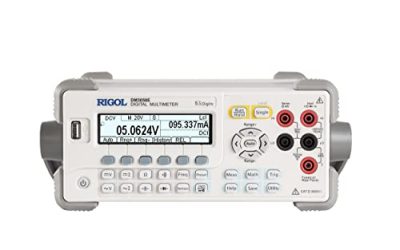
The Rigol DM3058E suits buyers who want a traditional full-size bench instrument and the resolution to see slow drift clearly in a logged run. Its 5.5-digit, 123,000-count display, dual-display operation, and measurement speed up to 123 readings per second make it the stronger choice for development and validation work where a second quantity, such as frequency, is worth watching beside the main reading. Logging is handled through its USB and RS-232 connections to a computer, so plan on a PC-based workflow rather than untethered internal storage for long captures.
Specs
- Display: 5.5 digit, 123,000 counts, dual display
- Measurement speed: up to 123 readings per second
- DC voltage: 200 mV to 1000 V
- AC voltage: True-RMS, 200 mV to 750 V
- DC current: 200 microamp to 10 A
- AC current: True-RMS, 20 mA to 10 A
- Frequency measurement: 20 Hz to 1 MHz
- Interfaces: USB Device, USB Host, RS-232
Best for: Higher-resolution development and validation benches logging to a computer
Watch out for: No internal logging memory is listed, so the computer connection is part of the logging setup
ASIN: B00KBZK1QW
OWON XDM1041

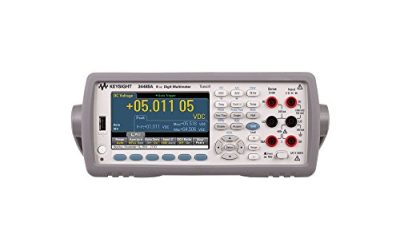
The OWON XDM1041 is the compact route to a logging bench meter. Its 55,000-count display, DC voltage accuracy up to 0.05 percent, and sampling up to 65 readings per second cover everyday electronics work, while the built-in data record function stores measured data in internal memory for later reading and processing on a computer. That makes it practical for a self-contained overnight capture on a small bench where a full-size instrument would crowd out the project itself. True-RMS AC voltage and current measurement, a dual-line display, and chart-mode trend viewing round out a specification aimed squarely at monitoring tasks.
Specs
- Display: 55,000 counts, 3.5 inch high resolution LCD, dual line display
- Sampling: up to 65 readings per second
- DC voltage accuracy: up to 0.05 percent
- DC voltage: 50 mV to 1000 V
- AC voltage: True-RMS, 500 mV to 750 V
- DC current: 500 microamp to 10 A
- AC current: True-RMS, 500 microamp to 10 A
- Data logging: 1,000 points, logging interval 15 ms to 9999.999 s
- Temperature: K type and PT100 support
- Interface: USB port, SCPI support
Best for: Compact benches that need self-contained stored records without a permanently attached computer
Watch out for: The 1,000-point logging length fills quickly at short intervals, so set the interval for the length of the run
ASIN: B0B5QBSJ2T
Which One Fits Your Situation
Logging a supply or battery run overnight
Choose the OWON XDM1041. Its internal data record function stores up to 1,000 points without a computer staying connected, and a sensibly chosen logging interval stretches that capacity across an overnight discharge or warm-up run. The records can then be read and processed on a computer in the morning. The Rigol can log for longer through a PC, but only if leaving that computer attached and running all night is acceptable on your bench.
Watching small drift on a precision rail
Choose the Rigol DM3058E. A logged trend is only useful if the display resolution can separate real drift from rounding, and its 123,000 counts and 5.5-digit resolution show changes that a 55,000-count meter may step over. Its faster measurement speed also helps when the rail moves during load changes. Pair it with a computer over USB or RS-232 so the captured run can be compared against earlier runs under the same conditions.
Measuring distorted AC loads in a repair shop
Either meter reports true-RMS AC values, so the choice turns on range and workflow. The Rigol DM3058E offers the broader bench specification and dual display for checking a second quantity during diagnosis. The OWON XDM1041 is easier to place beside equipment being repaired and can store a short record of how a load behaves over minutes. For repeated waveform-related faults, log the run instead of relying on one reading taken while the fault is absent.
Building a first instrument bench on limited space
Choose the OWON XDM1041. It delivers the two features this guide is built around, true-RMS AC measurement and data recording, in a compact desktop format with a colour display and computer transfer of stored records. It leaves bench room for a power supply, a soldering station, and the project itself. Move to the Rigol DM3058E later only if your work outgrows its resolution, its logging length, or its narrower AC frequency coverage.
Common Mistakes
- Buying a bench meter for logging without checking where records are stored. Some meters only log while connected to a computer, while others hold a limited number of points internally. If the storage model does not match the run you plan, such as an unattended overnight capture on a meter that needs a live PC link, the feature you paid for will not be there when the test actually happens.
- Assuming every AC meter is true-RMS. Average-responding meters are calibrated for clean sine waves and can read noticeably low or high on dimmers, switching supplies, and variable-speed drives. If your logged data will be used to judge a distorted load, confirm that both AC voltage and AC current are specified as true-RMS, and check the frequency range that specification covers before trusting the numbers.
- Setting the logging interval once and forgetting it. A very short interval on a long run exhausts a 1,000-point internal memory long before the event of interest, while a very long interval can step straight over a brief dip or spike. Estimate the run length, divide the available points across it, and leave margin for the unexpected instead of accepting the default interval the meter happens to ship with.
- Ignoring current range and fuse limits during logged runs. Bench meters measure current through fused inputs with defined range ceilings, and a load that surges at start-up can exceed the range you selected for its steady state. Check the AC and DC current ceilings in the specification, start on a higher range for unknown loads, and remember that a blown input fuse ends both the measurement and the log.
- Comparing meters by digit count alone. Extra resolution does not improve a noisy measurement, and it does not add logging memory, wider true-RMS bandwidth, or a better interface. Two meters with similar counts can differ completely in how records are stored and exported, so rank the logging workflow and AC specification first and treat resolution as the tiebreaker it usually is.
Frequently Asked Questions
What does true-RMS change in a logged measurement?
True-RMS conversion calculates the effective value of a waveform whatever its shape, so logged AC readings stay meaningful on distorted signals from switching supplies, dimmers, and drives. An average-responding meter assumes a sine wave and can drift away from the real value as distortion rises. Over a long log, that error is systematic, so every point carries the same bias rather than random noise that averages out.
Is internal logging better than logging to a computer?
Neither is universally better. Internal logging, like the 1,000-point record function on the OWON XDM1041, keeps a run self-contained and frees the computer, but capacity is finite. Logging to a computer through USB or RS-232, as with the Rigol DM3058E, suits much longer or scripted captures and puts the file straight into your analysis folder, at the cost of keeping the computer connected and awake for the whole run.
How many digits do I need for useful trend logging?
Enough resolution to make the change you care about visible above last-digit noise. For spotting drift on a stable rail, a 5.5-digit meter shows smaller steps than a 55,000-count model, itself far beyond a basic handheld. If the signal moves by large amounts, extra digits add file size without insight. Match resolution to the smallest change you would act on, not the largest number in the comparison table.
Can a bench multimeter replace a handheld meter?
Not completely. A bench meter offers better resolution, a mains-powered always-ready position, dual displays, and logging that suits fixed work, but it stays on the bench. Fault-finding around a building, a vehicle, or installed equipment still calls for a portable handheld with the appropriate safety ratings. Most serious benches keep both: the handheld finds the problem area, and the bench meter documents exactly how the circuit behaves over time.