Key takeaways
- Bench multimeters with data logging for electronics labs compared by resolution, reading speed, logging memory and interfaces, from Amazon listing details.
A bench multimeter earns the word logging only when it can watch a circuit for hours and hand you the record afterwards, and that is a different purchase from a meter that simply reads accurately. The decision that matters is where the readings accumulate: in the meter’s own memory with timestamps you can export, in a history buffer you review on the front panel, or streamed to a computer over USB, RS232 or LAN under SCPI control. Resolution still counts, but a 6.5-digit meter that cannot store a trend is the wrong tool for drift, warm-up and battery discharge work.
This guide is for electronics laboratories, repair benches and teaching labs that need unattended measurement records rather than spot readings. Every model below is a bench multimeter whose listing or listing-derived description states data logging or a data record function, and the specifications quoted come from those product details.
Quick Picks
As an Amazon Associate we earn from qualifying purchases.
| Product | Best for | Key spec from title |
|---|---|---|
| Rigol DM3058E | A proven lab bench meter with computer logging | 5.5 digit, 123,000 counts, USB and RS232 |
| Siglent SDM3065X | On-meter history, trend charts and network control | 6.5 digit, data logging, USB and LAN |
| OWON XDM1041 | A compact bench with internal recording on a budget bench | 55,000 counts, data record function, USB/RS232 |
How to Choose
Decide where the log lives before comparing digits
Logging architectures differ more than brochures suggest. Some meters record internally and let you pull the file to a computer afterwards, which suits a bench where no PC can stay connected. Others are built to stream readings to software over their interface, which suits automated test but ties up a computer for the whole run. A third group keeps a history buffer with a trend chart on the front panel, ideal for watching drift during a soak test. Identify which pattern your lab actually uses, then check that the listing for your chosen model states that capability in those terms.
Resolution and counts set the smallest change you can see
A logging meter’s job is often to reveal slow, tiny movement — a reference drifting, a cell discharging, a sensor settling. That is resolution work: 123,000 counts on a 5.5-digit meter resolves far smaller steps than 55,000 counts, and a 6.5-digit meter resolves smaller steps again. Match the counts figure from the listing to the size of change you need to prove. Buying excess resolution for go-or-no-go checks wastes money, but buying too little makes a week of logged data worthless because the trend hides inside one count of noise.
Reading speed and logging interval are different specifications
A meter can sample quickly yet log slowly, or the reverse, and listings quote both kinds of numbers. Reading speed in readings per second governs how fast the display and a streamed capture can update. The logging interval governs the spacing of stored points, and the memory length governs how many points fit before the record stops or wraps. Multiply interval by memory length before you buy: a 1,000-point memory at one reading per second covers under twenty minutes, while the same memory at one point per minute covers most of a day.
Interfaces decide how the data leaves the bench
USB is the baseline for moving logs and remote control, RS232 still appears on older lab infrastructure and long cable runs, and LAN lets a meter sit on the lab network where any workstation can reach it. SCPI command support matters if the meter will join scripted measurements alongside other instruments, because it lets the same test program drive the meter without front-panel steps. Check the exact interface list on the listing for the variant you are ordering, since some models sell in more than one interface configuration.
The 3 Best Options
Rigol DM3058E Digital Multimeter

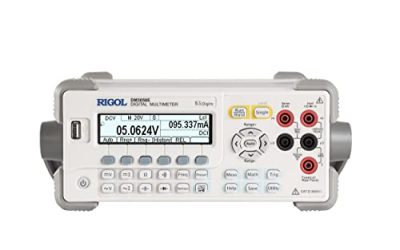
The DM3058E is the established lab choice in this group: a 5.5-digit bench meter with 123,000 counts, True-RMS measurement and a dual display that can show two parameters of one signal at once. Its listing details give a reading speed of 123 readings per second and interfaces of USB and RS232 with SCPI support, which is the combination that makes scripted logging from a computer straightforward — a test program polls the meter and files the results. Maximum ratings of 1000 volts and 10 amps cover general electronics laboratory work without babying the instrument.
Specs
- Resolution: 5.5 digits, 123,000 counts
- Reading speed: 123 readings per second
- Measurement: True-RMS, dual display
- Interfaces: USB and RS232
- Remote control: SCPI support, logging driven from a script or PC software
- Maximum input: 1000 V, 10 A
Best for: Laboratories that log through a connected computer and want a mature, widely supported bench meter.
Watch out for: Its logging pattern is PC-driven over USB or RS232 rather than a large standalone internal archive, so plan on a computer staying attached during long captures.
ASIN: B00KBZK1QW
Siglent SDM3065X Digital Multimeter

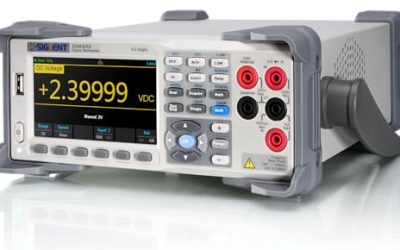
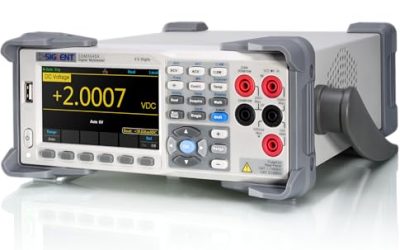
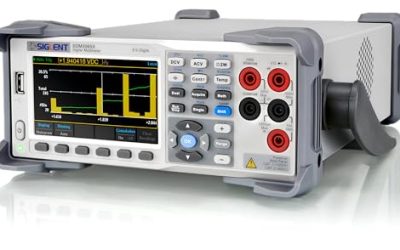
The SDM3065X is the pick when the record should live on the meter itself. It is a 6.5-digit bench multimeter whose listing details name data logging with history records and a trend chart on the front panel, so a drift run can be reviewed on the instrument before anything is exported. Interfaces are USB and LAN, and the LAN connection is the practical difference here: the meter joins the lab network, and logging or retrieval can happen from whichever workstation is free. The extra digit over 5.5-digit rivals resolves the smallest steps in this guide, suiting reference and calibration-adjacent work.
Specs
- Resolution: 6.5 digits
- Logging: data logging with history records
- Display analysis: trend chart on the front panel
- Interfaces: USB and LAN
- Measurement: dual display bench multimeter
Best for: Labs that want on-meter logging history and network access without a permanently attached PC.
Watch out for: Confirm the exact variant and interface set on the product page before ordering, because Siglent sells closely related models and configurations side by side.
ASIN: B07YL2J7VT
OWON XDM1041 Bench Digital Multimeter

The XDM1041 brings genuine logging to a compact, lighter bench footprint. It is a 55,000-count meter with a 3.7-inch LCD per its listing title, True RMS measurement and a stated data record function: readings are stored in internal memory, up to 1,000 points, with the logging interval adjustable from 15 milliseconds to just under 10,000 seconds, then read and processed on a computer afterwards. This listing is the USB and RS232 version, and SCPI support is stated, so scripted capture remains possible despite the modest price class. The 1,000-point ceiling is the honest limitation to plan around.
Specs
- Resolution: 55,000 counts
- Display: 3.7-inch LCD screen per the listing title
- Measurement: True RMS
- Logging: data record function, internal memory, 1,000 points maximum
- Logging interval: 15 milliseconds to 9999.999 seconds
- Interfaces: USB and RS232 (this listing variant)
- Remote control: SCPI support
- Reading speed: up to 65 readings per second
Best for: Teaching labs, repair benches and secondary stations that need real logging without a flagship meter’s footprint.
Watch out for: The 1,000-point logging length fills quickly at fast intervals, so set the interval from your total test duration first; also confirm you are ordering the USB/RS232 variant rather than a different configuration.
ASIN: B0B5QBSJ2T
Which One Fits Your Situation
You run scripted tests and the PC is always on the bench
Take the Rigol DM3058E. USB and RS232 with SCPI support slot it into existing test programs, the dual display helps while you set a test up by hand, and 123 readings per second keeps streamed captures responsive. It is the least surprising meter here, which is a compliment in a production or research lab.
You soak-test devices and review drift on the meter itself
Choose the Siglent SDM3065X. History records and a trend chart on the front panel mean the evidence of a warm-up drift or a settling sensor is visible before any export, and LAN access lets you start or retrieve a run from another desk. Its 6.5-digit resolution also resolves the smallest movement of the three.
Bench space and budget are tight but logging is non-negotiable
The OWON XDM1041 is the fit. It records internally with a flexible interval range, exports to a computer for analysis, and takes up a fraction of the bench the other two occupy. Size the logging interval to the job so the 1,000-point memory spans the whole test instead of the first hour of it.
Common Mistakes
- Buying on digit count alone and discovering the meter’s logging is only a small buffer, or only works while a PC stays connected.
- Ignoring the arithmetic of interval times memory length, so a long soak test silently stops recording partway through.
- Ordering the wrong interface variant of a model that sells in USB-only and USB/RS232 configurations under similar titles.
- Assuming every bench meter speaks SCPI, then finding a scripted test cannot drive the instrument you bought.
- Logging at the fastest interval by default, which fills memory with redundant points and buries the trend you actually needed.
Frequently Asked Questions
What makes a bench multimeter a logging multimeter?
A logging meter stores readings over time with a settable interval and lets you retrieve the record, either from internal memory, an on-screen history, or a stream to a computer under software control. A meter that only holds a single reading on screen is not logging, however accurate it is. Check the listing for a stated data logging or data record function, as this guide required for every model included.
How many points of logging memory do I need?
Divide your test duration by the interval you need. A one-hour test at one point per second needs 3,600 points, which already exceeds the OWON’s 1,000-point internal record and argues for a longer interval, the Siglent’s history approach, or PC-streamed logging with the Rigol. Slow phenomena such as discharge curves and thermal drift rarely need sub-second points, so a longer interval usually loses nothing.
Is 6.5-digit resolution worth it for logging work?
Only when the change you are tracking is small enough to disappear inside a lower-resolution meter’s last digit. Reference drift, precision divider checks and calibration-adjacent logging benefit from the SDM3065X’s extra digit. For monitoring supply rails, battery packs or sensor outputs at ordinary tolerances, 55,000 counts or 123,000 counts already resolve more than the circuit will repeatably do.
Can I control these meters from my own software?
Yes, within each model’s stated support. The Rigol and the OWON list SCPI support, which means standard instrument commands over USB or RS232 can trigger readings and configure the meter from a script. The Siglent adds LAN to USB, which suits networked control. Verify the command set and driver availability for your exact model before writing a long test program around it.