Key takeaways
- Five high-resolution bench multimeters for research laboratories compared on published digits, counts, DC accuracy, functions and connectivity.
A research laboratory bench places demands on a digital multimeter that a handheld meter is not built to meet. Experiments run for hours or days, signals sit in the microvolt and microamp region, and results feed into data acquisition software rather than a notebook. A high-resolution bench multimeter answers with a stable mains-powered design, a display resolving 5½ or 6½ digits, accuracy figures published against a one-year calibration interval, and remote interfaces for unattended logging.
Resolution alone does not guarantee a trustworthy reading. Usable accuracy comes from the specification sheet: DC accuracy stated as a percentage of reading plus a percentage of range, valid within a stated temperature band after a stated warm-up period. The five instruments below are all bench multimeters in the 5½-digit and 6½-digit classes, and each entry quotes the figures exactly as the manufacturer publishes them, conditions attached, so that like is compared with like.
Disclosure: As an Amazon Associate, we earn from qualifying purchases made through links on this page, at no extra cost to you.
What the digits and counts actually tell you
Display digits describe how many full digits a meter can show. A 5½-digit meter displays up to 199,999 counts in its classic form, while modern designs extend that figure: the Siglent SDM3055 publishes 240,000 counts, and the B&K Precision 5492B publishes 120,000 counts. Counts matter because they decide where range changes fall: a signal of 1.95 V sits near the top of a 2 V range on a high-count meter, keeping full resolution, while a lower-count design pushes the same signal onto a coarser range sooner.
Accuracy is a separate figure, and the one that decides whether a measurement can support a conclusion. Manufacturers express it as ±(percent of reading + percent of range) for a stated calibration interval, usually one year, at a stated temperature. Keysight expresses the headline DC performance of its 34465A as 30 ppm, which is 0.0030 percent. A ppm figure and a percent figure describe the same quantity in different units, so converting before comparing keeps the comparison honest.
Choosing a bench multimeter for laboratory work
Start with the signals the laboratory actually measures. Low-level DC work, such as sensor output characterisation and reference voltage checks, rewards the tightest DC accuracy and a low starting current range. The Keysight 34465A opens its DC current ranges at 1 µA with picoamp resolution, which suits leakage and bias current work. General electronics benches that mix DC, true RMS AC, resistance, frequency, and capacitance are well served by any of the 5½-digit models here, provided the published accuracy on the ranges in daily use is read carefully.
Reading speed divides the group sharply. The 34465A publishes up to 50,000 readings per second, the 34450A up to 190, the SDM3055 up to 150, the DM3058E up to 123, and the 5492B up to 57. Fast rates serve transient capture and automated sweeps; slow rates at full resolution serve stability, so each published rate should be read alongside its rate conditions.
Four-wire resistance measurement appears across the group and matters wherever lead resistance would swamp the quantity being measured, such as shunt resistors and contact resistance. Dual displays, fitted to the 34450A, SDM3055, DM3058E, and 5492B, show two parameters of one signal at once, for example voltage and frequency together. Connectivity decides how easily a meter joins an automated bench: LAN with LXI support, USB device and host ports, RS-232, and GPIB all appear here, and each entry states exactly which interfaces the specific model carries, because variants within a series differ.
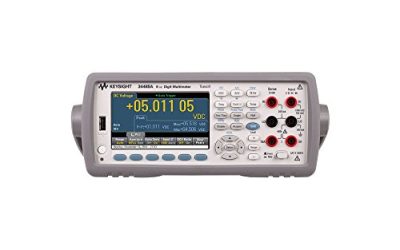
1. Keysight 34465A Truevolt Digital Multimeter

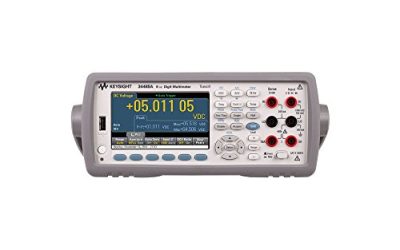
The 34465A is the resolution leader in this group and the natural anchor for a laboratory that treats the multimeter as a reference instrument. Keysight publishes a basic DC voltage accuracy of 30 ppm for this 6½-digit Truevolt bench meter, with DC voltage ranges from 100 mV to 1,000 V and a DC current range beginning at 1 µA with picoamp resolution. A maximum reading rate of 50,000 readings per second and 50,000 readings of standard memory, expandable to two million readings as an option, support both transient work and long logging runs. The 4.3-inch colour display presents histograms and trend charts on the instrument itself, which helps when a drifting signal needs a visual check before a logging session is configured. Connectivity covers USB and LAN with LXI Core compliance, with GPIB available as an option.
Specs
- Display: 6½ digits, 4.3-inch colour graphical display with histogram and trend chart views
- DC voltage: 100 mV to 1,000 V; basic DCV accuracy 30 ppm as published by Keysight
- DC current: 1 µA to 10 A, with picoamp resolution on the 1 µA range
- AC voltage and current: true RMS, 100 mV to 750 V and 100 µA to 10 A
- Resistance: 100 Ω to 1 GΩ, two-wire and four-wire
- Additional functions: frequency and period 3 Hz to 300 kHz, capacitance, temperature, continuity, diode test
- Reading rate and memory: up to 50,000 readings per second; 50,000 readings standard memory, two million readings optional
- Connectivity: USB, LAN (LXI Core); GPIB optional
2. Keysight 34450A Digital Multimeter

The 34450A brings Keysight bench measurement to the 5½-digit class with an emphasis on speed and logging. Keysight publishes a DC voltage accuracy of 0.015 percent; the underlying one-year figure for the 1 V range is 0.015 + 0.005, expressed as percent of reading plus percent of range, specified after a 90-minute warm-up in slow mode with a calibration temperature of 18 °C to 28 °C. A reading speed of up to 190 readings per second is the fastest headline rate among the 5½-digit models here, and up to 50,000 memory points hold logged data on the instrument. The ultra-bright OLED dual display shows two measurements at once. Eleven measurement functions cover DC and true RMS AC voltage and current, two-wire and four-wire resistance, frequency, continuity, diode test, capacitance, and temperature. Connectivity is the broadest at this level: USB 2.0, RS-232, and GPIB are all fitted, with SCPI commands plus Fluke 45 and Fluke 8808A command compatibility easing integration into existing automated setups.
Specs
- Display: 5½ digits, ultra-bright OLED dual display
- DC accuracy: 0.015 percent published; one-year 1 V range figure 0.015 + 0.005 (percent of reading + percent of range), 90-minute warm-up, slow mode, calibration temperature 18 °C to 28 °C
- Measurement functions: 11, covering DC voltage and current, true RMS AC voltage and current, two-wire and four-wire resistance, frequency, continuity, diode test, capacitance, temperature
- Reading rate and memory: up to 190 readings per second; up to 50,000 memory points for data logging
- Connectivity: USB 2.0, RS-232 serial interface, GPIB
- Command sets: SCPI, with Fluke 45 and Fluke 8808A command compatibility; BenchVue software included
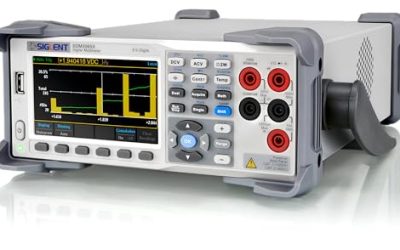
3. Siglent SDM3055 Digital Multimeter

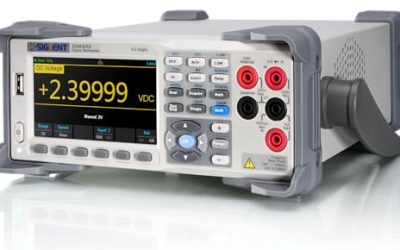
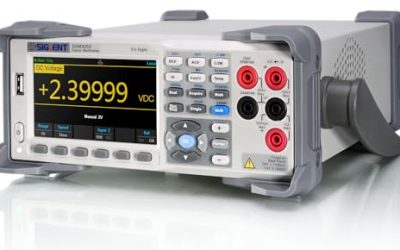
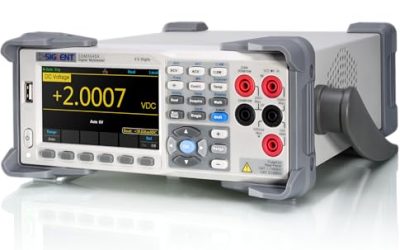
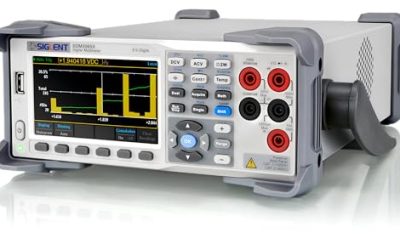
The SDM3055 pairs 5½-digit resolution with 240,000 counts, the highest count figure in this group, which keeps fine resolution available across more of each range. Siglent publishes DC voltage ranges from 200 mV to 1,000 V, with a one-year accuracy on the 200 mV range of ±(0.015 percent of reading + 0.004 percent of range), specified at 23 °C ± 5 °C after a half-hour warm-up at the slow rate. The dual display is a 4.3-inch TFT-LCD with 480 × 272 resolution, and the maximum reading rate is 150 readings per second. Coverage spans DC current from 200 µA to 10 A, true RMS AC voltage to 750 V and AC current from 20 mA to 10 A, two-wire and four-wire resistance to 100 MΩ, capacitance from 2 nF to 10,000 µF, frequency from 20 Hz to 1 MHz, and temperature through thermocouple and RTD sensors. Interfaces are USB Device, USB Host, and LAN; GPIB belongs to the separate SDM3055A variant, not this model.
Specs
- Display: 5½ digits, 240,000 counts, dual display on a 4.3-inch TFT-LCD, 480 × 272
- DC voltage: 200 mV to 1,000 V; one-year accuracy on the 200 mV range ±(0.015 percent of reading + 0.004 percent of range) at 23 °C ± 5 °C, after 0.5-hour warm-up, slow rate
- DC current: 200 µA to 10 A
- AC voltage and current: true RMS, 200 mV to 750 V and 20 mA to 10 A
- Resistance: 200 Ω to 100 MΩ, two-wire and four-wire
- Additional functions: capacitance 2 nF to 10,000 µF, frequency 20 Hz to 1 MHz, period, temperature via thermocouple and RTD sensors, continuity, diode test
- Reading rate and storage: up to 150 readings per second; 1 Gb internal NAND flash
- Connectivity: USB Device, USB Host, LAN; EasyDMM PC software
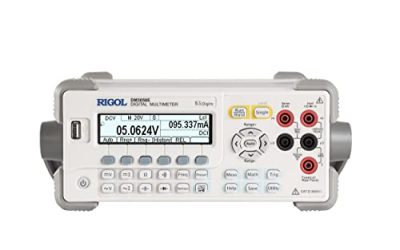
4. Rigol DM3058E Digital Multimeter

The DM3058E is Rigol’s 5½-digit bench meter for laboratories that want full measurement coverage with straightforward PC connection. Rigol publishes DC voltage ranges from 200 mV to 1,000 V, with a one-year accuracy on the 200 mV range of 0.015 + 0.004, expressed as percent of reading plus percent of range at 23 °C ± 5 °C. The maximum reading rate is 123 readings per second, and a dual display presents a second parameter alongside the primary reading. DC current runs from 200 µA to 10 A, true RMS AC voltage reaches 750 V with AC current from 20 mA to 10 A, and two-wire and four-wire resistance extends to 100 MΩ. Capacitance, frequency from 20 Hz to 1 MHz, diode test, continuity, and temperature measurement through external sensors round out the function set. On connectivity, the E model carries USB Device, USB Host, and RS-232. LAN and GPIB belong to the DM3058 without the E suffix, a distinction worth noting before ordering either variant.
Specs
- Display: 5½ digits, dual display
- DC voltage: 200 mV to 1,000 V; one-year accuracy on the 200 mV range 0.015 + 0.004 (percent of reading + percent of range) at 23 °C ± 5 °C
- DC current: 200 µA to 10 A
- AC voltage and current: true RMS, 200 mV to 750 V and 20 mA to 10 A
- Resistance: 200 Ω to 100 MΩ, two-wire and four-wire
- Additional functions: capacitance 2 nF to 10,000 µF, frequency 20 Hz to 1 MHz, diode test, continuity, temperature via external sensors
- Reading rate: up to 123 readings per second
- Connectivity: USB Device, USB Host, RS-232 (LAN and GPIB are fitted to the DM3058, not the DM3058E)
5. B&K Precision 5492B Bench Multimeter

The 5492B is a 5½-digit, 120,000-count bench multimeter with a dual display and a specification sheet aimed at steady laboratory and production-bench measurement. B&K Precision publishes a basic DC voltage accuracy of 0.01 percent; the detailed one-year figure for the 1.2 V range is 0.01 + 0.004, expressed as percent of reading plus percent of range, under the data sheet conditions of a one-year calibration cycle, an operating temperature of 18 °C to 28 °C, a 30-minute warm-up, and the slow 10 PLC rate. DC voltage reaches 1,000 V, true RMS AC voltage reaches 750 V, and AC and DC current both reach 12 A, the highest current ceiling in this group. Two-wire and four-wire resistance extends to 120 MΩ, frequency measurement reaches 1 MHz, and the maximum sample rate is 57 readings per second, with an internal buffer holding 512 readings and storage for ten instrument setups. Programming runs over USB and RS-232 with SCPI commands; the GPIB interface is fitted only to the 5492BGPIB variant. Published safety categories are CAT I 1000 V and CAT II 300 V.
Specs
- Display: 5½ digits, 120,000 counts, dual display
- DC voltage: to 1,000 V; basic VDC accuracy 0.01 percent published; one-year 1.2 V range figure 0.01 + 0.004 (percent of reading + percent of range), one-year calibration cycle, 18 °C to 28 °C, 30-minute warm-up, 10 PLC slow rate
- AC voltage: true RMS, to 750 V
- Current: AC and DC to 12 A
- Resistance: two-wire and four-wire, to 120 MΩ
- Additional functions: frequency to 1 MHz, period, continuity, diode test, limit mode for pass/fail checks, math functions including Rel, Max/Min, dBm, dB, percent, Hold
- Sample rate and memory: up to 57 readings per second; internal buffer of 512 readings; save and recall of ten setups
- Connectivity: USB and RS-232, SCPI programmable; GPIB fitted only on the 5492BGPIB variant
- Safety categories: CAT I 1000 V, CAT II 300 V
How the five compare
One instrument here sits a class above the rest on published DC performance: the Keysight 34465A, with 6½ digits, a 30 ppm basic DC voltage accuracy, the lowest current range starting at 1 µA, and the fastest reading rate at 50,000 readings per second. The Keysight 34450A answers with breadth instead: GPIB alongside USB and RS-232, 190 readings per second, and 50,000 logging points in a 5½-digit frame. The Siglent SDM3055 offers the highest display counts at 240,000, a LAN interface, and thermocouple and RTD temperature measurement. The Rigol DM3058E matches the SDM3055 on the main function ranges while keeping connectivity to USB and RS-232, a sensible fit for a single-PC bench. The B&K Precision 5492B closes the group with the widest current coverage at 12 A, four-wire resistance to 120 MΩ, and a pass/fail limit mode suited to repetitive checks.
Frequently asked questions
What does 6½-digit resolution add over 5½-digit in laboratory work?
The extra digit extends the smallest resolvable step on each range, which matters when a signal changes slowly and the change itself is the data, such as drift in a reference voltage or discharge behaviour in a cell. Resolution only helps when accuracy supports it, so the 6½-digit Keysight 34465A pairs its display with a published basic DC voltage accuracy of 30 ppm. Where signals are larger and changes are coarse, a 5½-digit instrument already resolves far beyond the accuracy of the measurement.
How should published DC accuracy figures be compared fairly?
Convert every figure to the same form before comparing. Manufacturers state accuracy as percent of reading plus percent of range, or as a ppm headline, always tied to conditions: a one-year calibration interval, a temperature band such as 23 °C ± 5 °C, a warm-up period, and often the slow measurement rate. A figure quoted at the slow rate after a long warm-up describes best-case behaviour, and the same instrument will publish looser figures at fast rates. The entries above keep each figure with its conditions for exactly this reason.
Which connectivity options matter for automated logging?
LAN with LXI compliance suits shared instruments on a laboratory network, as fitted to the Keysight 34465A and the Siglent SDM3055. USB device ports connect a single bench PC directly, and USB host ports accept memory devices for file transfer. GPIB remains relevant where older automated racks are still in service; it is standard on the Keysight 34450A, optional on the 34465A, and variant-dependent on the Siglent and B&K Precision models. RS-232 persists on the Rigol DM3058E and the 5492B for legacy controllers.
When is a 5½-digit bench multimeter the right choice?
A 5½-digit model fits the majority of electronics laboratory work: circuit bring-up, power supply verification, sensor checks, and teaching benches, where published accuracy around 0.01 to 0.015 percent on DC voltage already exceeds the tolerance of the circuits under examination. A 6½-digit model earns its place when measurements approach reference level, when microvolt and microamp signals carry the result, or when long logging runs must resolve small drift. Matching the instrument class to the signals actually measured keeps the bench honest without overspecifying it.
Closing notes
Each of the five meters here publishes its resolution, accuracy, and connectivity in enough detail to be matched against a laboratory’s real workload. Read the accuracy conditions as carefully as the headline figures, and confirm that the exact variant carries the interfaces the bench needs.