Key takeaways
- Compare the best precision bench multimeters for engineering workbenches: accuracy, digits, speed and safety features that matter for bench measurements.
An engineering workbench lives or dies on the trustworthiness of its measurements. When a prototype supply drifts by a few millivolts or a sensor reads a fraction off, the bench multimeter is the instrument that settles the argument, so its accuracy, resolution and stability matter far more than its price tag. A precision bench meter adds digits, counts and reading speed that a handheld meter cannot match, along with logging and automation that turn one-off checks into repeatable test routines.
This guide is for electronics engineers, lab technicians and product developers who need repeatable measurements on the bench. Every meter below was chosen from the name and specifications shown on its Amazon product page, and each one is a genuine bench multimeter sold on Amazon US.
Quick Picks
As an Amazon Associate we earn from qualifying purchases
| Product | Best for | Key spec from title |
|---|---|---|
| Keysight 34465A | Reference-grade accuracy and speed | 6.5-digit Truevolt, 0.003 percent DCV accuracy |
| Siglent SDM3065X | High-resolution dual-display bench work | 6.5-digit, 2,200,000 counts |
| Siglent SDM3055 | Solid 5.5-digit value for daily bench use | 5.5-digit, 240,000 counts |
| Rigol DM858 | Touch-screen bench meter on a budget | 5.5-digit, 7-inch touch display |
How to Choose
Digits, counts and accuracy
Digits and counts describe resolution, while accuracy describes how close a reading is to the true value, and the two are not the same thing. A 6.5-digit meter resolves 1,200,000 or 2,200,000 counts, so it can show tiny changes, but its accuracy is set by the percentage figure: 0.003 percent on the Keysight here against 0.03 percent on the Rigol. For reference work and calibration, accuracy is what matters. For routine debugging, resolution and a clear display matter more than the last digit of accuracy.
Reading speed and logging
Reading speed decides whether a meter catches a brief event or averages it away. The Keysight and Siglent 6.5-digit meters read thousands of times per second, which is fast enough to track a supply rail dipping under load, while the 5.5-digit meters here read 125 to 150 times per second and suit steady measurements. Logging matters just as much: a meter that stores readings or streams them over USB and LAN turns a one-off check into a record you can review, graph and attach to a test report.
Safety: ratings, fuses and good habits
Bench meters work with live circuits, so safety starts before you connect a probe. Check the voltage and category rating stated on the product page and printed on the meter itself, and never measure a circuit above that rating. Use the fused current input for current measurements, and never measure voltage while the leads are plugged into the current jacks. Keep probe insulation intact, work with one hand when you can, and treat every reading as a check, not a guarantee: if a result looks wrong, stop and re-check the range and connections.
Interfaces and automation
A bench meter earns its keep when it talks to your test setup. USB and LAN connections let the meter stream readings into logging software, run automated test sequences and store results without manual transcription. The meters in this guide all include USB and LAN, so the choice comes down to software: check that the meter works with the tools you already use, whether that is a vendor utility, a Python script or a full test framework. A meter that automates well saves hours across a development project.
The 4 Best Options
Keysight 34465A

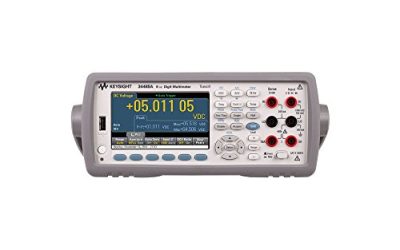
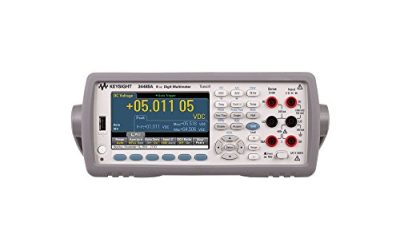
The 34465A is the reference instrument in this guide and the meter to choose when a measurement has to stand up to scrutiny. Its 6.5-digit Truevolt design resolves 1,200,000 counts with 0.003 percent basic DC voltage accuracy, and it takes up to 5,000 readings per second, so fast transients and slow drifts are both captured cleanly. The 4.3-inch display shows trends and histograms without a computer attached, and LAN and USB connections feed data straight into test software. It measures up to 1,000 V DC, 750 V AC and 10 A, covering almost every bench task an engineering lab will ask of it.
Specs
- 6.5-digit Truevolt digital multimeter, 1,200,000 counts
- Basic DC voltage accuracy 0.003 percent (30 ppm)
- DC voltage range up to 1,000 V; AC voltage up to 750 V
- DC and AC current up to 10 A
- Reading speed up to 5,000 readings per second
- 4.3-inch display with trend and histogram views
- LAN and USB interfaces
Best for: Reference measurements and automated test setups where accuracy cannot be compromised.
Watch out for: It is the most expensive meter here, so it is overkill for simple continuity and voltage checks.
Siglent SDM3065X

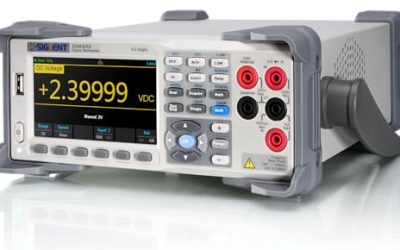
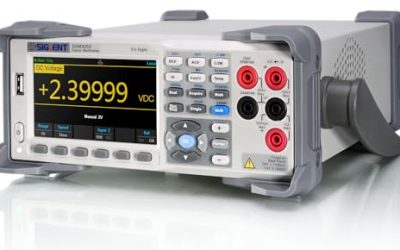
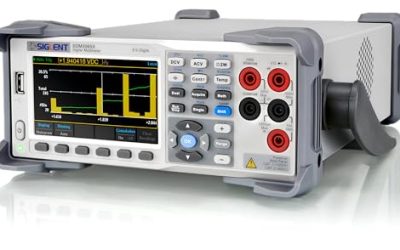
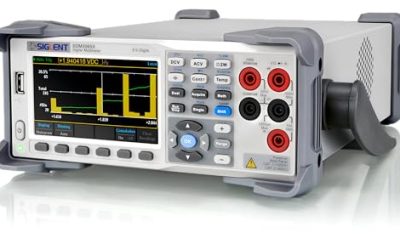
The SDM3065X gives a bench most of what the Keysight provides at a lower outlay, with a 6.5-digit display that resolves 2,200,000 counts and a dual-display mode that shows two measurements at once. Its basic DC voltage accuracy is 0.0035 percent, and it reads up to 10,000 times per second, which is fast enough to catch brief dips in a supply rail. The 4.3-inch TFT screen is easy to read across a crowded bench, and USB and LAN connections support logging and remote control. It measures DC voltage from 200 mV to 1,000 V and current up to 10 A.
Specs
- 6.5-digit bench multimeter, 2,200,000 counts
- Dual-display mode shows two measurements at once
- Basic DC voltage accuracy 0.0035 percent
- Reading speed up to 10,000 readings per second
- DC voltage range 200 mV to 1,000 V; AC voltage to 750 V
- DC and AC current up to 10 A
- 4.3-inch TFT display
- USB and LAN interfaces
Best for: Engineers who want 6.5-digit resolution and dual readings without reference-instrument pricing.
Watch out for: The ASIN has conflicting alternates on some marketplaces, so confirm the model number on the listing before ordering.
Siglent SDM3055

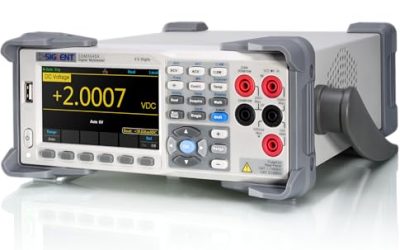
The SDM3055 is the workhorse of this guide: a 5.5-digit bench meter with 240,000 counts and a dual display, aimed at engineers who measure every day but do not need 6.5-digit resolution. Its basic DC voltage accuracy is 0.015 percent, which is more than enough for power-supply adjustment, sensor checks and general circuit debugging. It reads up to 150 times per second and stores readings for later review, and USB and LAN connections cover logging and remote control. DC voltage spans 200 mV to 1,000 V and current reaches 10 A, so it handles the same bench tasks as its bigger sibling.
Specs
- 5.5-digit bench multimeter, 240,000 counts
- Dual-display mode
- Basic DC voltage accuracy 0.015 percent
- Reading speed up to 150 readings per second
- DC voltage range 200 mV to 1,000 V; AC voltage to 750 V
- DC and AC current up to 10 A
- USB and LAN interfaces
Best for: Daily bench work where 5.5-digit resolution covers every routine measurement.
Watch out for: At 150 readings per second it is the slowest meter here, so it is not the pick for fast transient capture.
Rigol DM858

The DM858 brings a modern touch-screen interface to the precision bench, with a 7-inch display that shows measurements, trends and statistics without a computer. It is a 5.5-digit meter with 120,000 counts and 0.03 percent basic DC voltage accuracy, reading up to 125 times per second, and it covers 11 measurement types including capacitance, frequency and temperature. USB-C power keeps the bench tidy, and the large screen makes it the easiest meter here to read from across the room. For engineers who want a capable bench meter with a friendly interface, it is the most approachable pick in this guide.
Specs
- 5.5-digit bench multimeter, 120,000 counts
- Basic DC voltage accuracy 0.03 percent (1-year)
- Reading speed up to 125 readings per second
- 11 measurement types including capacitance, frequency and temperature
- 7-inch touch-screen display
- USB-C powered
- 500,000-point data logging memory
Best for: Engineers who want a large touch screen and straightforward bench measurements.
Watch out for: At 0.03 percent accuracy it is the least precise meter here, so skip it for reference-grade work.
Which One Fits Your Situation
Reference and calibration work
Choose the Keysight 34465A when a measurement has to stand up to scrutiny. Its 0.003 percent accuracy and 5,000 readings per second make it the reference instrument here, and its trend and histogram views help you spot drift without a computer. It is the most expensive meter in this guide, but for calibration and validation work that cost buys confidence.
Daily circuit debugging
Choose the Siglent SDM3055 for everyday bench work. Its 5.5-digit resolution and 0.015 percent accuracy cover power-supply adjustment, sensor checks and general debugging on the bench without fuss, and the dual display shows two measurements at once. It is the most practical pick here for engineers who measure every day.
Automated test and logging
Choose the Siglent SDM3065X when your bench runs automated tests. Its 6.5-digit resolution, 10,000 readings per second and dual display feed detailed data into logging software over USB and LAN. It gives a test setup most of what the Keysight provides, with money left over for the rest of the bench.
A first precision bench meter
Choose the Rigol DM858 if this is your first precision bench meter. The 7-inch touch screen makes it the easiest meter here to read and operate, and its 5.5-digit resolution covers most bench tasks. It is the least precise meter in this guide, so plan an upgrade later if your work moves toward reference-grade measurements.
Common Mistakes
- Confusing resolution with accuracy, and paying for digits that do not improve the measurement.
- Measuring current with the leads in the voltage jacks, or voltage with the leads in the current jacks.
- Ignoring the meter’s voltage and category rating, then using it on a circuit it was never rated for.
- Buying a meter that cannot log or automate, then transcribing readings by hand for every test.
- Choosing on price alone and ending up with a meter that cannot resolve the signals your work actually needs.
Frequently Asked Questions
What does 6.5-digit mean on a bench multimeter?
It describes resolution: a 6.5-digit meter can display up to 1,200,000 or 2,200,000 counts, so it shows very small changes in a measurement. It does not by itself guarantee accuracy, which is set by the percentage figure in the specifications. Check both numbers before you buy.
How accurate does a bench meter need to be?
For routine debugging, 0.015 to 0.03 percent is usually enough, and the 5.5-digit meters here cover that comfortably. For calibration, validation and reference work, look for 0.003 to 0.0035 percent, which only the 6.5-digit meters in this guide provide. Match the accuracy to the job, not to the specification sheet.
Do I need a bench meter if I already own a handheld meter?
For field checks and quick measurements, a handheld meter is enough. A bench meter earns its place when you need higher resolution, faster readings, logging or automation. If your work stays at checking voltages and continuity, the handheld meter will do.
What interfaces matter for logging measurements?
USB and LAN are the two that matter most, and every meter in this guide has both. USB suits a single bench computer, while LAN suits a shared lab or a test rack. Check that the meter works with your logging software before you buy, whether that is a vendor utility, a Python script or a test framework.