Key takeaways
- Five bench multimeters with real logging paths for research labs — Siglent SDM3055 with internal storage, Rigol DM3058E and B&K 5491B PC logging, and OWON XDM1041/XDM2041 recorders compared.
Logging is what separates a bench multimeter for research work from a general-purpose meter. A laboratory measurement often runs for hours or days — a battery discharge curve, a thermal drift record, a burn-in watch — and the meter has to capture readings on a schedule and hold them, either in its own memory or in a file on a connected PC. Every pick in this guide is a bench (benchtop) digital multimeter with a documented logging path; none of them is a handheld meter, and the logging evidence for each one is stated as it was verified, including where that evidence is thinner.
A note on what is not here: the premium names many labs reach for first could not be verified with a confirmed Amazon US listing in the research for this guide, so they were excluded rather than padded in. The five meters below are the ones with both a real bench form factor and a traceable logging story.
Top pick: Siglent SDM3055 — the only pick with large internal storage specified for measurement data, plus LAN and USB remote logging for unattended runs.
Runner-up: Rigol DM3058E — an established 5½-digit bench platform for labs that log to a PC over USB or RS232.
Quick Picks
As an Amazon Associate we earn from qualifying purchases.
| Pick | Meter | Resolution | Logging path | Best for |
|—|—|—|—|
| Top pick | Siglent SDM3055 | 5½-digit, 240,000 counts | 1 Gb internal storage + PC logging via USB/LAN | Long unattended runs logged inside the meter |
| Runner-up | Rigol DM3058E | 5½-digit, 123,000 counts | PC logging over USB/RS232 | Labs logging to a PC on an established platform |
| Best simple PC logger | B&K Precision 5491B | 4¾-digit, 50,000 counts | PC software data logging via USB/RS232 | Education and service-style benches |
| Best budget internal logging | OWON XDM1041 | 4½-digit, 55,000 counts | Internal memory record (1,000 points) + PC capture | Long, slow experiments on a budget |
| Best serial option | OWON XDM2041 | 4½-digit, 55,000 counts | Internal record (series-level evidence) + RS232/USB | Older data-acquisition PCs with serial ports |
How to Choose
Decide where the log should live
There are two logging architectures in this group. Meters with internal storage — the Siglent SDM3055 and the OWON models — record readings into their own memory, so the bench PC can be off, busy or absent during the run. PC-logging meters — the Rigol DM3058E and the B&K Precision 5491B — stream readings over USB or RS232 to software on a connected computer, which must stay on and connected for the whole experiment. Internal storage is the safer choice for overnight and multi-day runs; PC logging gives you live graphs and immediate files. Match the architecture to how your lab actually runs experiments, not to the headline specification.
Match the interface to your data-acquisition setup
Logging only works if the meter talks to your infrastructure. The SDM3055 offers USB Device, USB Host and LAN, with SCPI remote control and Siglent’s EasyDMM PC software — LAN is the flexible option for a meter that sits away from the logging PC. The DM3058E and the 5491B use USB and RS232, and the OWON XDM2041 is the pick built around an RS232 serial path into older data-acquisition PCs, while the XDM1041 connects over USB. If your lab standardises on SCPI-driven automation, check that the meter supports it: the Siglent and both OWON models list SCPI support.
Resolution and accuracy: read both numbers
Digit count tells you how finely the meter can resolve a reading; accuracy tells you how much to trust it. The SDM3055 pairs 240,000 counts with a basic DC voltage accuracy of 0.015 percent, the strongest combination here. The DM3058E offers 123,000 counts. The OWON XDM2041’s DC voltage accuracy of up to 0.025 percent is notably better than the XDM1041’s 0.05 percent, despite both being 55,000-count meters — which is why the 2041 is not simply a duplicate of its sibling. The B&K 5491B, at 50,000 counts, is the simplest instrument in the group and should be chosen for straightforward logging, not precision work.
Check the log depth against your experiment
A logging specification is only useful against your sampling plan. The OWON XDM1000 series specifies a data-logging length of 1,000 points with sampling intervals from 15 ms — plenty for a slow drift record sampled every few seconds, but a short record at fast intervals. The Siglent’s 1 Gb of internal NAND flash, specified for configuration files and measurement/historical data as well as external USB-disk storage, is in a different league for long runs. Before choosing, multiply your sampling interval by your experiment length and compare the result with the meter’s stated log depth.
The 5 Best Options
1. Siglent SDM3055 5½-Digit Dual-Display Bench Multimeter

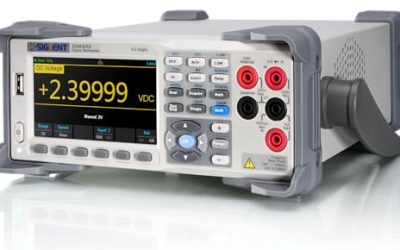
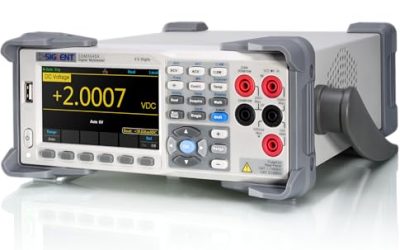
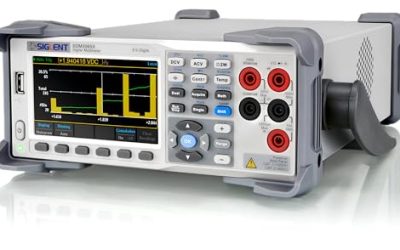
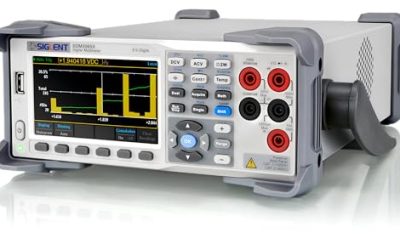
The SDM3055 is the most complete logging bench meter in this group. It is a 5½-digit, 240,000-count instrument reading up to 150 readings per second, with a dual display on a 4.3-inch TFT-LCD screen and a basic DC voltage accuracy of 0.015 percent. For logging, it carries 1 Gb of internal NAND flash specified for storing configuration files and measurement and historical data, plus external storage over a USB disk — retailer feature lists for this model explicitly include data logging. Add USB Device, USB Host and LAN interfaces with SCPI control through Siglent’s EasyDMM software, and it covers both standalone internal logging and networked PC logging in one bench instrument.
Specs
- 5½-digit bench multimeter, 240,000 counts, up to 150 readings/s
- DC voltage 200 mV–1000 V; AC voltage 200 mV–750 V; DC current 200 µA–10 A
- True RMS, dual display, 4.3-inch TFT-LCD
- Basic DC voltage accuracy: 0.015 percent
- Interfaces: USB Device, USB Host, LAN (GPIB is on the separate SDM3055A variant)
- SCPI remote control with EasyDMM PC software
- Logging: 1 Gb internal NAND flash for configuration and measurement/historical data, plus USB-disk storage
Best for: The research-lab default pick — real internal data storage plus LAN/USB remote logging for long unattended runs.
Watch out for: The scanner-card variant (SDM3055-SC) is a different listing; make sure the listing you open is the plain SDM3055 under this ASIN. If you need GPIB, that is the SDM3055A variant, not this model.
View the Siglent SDM3055 on Amazon
2. Rigol DM3058E 5½-Digit Bench Digital Multimeter

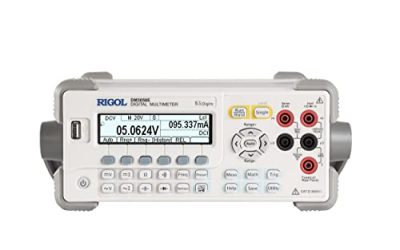
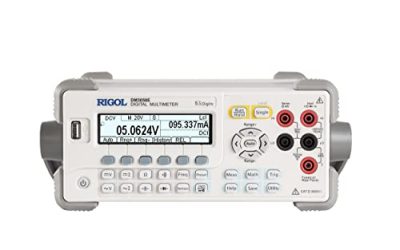
The DM3058E is Rigol’s long-running 5½-digit bench platform: 123,000 counts, a fastest measurement rate of 123 readings per second, a dual display, and a full measurement set covering AC/DC voltage and current, 2- and 4-wire resistance, capacitance, frequency, temperature and diode test, with maximum ranges of 10 A and 1000 V. Its logging story is deliberately framed the way the evidence supports: this is a PC logging meter. It connects over USB and RS232 and is built for automated measurement over those interfaces, with the log held by the PC software. No internal-memory logging detail was verified for this model, so do not buy it expecting the meter to record standalone.
Specs
- 5½-digit bench multimeter, 123,000 counts, fastest rate 123 readings/s
- Dual display
- Measures AC/DC voltage and current, 2- and 4-wire resistance, capacitance, frequency, temperature, diode test
- Maximum ranges: 10 A / 1000 V
- Interfaces: USB and RS232
- Logging: PC-based logging over USB/RS232 (no internal-memory logging detail verified)
Best for: Labs that log to a PC over serial or USB and want an established 5½-digit bench platform.
Watch out for: The logging PC has to stay on and connected for the duration of the run — there is no verified internal storage to fall back on. This is an older platform, so confirm the listing is live and sold as new when you check it.
View the Rigol DM3058E on Amazon
3. B&K Precision 5491B True RMS Bench Digital Multimeter

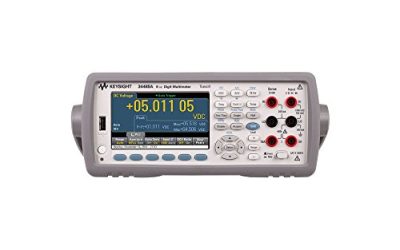
The 5491B is the straightforward option in this group: a 50,000-count, 4¾-digit True RMS bench multimeter with a dual display, DC voltage accuracy in the 0.02 percent class, a resistance range of 500 Ω to 50 MΩ and frequency measurement from 10 Hz to 1 MHz. Its logging path is documented in the manufacturer’s own datasheet: the meter can be remotely controlled with B&K’s application software, which supports front-panel emulation and data logging of measurement results, over its USB and RS232 interfaces. That makes it a clean PC-logging bench for teaching labs, service benches and research support benches that do not need 5½-digit resolution.
Specs
- 50,000-count, 4¾-digit True RMS bench multimeter
- Dual display
- DC voltage accuracy: 0.02 percent class
- Resistance range: 500 Ω–50 MΩ
- Frequency: 10 Hz–1 MHz
- Interfaces: USB and RS232
- Logging: PC data logging via the manufacturer’s application software (front-panel emulation and logging of results)
Best for: Education and service-style research benches that want simple PC data logging without a graphical DMM’s cost or complexity.
Watch out for: At 50,000 counts it has the lowest resolution in this group — present in a lab as the simpler logging option, not the precision instrument. As a PC logger it shares the DM3058E’s constraint: the connected computer must stay up for the whole run.
View the B&K Precision 5491B on Amazon
4. OWON XDM1041 Bench-Type Digital Multimeter
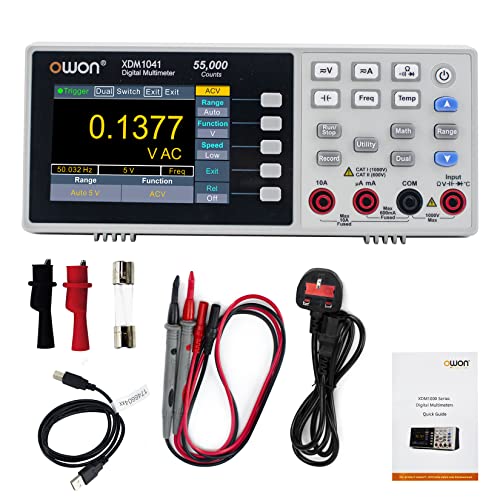
The XDM1041 is the budget route to genuine internal logging. It is a 4½-digit, 55,000-count True RMS bench meter with a 3.5-inch 480×320 TFT display, up to 65 readings per second, best DC voltage accuracy of 0.05 percent, current ranges from 500 µA to 10 A, and temperature (K-type and PT100) and capacitance measurement. Its listing states the logging function directly: manual or auto recording of measured data into internal memory, displayed in table form, with SCPI remote control through PC software over its USB port. OWON’s XDM1000-series documentation specifies a 1,000-point logging length with CSV export and sampling intervals from 15 ms.
Specs
- 4½-digit bench multimeter, 55,000 counts, True RMS
- 3.5-inch 480×320 TFT LCD
- Up to 65 readings/s
- Best DC voltage accuracy: 0.05 percent
- Current ranges: 500 µA–10 A; temperature (K-type and PT100) and capacitance
- USB port with SCPI remote control
- Logging: internal memory record, 1,000-point logging length, CSV export, sampling intervals from 15 ms
Best for: Budget logging for long, slow experiments — battery discharge, drift — where 1,000 internal points plus PC capture is enough.
Watch out for: Several near-duplicate listings exist for this model under other ASINs; use the listing linked here and confirm it is the exact one. The 1,000-point depth fills quickly at fast sampling intervals, so plan the interval against your experiment length. Some listings headline a different screen size; the primary listing for this ASIN specifies 3.5 inches.
View the OWON XDM1041 on Amazon
5. OWON XDM2041 Bench Digital Multimeter

The XDM2041 is the RS232 variant of OWON’s XDM1000 bench platform, and it earns its separate place on two differences: connectivity and accuracy. It is a 4½-digit, 55,000-count True RMS bench meter with a 3.7-inch 480×320 display, dual-line display, up to 65 readings per second, and DC voltage accuracy of up to 0.025 percent — a clear step better than the XDM1041’s 0.05 percent. It supports SCPI and connects over RS232 and USB, which suits labs whose data-acquisition PCs are older serial-based machines. On logging, be precise about the evidence: the data-record function is documented at the XDM1000 series level — measured data recorded to internal memory with the series’ 1,000-point logging length, readable and processed on a PC — while this model’s own listing emphasises SCPI and the dual display rather than the record function.
Specs
- 4½-digit bench multimeter, 55,000 counts, True RMS
- 3.7-inch 480×320 high-resolution LCD, dual-line display
- Up to 65 readings/s
- DC voltage accuracy: up to 0.025 percent
- SCPI support; RS232 and USB connectivity
- Logging: XDM1000-series internal data record (1,000-point logging length per the series specification), PC readout
Best for: Labs that need a serial (RS232) logging path into older data-acquisition PCs, with better DC voltage accuracy than the XDM1041.
Watch out for: The logging evidence for this specific model is series-level rather than from its own listing copy, so if internal recording is the deciding feature, verify the record function on the listing before ordering. Other ASINs exist for this model on different listings — the one linked here is the verified RS232-variant listing.
View the OWON XDM2041 on Amazon
Which One Fits Your Situation
You run long, unattended experiments
Choose the Siglent SDM3055. Its 1 Gb internal storage is specified for measurement and historical data, so the meter keeps logging even if the bench PC sleeps, reboots or is used for something else — and LAN control means you can check in on the run remotely.
Your lab already logs everything to a PC
Choose the Rigol DM3058E for an established 5½-digit platform over USB/RS232, or the B&K Precision 5491B if the measurements are routine and 50,000 counts is enough. Both stream to PC software; the difference is resolution and measurement depth, not logging architecture.
Your acquisition PC is an older serial machine
Choose the OWON XDM2041. Its RS232 path fits legacy data-acquisition setups without USB-serial adapters, and its 0.025 percent DC voltage accuracy is the better of the two OWON picks.
You need internal logging on a tight budget
Choose the OWON XDM1041. It records into its own memory with CSV export for slow experiments, at the cost of a 1,000-point ceiling — fine for discharge and drift work sampled at sensible intervals.
Common Mistakes
Assuming every bench meter logs internally. Two of the five picks here — the Rigol and the B&K — are PC loggers. If the PC stops, the log stops. Check the architecture before the run, not after.
Confusing resolution with accuracy. A 55,000-count meter at 0.05 percent accuracy (XDM1041) and one at 0.025 percent (XDM2041) resolve the same but do not measure with the same trust. Read both figures.
Ignoring log depth. A 1,000-point memory sampled every 15 ms is gone in seconds; sampled every minute it covers most of a day. Set the interval from the experiment, not from habit.
Buying a lookalike listing. The OWON models in particular appear under multiple similar listings with different ASINs. Order from the exact listing intended, and confirm the model and interface variant on the page.
Reaching for a handheld meter for bench logging. Handhelds are built for spot checks. For scheduled, unattended capture, a bench instrument with mains power, a real logging path and remote interfaces is the right tool class — which is why every pick here is a bench model.
FAQ
Can these meters log without a computer?
The Siglent SDM3055 and the OWON models can record into internal memory — 1 Gb of storage on the Siglent, and a 1,000-point record on the OWON XDM1000 series. The Rigol DM3058E and B&K Precision 5491B log through PC software, so they need a connected computer running for the whole experiment.
What is SCPI, and does it matter for a research lab?
SCPI is the standard command language for programmable instruments. If your lab automates measurements with scripts or test software, SCPI support — listed for the Siglent SDM3055 and both OWON models — makes the meter far easier to integrate than a meter with only a vendor front-panel application.
Why are there no Keithley, Keysight or Fluke bench meters in this list?
Those brands make well-regarded logging bench DMMs, but no listing for them could be verified with a confirmed ASIN on Amazon US during the research for this guide, so they were left out rather than linked speculatively. If your lab buys through a distributor, they remain worth considering through that channel.
How many readings can the OWON meters store?
The XDM1000 series specifies a data-logging length of 1,000 points, with sampling intervals from 15 ms and CSV export. That suits slow experiments — discharge curves, drift, soak tests — far better than fast transient capture.