Key takeaways
- Bench multimeters that pair real data logging with four-wire Kelvin resistance, compared on logging depth, reading speed, accuracy and interfaces.
A bench meter that logs sounds simple until you shop for one and discover how many models record nothing at all, or store a handful of readings with no way to get them off the instrument. The real decision is whether the log lives on the meter itself, deep enough for an overnight run, and whether low-resistance readings stay honest once test-lead resistance enters the picture. That second problem is exactly what four-wire Kelvin measurement solves, and it is missing from most entry-level bench meters.
This shortlist is for electronics engineers, calibration and repair technicians, and serious lab hobbyists who measure milliohm-level parts or watch a circuit drift over hours. Every model below was picked from its Amazon listing details: a benchtop digital multimeter whose listing confirms both data logging or mass data storage and 2/4-wire resistance measurement.
Quick Picks
As an Amazon Associate we earn from qualifying purchases
| Product | Best for | Key spec from title |
|---|---|---|
| Siglent SDM3065X | Deep on-meter logging at 6½ digits | 6½ digit, 2,200,000 counts |
| Rigol DM3068 | Automated benches needing GPIB and LXI | 6.5 digit, 10,000 rdgs/s |
| Rigol DM3058E | PC-tethered logging on a budget | 5.5 digit, 123 rdgs/s |
| Siglent SDM3045X | First logging bench meter with LAN | 4½ digit, 150 rdgs/s |
How to Choose
Where the log actually lives
Logging means different things across this category, so check where readings are stored before anything else. Some meters keep the log in internal flash and let you copy files to a USB stick at the front panel, which suits unattended runs away from a computer. Others hold a modest block of readings in volatile memory, or expect a PC on USB or RS-232 to capture the stream. Decide which pattern matches your bench: a meter that stores overnight data by itself behaves very differently from one that stops logging the moment the laptop sleeps.
Four-wire Kelvin resistance, verified
Four-wire resistance separates the current source leads from the voltage sense leads, so the resistance of your test leads and clips drops out of the result. It matters whenever you measure shunt resistors, motor windings, connector contacts or PCB traces in the milliohm and low-ohm range. Confirm the listing actually names 2/4-wire resistance, because plenty of bench meters advertise a long function list while quietly offering two-wire ohms only. Also note the lowest resistance range on offer, since that sets the floor for the small parts you can resolve.
Reading speed versus resolution
A 6½-digit meter resolves far smaller changes than a 4½-digit one, but headline reading speed usually applies at reduced resolution. If your log tracks slow thermal drift, resolution and stability matter more than speed; if you are capturing a production test sequence, thousands of readings per second may matter more. Match the digit count to the smallest change you genuinely need to see in the log, and treat maximum speed figures as best-case numbers rather than the rate you will get at full digits.
Interfaces and software path
The interface list decides how painless logging is after day one. LAN with LXI or SCPI support drops neatly into automated test setups and lets a script pull readings without extra adapters. USB host ports make manual file export trivial, while older RS-232 and GPIB connections still dominate in established labs with existing cabling. Check that the meter speaks a standard command set your software already understands, because a cheap meter with an awkward data path costs more time than a pricier one that exports clean files.
The 4 Best Options
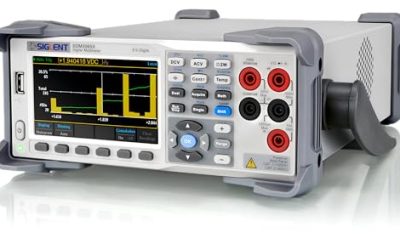
Siglent SDM3065X

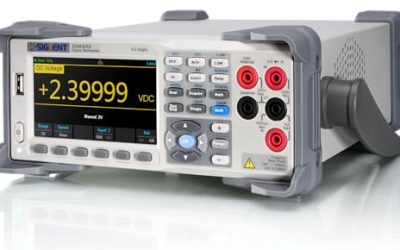
The SDM3065X is the strongest fit when the log itself is the deliverable. Its 1 Gb of internal NAND flash stores configuration and data files on the meter, and file management supports a USB stick as well as local storage, so a long run can be captured on the bench and carried away without a tethered PC. The 6½-digit, 2,200,000-count resolution keeps slow drift visible in the record, and the dual display with trend chart and histogram views makes it easy to sanity-check a run while it is still recording.
Specs
- 6½ digit resolution, 2,200,000 counts
- DC voltage 200 mV to 1000 V, AC voltage 200 mV to 750 V, True-RMS
- DC current 200 µA to 10 A
- 2/4-wire resistance, 200 Ω to 100 MΩ
- 1 Gb NAND flash for configuration and data file storage
- 4.3-inch TFT-LCD dual display
- USB Device, USB Host and LAN interfaces
- Capacitance, frequency, continuity, diode and temperature (TC and RTD) functions
Best for: unattended overnight logging where the data must live on the meter itself.
Watch out for: the scanner-card variant is a different model, so confirm the plain SDM3065X listing if you do not need multiplexed channels.
ASIN: B07YL2J7VT
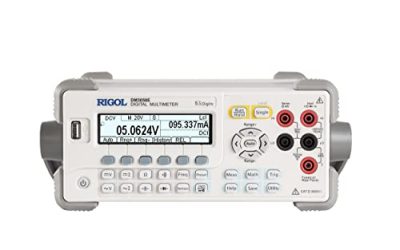
Rigol DM3068

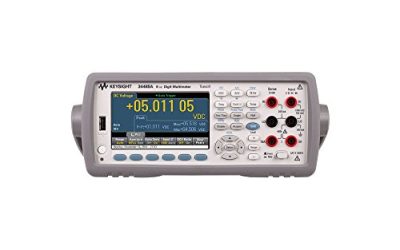
Rigol’s DM3068 targets benches that already run automated sequences. It pairs 6½-digit resolution with up to 10,000 readings per second and a full spread of remote interfaces, including LXI Ethernet and GPIB alongside USB and RS-232, so it slots into legacy and modern test racks alike. Built-in data storage holds groups of readings on the instrument, and the meter supports the command sets of established lab DMMs, which shortens the work of swapping it into an existing logging script.
Specs
- 6½ digit resolution, 2,200,000 counts
- Up to 10,000 readings per second
- Resistance measurement in 2-wire and 4-wire modes
- 512 K readings volatile memory, with built-in data and setup storage groups
- USB, RS-232, LAN (LXI) and GPIB interfaces
- True-RMS AC voltage and current
- Capacitance, frequency, period, diode, continuity and temperature functions
- Dimensions 9.12 x 11.44 x 4.21 inches
Best for: automated test benches that need GPIB or LXI control plus four-wire ohms.
Watch out for: two different ASINs circulate for this model in older listings, so match the listing title and model number before ordering.
ASIN: B00E3SM4BS
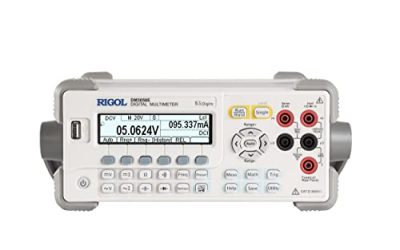
Rigol DM3058E

The DM3058E is the pragmatic choice for a single bench where a PC is always within cable reach. Its listing confirms logging through the RS-232 and USB ports, so a laptop running capture software becomes the log store while the meter handles 5½-digit measurement. That keeps the instrument simpler and the workflow familiar: set the function, start the capture, and review the file on the computer. Four-wire resistance is on the function list, which is rare at this level and makes it usable for low-value resistor checks as well as logging.
Specs
- 5.5 digit resolution, 123,000 counts
- Up to 123 readings per second
- True-RMS measurement
- Resistance measurement in 2-wire and 4-wire modes
- USB and RS-232 connectivity for data logging to a PC
- Maximum measurement range 10 A and 1000 V
- Capacitance, frequency, temperature, continuity and diode functions
Best for: budget-conscious buyers happy to log to a connected computer.
Watch out for: there is no LAN or GPIB on the E model, and logging stops being standalone once the PC leaves the bench.
ASIN: B00KBZK1QW
Siglent SDM3045X

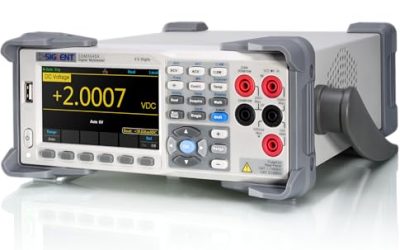
The SDM3045X is the entry point into this shortlist and still covers both headline requirements. Its listing describes 1 GB of NAND flash for mass storage, so readings and setups can be kept on the meter, and the function list includes 2/4-wire resistance next to the usual voltage, current and capacitance ranges. A 4½-digit, 60,000-count display will not resolve the tiniest drift, but for logging charge curves, supply behaviour or temperature-linked resistance changes it captures the shape of events clearly, and LAN control is built in.
Specs
- 4½ digit resolution, 60,000 counts
- Up to 150 readings per second
- True-RMS AC voltage and current
- DCV/DCI, ACV/ACI, 2/4-wire resistance, capacitance, continuity, diode, frequency, period and temperature
- 1 GB NAND flash mass storage
- 4.3-inch TFT-LCD dual display
- USB Host, USB Device and LAN interfaces
- Statistics and graph displays
Best for: first-time logging bench buyers who want LAN control and on-meter storage.
Watch out for: the lower count limits how small a resistance change you can resolve in four-wire mode compared with the 6½-digit models above.
ASIN: B01IXPKIV4
Which One Fits Your Situation
You log overnight runs with no PC nearby
Choose the Siglent SDM3065X. Its internal flash holds the data files on the instrument, the front USB host port makes export a stick-and-go job, and the trend chart view lets you confirm the run looks sane before you clear it. The Rigol models either lean on a computer or hold smaller reading groups, which suits supervised captures better than unattended ones.
Your bench already runs GPIB or LXI automation
The Rigol DM3068 fits existing racks with the least friction. GPIB and LXI are both present, the reading rate keeps up with sequenced tests, and compatibility with established DMM command sets means older logging scripts usually need only small edits. Four-wire resistance is built in, so low-ohm verification steps do not require a second instrument on the rack.
You measure shunts and windings at one desk
Either Rigol works, but the DM3058E keeps the spend down when a computer is permanently at the bench. Four-wire mode removes lead resistance from milliohm readings, and logging over USB or RS-232 builds the record on the PC where you will analyse it anyway. Pick the DM3068 instead only if you also need the extra digit or rack interfaces.
You are equipping a teaching or starter lab
The Siglent SDM3045X covers the teaching points, Kelvin sensing and stored logs, without the cost of 6½-digit hardware. Students can record a full experiment to internal storage, export it, and still use the meter as a general-purpose bench DMM the rest of the week. Its dual display and statistics views also make measurement behaviour easier to demonstrate live.
Common Mistakes
- Assuming every bench meter logs: many store nothing and only stream readings, so confirm internal storage or a logging path in the listing before buying.
- Trusting two-wire ohms for milliohm work: lead and clip resistance can exceed the part you are measuring, which is why four-wire Kelvin sensing exists.
- Confusing a scanner-card variant with the base meter: the -SC models add multiplexed channels and cost more, and the base model cannot be upgraded later.
- Ignoring what happens when memory fills: check whether the meter stops, overwrites, or splits files, because an overnight log that halts at midnight is useless.
- Buying maximum reading speed for slow jobs: headline rates apply at reduced resolution, so a drift log gains nothing from a five-figure readings-per-second figure.
Frequently Asked Questions
Why does four-wire resistance matter for logging work?
Lead resistance adds a fixed error to every two-wire reading, and that error drifts with temperature and cable movement during a long log. Four-wire Kelvin sensing removes the leads from the measurement, so a resistance log reflects the device under test rather than the test setup. For shunts, windings and contacts under a few ohms, the difference decides whether the data means anything.
Can these meters log without a computer connected?
The two Siglent models store data files in internal NAND flash, so they can record on the bench and export later by USB. The Rigol DM3068 keeps reading groups in internal memory for automated setups. The DM3058E is the exception: its listing describes logging through USB or RS-232 to a PC, so plan on a computer staying attached during captures.
How many readings can a bench meter log?
Capacity varies widely, from grouped blocks of readings on older designs to file-based storage in a gigabyte of flash on newer ones. The practical limit also depends on reading speed and which functions are recorded. For multi-day logging, favour a meter with file storage and a USB export path, and confirm the file format opens in the spreadsheet or analysis tool you already use.
Do I need Kelvin test leads for four-wire measurement?
Standard leads can be adapted, but proper Kelvin clips or a four-wire lead set make the sense and source connections at the part itself, which is where the accuracy comes from. Check whether the meter ships with suitable leads or expects a separate set, and budget for clips sized to the components you measure most, from surface-mount shunts to motor terminals.