Key takeaways
- Compare dual-display bench multimeters for product development: digits, counts, DC accuracy, reading speed and interfaces on the Siglent and Rigol picks.
When you bring up a new board, the reading you actually need is rarely a single number. You want the rail voltage and the current it draws at the same moment, or the AC level and its frequency together, because a fault usually lives in the relationship between two values rather than in either one alone. A dual-display bench multimeter shows that second measurement on the same screen from the same connection, so the real decision is which pairing of readings, resolution class and interface fits the way your team develops products.
This guide is for hardware engineers validating prototypes, test technicians building repeatable bench checks, and small product teams equipping a first serious development bench. Every model below is a mains-powered bench digital multimeter whose own listing states dual-display capability, and the picks were chosen from the digits, counts, accuracy figures, ranges and interfaces printed on the Amazon product pages rather than from brand reputation.
Quick Picks
As an Amazon Associate we earn from qualifying purchases.
| Product | Best for | Key spec from title |
|---|---|---|
| Siglent SDM3055 | Development benches that want 5.5 digits with LAN logging | 5.5 digit, 240,000 counts, dual display |
| Rigol DM3058E | Prototype work built around USB and RS-232 control | 5.5 digit, dual display, up to 123 readings/s |
| Siglent SDM3045X | Automated checks where 4.5 digits is enough resolution | 4.5 digit, 66,000 counts, dual display |
How to Choose
Decide which two readings you need on screen together
Dual display is not one single feature across this class. On the meters here it pairs a main measurement with a second value taken from the same input, such as DC voltage with DC current, AC voltage with frequency, or a reading shown alongside its own statistics. Before choosing, list the pairs you genuinely use during bring-up: voltage plus current for power budgets, AC level plus frequency for oscillator and supply checks, or resistance plus a limit result for incoming inspection. If your daily pair is not one the meter supports as a simultaneous combination, the second display line adds little over a single-display model.
Match digits and counts to the change you are trying to see
Resolution decides the smallest change you can watch, and it is not the same as accuracy. A 4.5-digit, 66,000-count meter like the SDM3045X resolves a 5 V rail to about a millivolt, which is plenty for confirming regulator output and spotting load steps. A 5.5-digit model with 240,000 counts resolves the same rail far more finely, which matters when you trim a reference, compare two prototype revisions, or watch slow drift during a soak test. Buy the extra digit when your pass limits are written in millivolts or microvolts; skip it when your limits are written in whole percent.
Read the accuracy line, not the digit count, for pass and fail work
Product development eventually turns into a decision: does this unit pass? That decision rests on the basic DC accuracy figure and the conditions attached to it, not on how many digits the display shows. The 5.5-digit Siglent in this guide lists a basic DC voltage accuracy of 0.015 percent of reading plus a small range term, and its specification assumes a warm-up period and a controlled room temperature band. Check the range you will actually use, because accuracy is stated per range, and check whether your test procedure can live with the stated warm-up time before recorded measurements start.
Pick interfaces for the logging you will really automate
Every meter here can be driven remotely, but the port mix differs and it decides how the meter joins your test setup. LAN suits a shared bench or a rack where a script polls several instruments over the network, and both Siglent models include it. The Rigol DM3058E instead provides USB and RS-232, which fits a single dedicated test PC and older control software, but it has no LAN or GPIB in this E version. Also weigh internal storage: the Siglent models carry 1 Gb of internal flash for configuration and data files, which helps when a bench runs logging jobs away from a PC.
The 3 Best Options
Siglent SDM3055

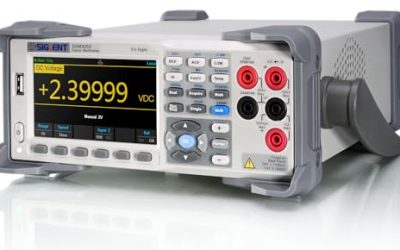
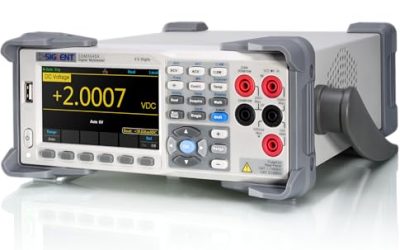
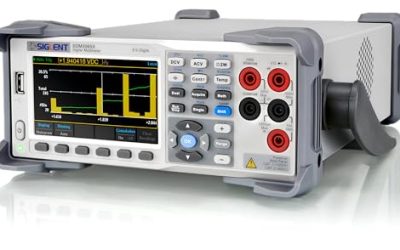
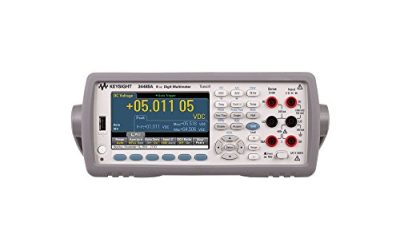
For a development bench that will grow into automated logging, the SDM3055 is the most complete package in this guide. Its dual display runs on a 4.3 inch colour TFT screen, so a main reading and its paired second value stay legible while you probe. The 5.5-digit, 240,000-count resolution and 150 readings per second suit both careful reference checks and faster production-style sampling. It covers the full development spread, from 200 microamp current work up to 10 A, and its LAN port lets a test script collect results without tying the meter to one PC.
Specs
- Resolution: 5.5 digits, 240,000 counts
- Display: 4.3 inch TFT-LCD, 480 x 272, dual display supported
- Basic DC voltage accuracy: 0.015% of reading + 0.004% of range (200 mV range)
- DC voltage: 200 mV to 1000 V; DC current: 200 µA to 10 A
- AC voltage: true RMS, 200 mV to 750 V; AC current: true RMS, 20 mA to 10 A
- Resistance: 2-wire and 4-wire, 200 Ω to 100 MΩ
- Capacitance: 2 nF to 10,000 µF; frequency: 20 Hz to 1 MHz
- Reading speed: up to 150 readings per second
- Interfaces: USB Device, USB Host, LAN; 1 Gb internal flash storage
- Temperature: thermocouple and RTD sensor support
Best for: Product development benches that want 5.5-digit resolution, a voltage-plus-current dual readout and network logging in one instrument.
Watch out for: The accuracy specification assumes a 30-minute warm-up and a controlled temperature band, so schedule warm-up into any recorded test procedure.
ASIN: B00QT3RTV0
Rigol DM3058E

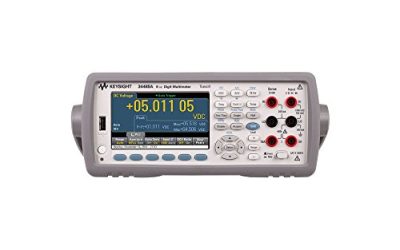
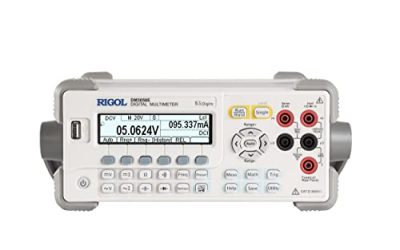
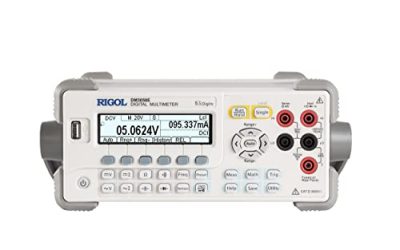
The DM3058E is the established workhorse choice for prototype benches that are controlled from one PC. Its dual display can show two properties of the same signal at once, which Rigol positions as doing the job that once needed two meters or two separate measurements. Resolution is a true 5.5 digits with a reading rate of up to 123 readings per second, fast enough for scanning through test points during debug. It measures the same broad function set as the Siglent, including 4-wire resistance for low-value parts, and it stores up to 10 setup configurations that can be cloned to other units over USB storage.
Specs
- Resolution: 5.5 digits
- Display: 256 x 64 LCD with dual (double) display support
- DC voltage: 200 mV to 1000 V; DC current: 200 µA to 10 A
- AC voltage: true RMS, 200 mV to 750 V; AC current: true RMS, 20 mA to 10 A
- Resistance: 2-wire and 4-wire, 200 Ω to 100 MΩ
- Capacitance: 2 nF to 10,000 µF; frequency: 20 Hz to 1 MHz
- Basic DC voltage accuracy: 0.015% of reading + 0.004% of range (200 mV range)
- Reading speed: up to 123 readings per second
- Interfaces: USB Device, USB Host, RS-232 (no LAN or GPIB on the E version)
- Stored setups: 10 configurations, clonable via USB storage device
Best for: Prototype and debug benches that run from a dedicated PC over USB or RS-232 and use the second display for paired signal readings.
Watch out for: The E version drops the LAN and GPIB interfaces of the full DM3058, so confirm your control setup does not need network access to the meter.
ASIN: B00KBZK1QW
Siglent SDM3045X

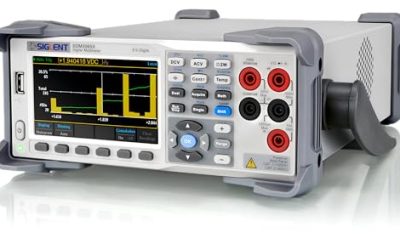
Where a development team mainly needs a dependable dual readout and network control rather than the last digit, the SDM3045X covers the brief at a lower specification tier. It shares the same 4.3 inch colour screen, dual-display layout and interface set as its bigger sibling, including LAN for scripted logging, and it still measures at up to 150 readings per second. The trade is resolution: 4.5 digits and 66,000 counts, with the lowest DC ranges starting at 600 mV and 600 µA instead of the finer 200 mV and 200 µA ranges of the 5.5-digit models, so very small signals are resolved less finely.
Specs
- Resolution: 4.5 digits, 66,000 counts
- Display: 4.3 inch TFT-LCD, 480 x 272, dual display supported
- DC voltage: 600 mV to 1000 V; DC current: 600 µA to 10 A
- AC voltage: true RMS, 600 mV to 750 V; AC current: true RMS, 60 mA to 10 A
- Resistance: 2-wire and 4-wire, 600 Ω to 100 MΩ
- Capacitance: 2 nF to 10,000 µF; frequency: 20 Hz to 500 kHz
- Reading speed: up to 150 readings per second
- Interfaces: USB Device, USB Host, LAN; 1 Gb internal flash storage
- Temperature: thermocouple and RTD sensor support with built-in cold junction compensation
Best for: Automated bench checks, soak logging and shared lab benches where 4.5-digit resolution is enough and LAN control matters more than fine resolution.
Watch out for: The 600 mV and 600 µA lowest ranges limit how finely you can resolve small sensor signals and sleep currents compared with the 5.5-digit models.
ASIN: B01IXPKIV4
Which One Fits Your Situation
You are characterising a power supply design
You need the output voltage and the drawn current on screen together while you step the load, then a log of both as the design warms up. The SDM3055 fits this work best: its dual display pairs the two readings, its 5.5-digit resolution shows small regulation changes, and LAN logging lets a script record the whole run while you keep probing the board.
You are debugging prototypes at one dedicated bench
Your meter sits next to a single test PC, runs the same checks on every board revision, and rarely joins a network. The DM3058E suits that setup, with dual display for paired signal readings, 10 stored setups you can recall per board type, and USB or RS-232 control that matches older bench software already in use.
You are setting up automated pass and fail checks
The task is repeatable verification on many units: apply a stimulus, read two values, record a verdict. The SDM3045X handles this well because its LAN interface and 150 readings per second keep a script moving, and 4.5-digit resolution is enough when limits are written as percentages rather than millivolts. Its internal flash also holds configurations between runs.
Your bench is shared by a whole product team
Different engineers book the same bench for bring-up, verification and soak tests, so the meter must be reachable from any workstation and hold its own files. Either Siglent works here thanks to LAN access and 1 Gb of internal storage; choose the SDM3055 when the team also trims references or compares close prototype revisions, and the SDM3045X when the shared work is routine verification.
Common Mistakes
- Assuming dual display means two independent channels: these meters derive the second reading from the same input signal, so they cannot watch two separate circuit nodes at once the way two meters can.
- Comparing digit counts instead of accuracy figures when setting pass limits, then discovering the last digit moves more than the tolerance allows.
- Choosing a meter with no LAN for a bench that later gets automated, or paying for interfaces the test setup will never use.
- Ignoring the lowest ranges: a meter that starts at 600 µA cannot resolve the microamp-level sleep behaviour of a battery-powered product.
- Skipping the warm-up and temperature conditions printed with the accuracy specification, then treating early readings as final verification data.
Frequently Asked Questions
What does dual display actually show on a bench multimeter?
It shows a main measurement and a second, related value on the same screen at the same time, taken from the same input connection. Typical pairings include DC voltage with DC current, AC voltage with frequency, or a reading alongside its statistics. It saves swapping functions mid-test, but it is not a second independent measurement channel.
Is 4.5 digits enough for product development work?
For much of it, yes. A 4.5-digit, 66,000-count meter resolves a 5 V rail to roughly a millivolt, which covers regulator checks, load testing and most pass or fail limits written in percent. Move to 5.5 digits when you trim references, compare close design revisions, or set limits in millivolts and microvolts that the coarser display cannot separate.
Can these meters log measurements to a computer?
Yes. All three models support remote control and data transfer: the Siglent SDM3055 and SDM3045X connect over USB and LAN and store files on 1 Gb of internal flash, while the Rigol DM3058E connects over USB and RS-232. That lets a script record long soak tests or automated verification runs without anyone copying readings by hand.
Why does the accuracy specification mention warm-up time?
Bench multimeters reach their stated accuracy only after their internal reference and circuitry stabilise, which is why the specifications assume a warm-up period, around 30 minutes on the Siglent models, and a room temperature band. Readings taken straight from a cold start can sit outside the published tolerance, so verification procedures should build warm-up in before recording results.