Key takeaways
- Five bench multimeters for electronics laboratories compared on stated resolution, from 4½-digit meters to a 6½-digit model with 2,200,000 counts.
The decision when buying a bench multimeter for an electronics laboratory is how much resolution your work genuinely resolves. A 6½-digit meter shows drift and small differences that a 4½-digit display rounds away, yet those extra digits help only when your circuits and test leads are stable enough to make them meaningful. Paying for resolution a bench cannot support wastes budget, while buying too little hides the small changes that fault-finding and verification work depends on, so the digit count deserves more attention than any other listing figure.
This roundup serves three kinds of buyers: technicians staffing repair and service benches, engineers verifying designs in development laboratories, and quality-control staff recording measurements all day. Every meter below is a benchtop unit picked from the names and specifications on its Amazon page. Where a listing leaves a figure unstated, such as a counts value, the article says so instead of borrowing the number from a datasheet, keeping the comparison honest about what each page promises.
Quick Picks
As an Amazon Associate we earn from qualifying purchases.
| Product | Best for | Key spec from title |
|---|---|---|
| Siglent SDM3045X | Everyday mixed measurements on service benches | 4½-digit digital multimeter |
| Siglent SDM3055 | Verification work needing 5.5-digit headroom | 5.5-digit digital multimeter |
| Siglent SDM3065X | Drift tracking and reference comparison | 6½-digit digital multimeter |
| Rigol DM3058E | Legacy stations controlled over RS232 | 5.5-digit, up to 123 readings per second |
| OWON XDM2041 | Scripted setups using SCPI control | 55,000 counts, 480×320 LCD |
How to Choose
Match the Digit Count to Your Measurements
Digit count describes how many digits the display can show and sets the smallest change the meter can reveal. A 4½-digit unit suits routine voltage checks and continuity work, while 5.5-digit models expose smaller variations during design verification, and a 6½-digit instrument serves laboratories tracking drift or comparing references. Some listings state a counts figure instead, and a few state neither clearly, so read the exact wording on the page. Never assume a counts value the seller has not printed, because sibling listings of one model can describe its resolution differently.
Confirm True RMS and the Function List
Laboratory AC work often involves waveforms that are not clean sine waves, so True RMS measurement matters whenever drives, switching supplies or dimmers feed the circuit under test. Most listings here state True RMS capability, but their function lists differ in the details each page chooses to print. Check that the functions your bench relies on, such as four-wire resistance, capacitance or temperature with cold junction compensation, actually appear in the listing text rather than assuming a model line includes them across every variant sold online today.
Weigh Reading Rate, Display and Bench Space
Reading rate decides how quickly a meter settles during repetitive checks, and the stated rates here span from 65 readings per second up to 150, with one model stating 123. A dual display lets you watch two related values together, which speeds up comparison work at a crowded bench. Physical size matters as well: one unit here measures 22 by 14 by 5 inches, far larger than a compact meter, so measure your shelf or rack space against the stated dimensions before the box arrives at the laboratory door.
Check Interfaces and the Exact Listing Before Ordering
Remote control separates otherwise similar meters: some listings here offer USB host and device ports plus LAN, one adds RS232 for older instruments, and another states SCPI support for scripted setups. Decide which connection your laboratory software expects before choosing. Finally, verify the offer itself, because several of these models also appear under sibling ASINs whose stock status and even stated specifications differ. Match the ASIN on the page to the one you intended, and confirm a live buy option exists, since availability signals for older listings can be months out of date.
The 5 Best Options
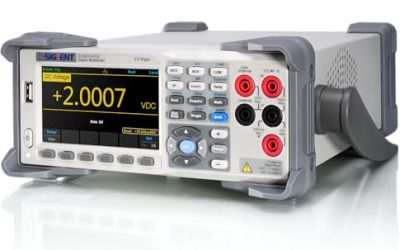
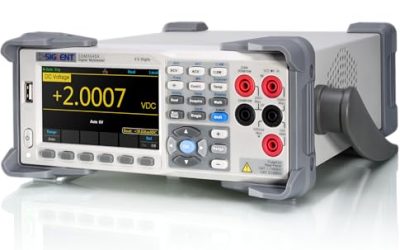
Siglent SDM3045X

The entry point of this group, the SDM3045X is the meter to consider when a laboratory needs a capable general-purpose bench instrument without paying for resolution its work will never use. Its listing presents it as a 4½-digit True RMS multimeter covering the everyday measurement set, including temperature work supported by built-in cold junction compensation. A dual display and a reading rate of up to 150 readings per second suit benches that move quickly between checks, while USB host, USB device and LAN interfaces cover both local logging and networked setups in teaching and service laboratories.
Specs
- Resolution: 4½ digit as stated in the listing title
- Counts: not stated in the listing
- Measurement: True RMS
- Functions: DC and AC voltage and current, 2-wire and 4-wire resistance, capacitance, continuity, diode, frequency, period and temperature
- Temperature support: built-in cold junction compensation
- Display: dual display
- Interfaces: USB host, USB device and LAN
- Reading rate: up to 150 readings per second
Best for: General-purpose electronics benches that need one dependable meter for daily voltage, current, resistance and temperature checks.
Watch out for: The listing does not state a counts figure, so open the live product page and confirm the exact resolution specification before ordering if counts matter to your work.
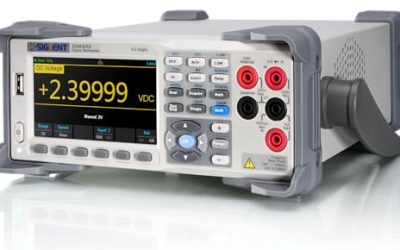
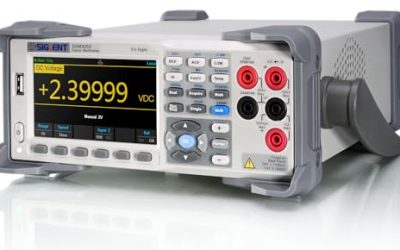
Siglent SDM3055

Stepping up within the same brand family, the SDM3055 raises the stated resolution to 5.5 digits for laboratories whose verification work exposes smaller differences than a 4½-digit display can show. The listing describes a True RMS instrument with the same broad everyday function coverage, including temperature measurement with built-in cold junction compensation. Statistics and graph functions are stated on the page, which suits benches that log repeated readings and review their spread. USB host, USB device and LAN connections mirror those of the SDM3045X, and the stated reading rate again reaches up to 150 readings per second.
Specs
- Resolution: 5.5 digit as stated in the listing title
- Counts: not stated in the listing
- Measurement: True RMS
- Functions: DC and AC voltage and current, 2-wire and 4-wire resistance, capacitance, continuity, diode, frequency, period and temperature
- Temperature support: built-in cold junction compensation
- Display: dual display
- Interfaces: USB host, USB device and LAN
- Reading rate: up to 150 readings per second
- Extra features stated: statistics and graph functions
Best for: Development laboratories that want 5.5-digit resolution headroom for verification work without moving to the largest meter in this group.
Watch out for: Recent stock signals for this listing are thin, so confirm a live buy option and current availability on the product page before ordering.
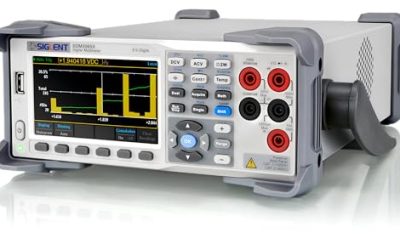
Siglent SDM3065X

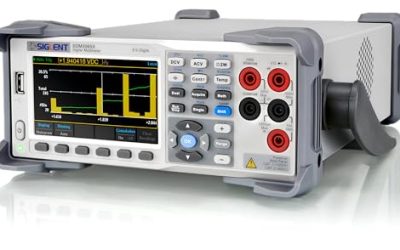
The SDM3065X is the resolution leader among these five, presented in its listing as a 6½-digit multimeter with 2,200,000 counts for laboratories that track very small changes over time. Readings appear on a 4.3-inch TFT-LCD with dual display, and the listing states True-RMS AC voltage and current measurement. Its stated resistance ranges run from 200 ohms up to 100 megohms, covering delicate sensor work through insulation checks. The box contents are spelled out on the page, and the stated dimensions make this a substantial bench unit, so shelf space deserves a thought before ordering.
Specs
- Resolution: 6½ digit as stated in the listing title
- Counts: 2,200,000 counts
- Measurement: True-RMS AC voltage and current
- Display: 4.3-inch TFT-LCD, dual display
- Resistance ranges stated: 200 Ω, 2 KΩ, 20 KΩ, 200 KΩ, 1 MegΩ, 10 MegΩ, 100 MegΩ
- Included in the box: USB cable, Quick Start guide and power cord
- Dimensions: 22 x 14 x 5 inches
- Weight: 4.47 kg
Best for: Precision-focused laboratories that compare references, log drift and need the finest resolution stated anywhere in this group.
Watch out for: Availability evidence for this listing rests on limited crawl data, so confirm a live buy option on the page before ordering, and check the 22 x 14 x 5 inch footprint against your bench space.
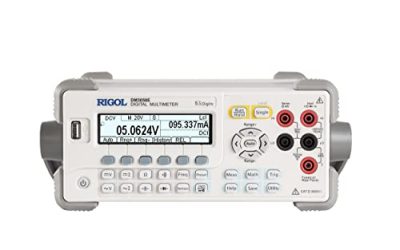
Rigol DM3058E

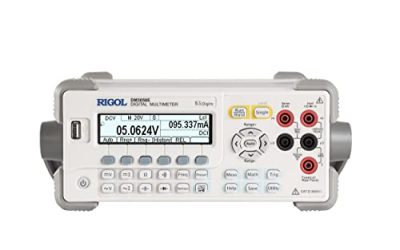
Rigol’s entry is the connectivity outlier of the group, and that is its appeal for older laboratory setups. The listing presents the DM3058E as a 5.5-digit multimeter with a fastest reading rate of 123 readings per second and a maximum measurement range of 10 A and 1000 V. Alongside USB it states RS232 connectivity, which keeps the meter usable with legacy serial controllers and older automated rigs that newer LAN-only instruments leave behind. Laboratories standardizing on serial control, or keeping a long-serving test station alive, are the natural audience for this particular specification mix.
Specs
- Resolution: 5.5 digit as stated in the listing title
- Counts: not stated in the listing
- Reading rate: up to 123 readings per second
- Interfaces: USB and RS232
- Maximum measurement range: 10 A, 1000 V
Best for: Laboratories that still run serial-controlled test stations and need a 5.5-digit bench meter speaking RS232.
Watch out for: Confirm a live buy option under this exact ASIN before ordering, because the same model also appears under a different ASIN showing out of stock, and the stock signal for this listing is dated.
OWON XDM2041

The XDM2041 takes a different route to resolution, leading with a counts figure instead of a digit count. Its listing states 55,000 counts with True RMS AC voltage and current measurement, shown on a 3.7-inch LCD with 480×320 resolution and a dual-line display. The stated reading rate reaches up to 65 readings per second, slower than the Siglent models here but adequate for steady bench work. SCPI support is the distinguishing feature, making this meter the natural fit for laboratories that drive measurements from scripts and want readings flowing into their own software.
Specs
- Counts: 55,000 counts as stated in the listing title
- Digit count: not stated in the listing
- Measurement: True RMS AC voltage and current
- Display: 3.7-inch LCD, 480×320, dual-line display
- Reading rate: up to 65 readings per second
- Connectivity: SCPI support stated
Best for: Compact benches and scripted setups that want a counts-led meter with SCPI control and a dual-line display.
Watch out for: The availability signal for this listing is dated, so confirm current stock on the page before ordering, and check the ASIN shown matches B0B7NFZJ8Q because sibling listings exist for this model.
Which One Fits Your Situation
Your Bench Handles a Bit of Everything
A mixed repair and service bench needs breadth more than extreme resolution. The SDM3045X covers the everyday function set its listing describes, adds temperature measurement with cold junction compensation, and connects over USB and LAN, so one instrument can serve walk-up checks and logged jobs alike without dominating the budget or the shelf.
You Verify Designs and Watch Small Drifts
Design verification rewards resolution headroom. The SDM3055 steps up to 5.5 digits with statistics and graph functions for reviewing repeated readings, while the SDM3065X goes further at 6½ digits and 2,200,000 counts for drift tracking and reference comparisons. Pick the Siglent whose stated resolution matches the smallest change your prototypes need to reveal.
Your Test Station Still Runs on Serial Control
Older automated rigs often speak only RS232, and most modern bench meters have dropped the port. The DM3058E keeps it alongside USB, pairs it with a stated 5.5-digit resolution and a fastest rate of 123 readings per second, and covers ranges up to 10 A and 1000 V, so a legacy station gains a current meter without a control-system rebuild.
You Drive Measurements from Scripts
When a computer runs the measurement plan, the meter’s command set matters as much as its display. The XDM2041 states SCPI support with a dual-line display and 55,000 counts, suiting scripted logging at up to 65 readings per second. Benches preferring network control instead can look at the LAN-equipped Siglent SDM3045X and SDM3055, whose listings state USB host, USB device and LAN interfaces for remote setups.
Common Mistakes
- Assuming a counts figure that the listing never prints, instead of treating an unstated specification as unknown until the live page confirms it.
- Buying the highest digit count available when the bench’s leads, references and workload cannot resolve the extra digits the premium pays for.
- Overlooking connectivity until the meter arrives, then discovering the laboratory software expects RS232, LAN or SCPI that the chosen model does not state.
- Ordering a same-model listing under a different ASIN without checking, when the sibling page may show different stock status or even different stated specifications.
- Ignoring physical size, and finding on delivery day that a 22 by 14 by 5 inch instrument does not fit the shelf or rack position planned for it.
Frequently Asked Questions
Is a 6½-digit multimeter always better than a 4½-digit one?
Not necessarily. Extra digits only help when your circuits, references and test leads are stable enough for the added resolution to mean something. A repair bench doing continuity and supply checks gains little from 6½ digits, while a laboratory tracking drift or comparing references uses every digit. Match the stated resolution to the smallest change your work must reliably reveal.
What does True RMS mean for a laboratory bench?
True RMS describes how a meter measures AC signals. Instead of assuming a clean sine wave, a True RMS instrument calculates the effective value of the waveform actually present, which matters around switching supplies, motor drives and dimmers. Check the page of the model you choose for its exact True RMS wording, since the specifications each listing prints are not identical.
Why do some of these listings leave the counts figure unstated?
Listing pages are written by different sellers and brand teams, so the specifications each one chooses to print vary. Three meters here are described by digit count without a counts figure, and the honest response is to treat that value as unstated rather than borrowing it from a datasheet, a review or a sibling listing, then verify it on the live page before ordering.
Which interface should a laboratory look for first?
Start from the equipment already in the room. A station built around older serial controllers needs RS232, which only the Rigol listing states here. Networked benches are served by the Siglent SDM3045X and SDM3055 with USB host, USB device and LAN, while scripted setups benefit from the OWON meter’s stated SCPI support. Choosing the interface first prevents an otherwise suitable meter from sitting unused.