Key takeaways
- Two precision bench multimeters suited to technical training labs: dual-display 4.5-digit and compact 55,000-count models compared on accuracy, speed and PC links.
A training bench asks different things of a multimeter than a production line does. Students need a display they can read from the side of the bench, controls that survive being reset a hundred times a term, and readings stable enough that a whole class can compare results and trust them. The decision is really about matching digit count, basic accuracy and data capture to the level of the course being taught. Unlike a production bench, a training bench also has to forgive mistakes, so input protection and clear range marking matter as much as the raw specification.
Both meters here are true bench instruments with verified Amazon US listings, picked for teaching environments: one full-size dual-display model for shared lab benches, and one compact unit that suits student workstations, distance-learning kits and smaller budgets spread across many seats. Both are mains-powered bench instruments rather than handhelds in stands, which keeps them ready at the start of every session without a battery routine.
Quick Picks
As an Amazon Associate we earn from qualifying purchases.
| Product | Best for | Key spec from title |
|---|---|---|
| Siglent SDM3045X | Main lab benches and instructor stations | 4.5-digit dual display, 66,000 counts, 1000 V DC / 10 A |
| OWON XDM1041 | Student workstations and compact training kits | 55,000 counts, 3.5-inch TFT display, USB and RS232 |
How to Choose
Digits and counts set the ceiling for coursework
The display resolution decides which experiments a class can actually run. A 4.5-digit, 66,000-count meter resolves small voltage steps that a basic handheld rounds away, which matters once students move from battery checks to sensor outputs and reference circuits. For introductory courses, anything in this class is more than enough; for advanced electronics training, the extra counts and a proper dual display — showing, for example, voltage and frequency together — shorten lab time because students stop re-measuring the same node twice with different settings. Standardising on one model across the room also makes every group’s results directly comparable.
Basic DC accuracy is the number to compare
Brochure accuracy figures are only comparable when they describe the same thing: basic DC voltage accuracy over a stated period. A training meter does not need metrology-lab figures, but it does need honest ones, because students calibrate their expectations against the instrument in front of them. Look for the accuracy stated in the listing or manual, favour True RMS AC measurement for any course covering mains or waveform work, and remember that a meter’s last digit will always dance a little — stability at the reading matters more in class than one extra count. Ask for the accuracy figure at the range your course uses most, not the manufacturer’s best-case range.
Data logging turns a meter into a teaching tool
The feature that changes how a bench meter earns its place in a training lab is capture: the ability to record readings over time and move them to a PC. Drift experiments, battery discharge curves and temperature runs all become visible instead of anecdotal. Check the interfaces on the listing — USB device and host ports, LAN or RS232 — and whether the meter can store trend data internally. Instructors preparing worksheets will also care about SCPI remote control, since scripted measurements make demonstrations repeatable from one term to the next. Even a simple exported data file is enough for students to plot, annotate and submit alongside their written conclusions.
Bench practicalities: size, power and shared use
A meter shared by thirty students a week lives a harder life than one on a private bench. Front-panel layout, a tilt stand or compact footprint for crowded workstations, and a clear colour display all affect how smoothly sessions run. Also confirm the mains arrangement and input protection ratings suit your lab’s supply and the circuits students will probe; training environments see more misconnected leads than any other setting, so robust input jacks and sensible fuse access are worth as much as another digit. A meter that is pleasant to use also gets handled carefully; an awkward one gets forced, dropped and misread.
The 2 Best Options
Siglent SDM3045X

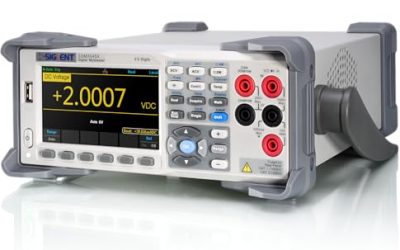
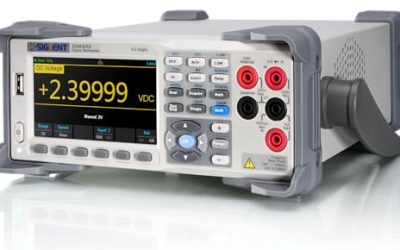
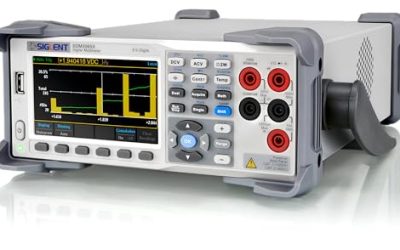
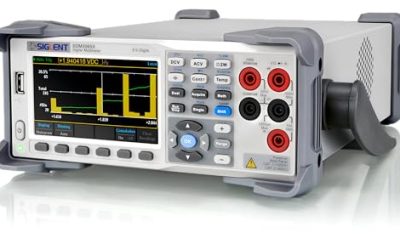
Siglent’s SDM3045X is the anchor instrument of this pair: a 4.5-digit bench meter with a dual display on a 4.3-inch TFT screen, so an instructor can show two parameters at once during demonstrations. Its 66,000-count resolution and measurement speed of up to 150 readings per second handle everything from basic DC labs to trend plotting, and the built-in cold-junction compensation supports temperature exercises without extra hardware. USB and LAN interfaces with SCPI control let it join scripted setups, while its size suits a fixed lab bench rather than a travelling kit. Trend views let instructors show noise, drift and averaging effects live.
Specs
- Display: 4.3-inch TFT-LCD, 480 x 272, dual display
- Resolution: 4.5 digits, 66,000 counts
- Measurement speed: up to 150 readings per second
- Ranges: up to 1000 V DC, 10 A current measurement
- Functions: DC/AC voltage and current, 2-wire and 4-wire resistance, capacitance, continuity, diode test, frequency/period, temperature sensors
- Interfaces: USB Device, USB Host, LAN; SCPI remote control
- AC measurement: True RMS
- Temperature support: built-in cold-junction compensation
- Item model number: SDM3045X
Best for: Teaching labs that need one capable, readable meter per main bench, with PC logging for coursework.
Watch out for: It is a full-size bench instrument with a matching footprint — measure bench depth before ordering for shallow workstations, and confirm the mains lead arrangement suits your lab’s sockets.
ASIN: B01IXPKIV4
OWON XDM1041
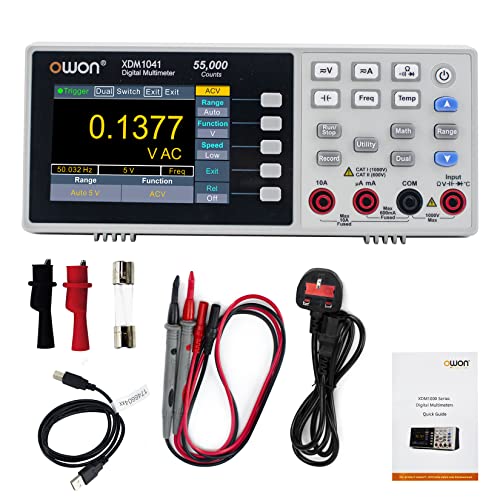
The XDM1041 shrinks the bench meter idea down to a compact box with a 3.5-inch colour display and 55,000 counts, suited to rooms where every student seat needs its own instrument. Its stated DC accuracy of 0.05 percent is respectable for training work, the 65 readings-per-second capture rate feeds its data-logging functions, and it records through USB or RS232 so results can be pulled into lab reports. It also measures temperature, a common training topic that otherwise needs a second instrument. For satellite labs, maker spaces and home training benches, it covers the syllabus at a fraction of the bench space. It also stores easily between terms.
Specs
- Display: 3.5-inch TFT LCD, 480 x 320
- Resolution: 55,000 counts
- Best DC voltage accuracy: 0.05 percent
- Speed: up to 65 readings per second
- AC measurement: True RMS
- Interfaces: USB, RS232
- Additional functions: temperature measurement, data logging and trend display
- Form factor: compact desktop design for individual workstations
- Item model number: XDM1041
Best for: Individual student stations, compact training kits and budget-spread lab rollouts.
Watch out for: The smaller screen and lighter build suit supervised coursework better than heavy shared-bench abuse; check the listing variant carefully, as this model family has several similar listings with different configurations and accessories.
ASIN: B0B2PGTKHX
Which One Fits Your Situation
You are equipping a shared teaching laboratory
The SDM3045X fits the shared-bench role: bigger dual display for demonstrations, faster sampling, LAN as well as USB for scripted control, and 4-wire resistance for proper measurement-technique teaching. One per bench, paired with printed worksheets, is the standard arrangement for this class of course. Standardising on one model also simplifies spare leads, fuses and the screenshots used in lab handouts.
Every student needs a meter at their own seat
Choose the XDM1041. Its compact body leaves room on the workstation for the circuit under test, the display is still colour and readable, and the per-seat cost of equipping a whole cohort is far easier to justify. USB logging means students still submit captured data with their reports. A class set also fits into a single storage cabinet between terms, which matters in rooms that host other subjects.
You teach measurement technique and error analysis
The Siglent’s dual display and 4-wire resistance mode let you demonstrate lead-resistance errors and their correction directly, which is hard to show convincingly on a basic meter. Its higher count resolution also makes quantisation error a visible, discussable phenomenon rather than a textbook abstraction. Pair it with a printed uncertainty worksheet and students can quantify each error source themselves instead of taking the concept on faith.
You run short courses, a makerspace or a training-kit service
Portability and quick setup dominate this use. The XDM1041 travels between rooms, powers up fast and still logs data for participants’ project work, while one SDM3045X kept at the instructor’s station covers demonstrations and the occasional measurement a compact meter cannot make. That two-tier arrangement mirrors how most short-course providers actually equip themselves.
Common Mistakes
- Buying handheld meters for bench courses and losing the logging, dual-display and mains-powered stability that make lab sessions run smoothly and consistently from group to group.
- Comparing meters by digit count alone while ignoring basic DC accuracy and input protection — especially the protection rating students will rely on when, not if, they misconnect a lead.
- Ordering the wrong regional variant or a similarly named model from the same family — check the exact model number on the listing, including any suffix letters.
- Forgetting leads, spare fuses and, for temperature work, the thermocouple the exercise assumes — plus a printed quick-start sheet for the first session with a new cohort.
- Skipping the interface check: a meter without the USB or LAN connection your coursework software expects becomes a standalone island.
Frequently Asked Questions
Why use a bench multimeter for training instead of handhelds?
Bench meters run from mains power, so there are no flat batteries mid-lesson, and they add dual displays, faster sampling, data logging and PC control that handhelds rarely match. Those features map directly onto teaching tasks: demonstrations, recorded experiments and comparable results across a class. They also remove battery management from the instructor’s workload entirely.
What accuracy does a training bench actually need?
For most technical training, a 4.5-digit meter with basic DC accuracy around a few hundredths of a percent is ample — the errors students study come from circuits and technique, not the instrument. Courses covering calibration or precision analogue work should step up to 5.5-digit instruments instead. Chasing more digits than the course needs usually buys cost without teaching value.
Is True RMS important for coursework?
Yes, once the syllabus leaves pure DC and sine waves behind. Motors, dimmers, switching supplies and many sensor signals are not sinusoidal, and an average-responding meter reads them incorrectly. True RMS measurement keeps those lab results honest and avoids teaching a wrong intuition. Both meters in this guide measure True RMS, which keeps results consistent across every bench in the room.
Can these meters log data for student reports?
Both picks here can. The SDM3045X offers USB and LAN with SCPI control for scripted capture, while the XDM1041 logs through USB or RS232 with on-screen trend display. Confirm the software workflow your course uses before standardising on one model for a whole cohort, and check that the model appears in your software’s supported-instrument list before buying a class set.